Murderpedia has thousands of hours of work behind it. To keep creating
new content, we kindly appreciate any donation you can give to help
the Murderpedia project stay alive. We have many
plans and enthusiasm
to keep expanding and making Murderpedia a better site, but we really
need your help for this. Thank you very much in advance.
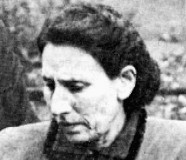
Styllou
CHRISTOFI
Classification: Murderer
Characteristics:
Revenge - Jealousy
Number of victims: 2
Date of murder:
1925 / July 29, 1954
Date of arrest:
July 29, 1954
Date of birth: 1900
Victim profile:
Her
mother-in-law /
Hella Christofis, 36 (her
daughter-in-law)
Method of murder: Ramming
a lighted torch down her throat / Strangulation
Location: Cyprus / United
Kingdom
Status:
Executed by hanging at Holloway prison on December 13, 1954
Styllou Pantopiou Christofi (1900 - 13
December 1954) was a Greek Cypriot woman hanged in Britain for
murdering her daughter-in-law. She was the second to last woman to be
executed in Britain, followed in 1955 by Ruth Ellis.
Background
Christofi was tried in Cyprus in 1925 on a charge
of murdering her mother-in-law by ramming a lighted torch down her
throat. She was found not guilty and released.
She came to Britain in 1953 to see her son,
Stavros, whom she had not seen for 12 years. He was working as a
waiter in London and was married to a German woman, Hella, with whom
he had three children.
Murder
Christofi did not get along with Hella and on the
night of 29 July 1954, hit Hella on the head with an ash pan from the
boiler. She then strangled her and in order to dispose of the corpse,
dragged it into the garden, poured paraffin over it and set it alight.
A neighbour witnessed this but did not realise the article being burnt
was a body.
Christofi, who spoke little English, later ran into
the street to raise the alarm and stopped a passing car saying:
"Please come. Fire burning. Children sleeping". When the police
arrived they became suspicious on finding blood stains in the house.
Christofi explained: "I wake up, smell burning, go downstairs. Hella
burning. Throw water, touch her face. Not move. Run out, get help."
Trial and execution
Christofi was charged with murder and her trial
started at the Old Bailey on 28 October 1954. Her counsel offered a
defence of insanity but the jury rejected it. Christofi was sentenced
to death and hanged at Holloway prison by executioner Albert
Pierrepoint on 13 December 1954. Pathologist Francis Camps examined
the body. Her wish to have a Maltese Cross put on the wall of the
execution chamber was granted. It remained there until the room was
dismantled in 1967.
Albert Pierrepoint claimed in his autobiography,
Executioner: Pierrepoint, that Christofi failed to attract much
media attention or sympathy because, unlike the pretty Ruth Ellis, she
was less glamorous. A "blonde night-club hostess" was much more
alluring than "a grey-haired and bewildered grandmother who spoke no
English."
Burial
The body of Christofi was buried in an unmarked
grave within the walls of Holloway Prison, as was customary. In 1971
the prison underwent an extensive programme of rebuilding, during
which the bodies of all the executed women were exhumed. With the
exception of Ruth Ellis, the remains of the four other women executed
at Holloway (i.e. Styllou Christofi, Edith Thompson, Amelia Sach and
Annie Walters) were subsequently reburied in a single grave (plot 117)
at Brookwood Cemetery in Surrey.
Wikipedia.org
Styllou Christofi
Ruth Ellis was portrayed by some papers as the dashing
blonde dumped by her lover while Styllou Christofi's case was hardly
covered by the media. Yet they were both executed at Holloway Prison
within 7 months of each other.
In his autobiography, "Executioner: Pierrepoint",
Albert Pierrepoint also compare the vastly different media coverage
between this case and that of Ellis and Merrifield. All three were
women, yet he stated that the execution of the dashing blonde (Ellis)
seemed to trouble the media more that the execution of the less
glamorous Christofi and Merrifield.
The Case Details
Mrs Styllou Christofi was a 53 year old illiterate
Greek Cypriot who killed her daughter-in-law out of jealousy. Earlier
in Cyprus, in 1925, she was acquitted of the murder of her
Mother-in-law by ramming a burning torch down her throat.
He son, Stavros Christofi who was employed as a waiter,
was happily married to his 36 year old German wife Hella, who worked
in a fashion shop. They had three children, and resided in Hampstead.
In 1953, Styllou Christofi arrived from Cyprus and
moved in with her son and daughter-in-law. She was the classic
mother-in-law and came to dominate the household. She spoke virtually
no English, and her peasant upbringing in Cyprus allowed her no
understanding of the modern family run by her son and daughter-in-law.
On the evening of 29 July 1954, after her son Stavros
had left his Hampstead home, Mrs Christofi stunned Hella by hitting
her on the head with the kitchen stove's ash plate. She then strangled
Hella. Later that night, a neighbour was taking his dog into his
garden, when he saw flames in the Christofi's garden. This turned out
to be the petrol-soaked body of Hella Christofi.
Mrs. Christofi raised the alarm by stopping a passing
car and shouting "Please come. Fire burning. Children sleeping".
When the driver went to the back of the house, he saw the body and
called the police. Mrs. Christofi claimed that she had woken up about
1am smelling smoke and found Hella lying in a piece of paper in her
mother-in-law's room.
Styllou Christofi was tried for murder at the Old
Bailey, found guilty and sentenced to death by hanging. She was
executed at Holloway Prison on 13 December 1954.
Stephen-stratford.co.uk
Styllou Pantopiou Christofi
By the time Styllou Christofi
came to England to join her son, Stavros, and his German born wife
Hella, in July 1953, she already knew what it was like to be tried for
murder.
Back in Cyprus, at the age of
twenty five, Styllou had been put on trail for killing her
mother-in-law by ramming a burning torch down her throat. She had been
found not guilty!
Stavros was a waiter at the Cafe
de Paris in London's West End, and his wife worked in a fashion shop.
They had three children and a happy married life together. All this
changed when Styllou arrived.
Styllou was a matriach of the old
school and made her feelings plain. Speaking little English she soon
developed a dislike for the country she had come to live in and
constantly found fault with Hella and the way she chose to bring up
her children. Hella put up with this for some time but finally her
patience snapped and she gave Stavros an ultimatum.
Hella had arranged to take the
children on a holiday to her family in Germany and she demanded that
upon her return, Stavros would have shipped his mother back to Cyprus
and out of their lives forever. Stavros spoke to his mother about this
and Styllou decided to herself that if someone had to go, it would be
Hella and not her.
On July 29th, 1954, after Stavros
had left for work and the children were safely in bed, Styllou picked
up the heavy ash- plate from the fireplace and struck Hella over the
head, Šrendering her unconscious. She then took a scarf and proceeded
to strangle the life out of the helpless woman, dragging her body into
the garden when she had finished.
At around midnight, a neighbour,
John Young, was taking his dog for its' usual evening constitutional
when he noticed the glow of flames in the Christofi's back yard.
Thinking it was a strange time of night to organise a bonfire, the
neighbour went to investigate. Seing what looked like a tailor's dummy
on fire, Mr Young took no further action when he saw Styllou come out
and stoke up the flames.
At one o'clock the following
morning, Mr Burstoff and his wife were on their way home from their
restaurant. Running into the street and hurling herself in front of
the car, Styllou shouted in her broken English; "Please come. Fire
burning. Children sleeping."
Mr Burstoff, thinking that the
kitchen might be on fire, and children's lives might be in danger,
rushed to help but soon discovered that the fire was in fact in the
yard, and was a human body. Styllou had tried to burn the corpse by
covering it with paraffin soaked newspaper.
Styllou tried to say that it must
have been an accident. She had been woken from her sleep by the smell
of smoke and upon investigating had found Hell's body in the yard. She
could offer no explanation as to how Hella had come to set fire to
herself and the entire story seemed to lose what little conviction it
might have ever had when Hella's wedding ring was found in Styllou's
room, wrapped in a piece of newspaper.
Styllou Christofi was tried at
the Old Bailey and found guilty of murder. Awaiting execution in the
condemned cell at Holloway, her only complaint was that her son,
Stavros, had not been to see her and she could not understand why.
Being a member of the Greek Orthodox church, Styllou asked that a
cross from that church be placed where she could see it in the
execution cell. The request was granted and the cross was nailed to
the wall in front of the drop. It would have been the last thing
Styllou would ever see and remained in the cell until it was
dismantled in 1967.
Only one more condemned woman
would ever see that cross.
Murderfile.net
Styllou Pantopiou Christofi – A Greek (Cypriot) tragedy?
The
penultimate British female hanging was that of Styllou Pantopiou
Christofi, a fifty four year old Greek Cypriot, at London’s Holloway
prison on Wednesday the 15th of December, 1954.
Styllou had
been convicted of the murder of her daughter in law, thirty six year
old Hella Dorothea Christofiswhom she had battered and
strangled to death at their home at 11 South Hill Park, Hampstead,
London on Wednesday the 28th of July, 1954.
Hella who
was of German origin, had been married to Styllou’s son, Stavros, for
some fifteen years and the couple had three children. They
enjoyed a happy marriage until Styllou went to live with them in July
1953. The two women bickered and rowed about the way that Hella
bought up the children which did not accord to Styllou’s old fashioned
views. The situation reached the point where Hella had had
enough and decided to take the children and herself on holiday to
Germany, telling Stavros that she didn’t expect to find her mother in
law still there when she returned.
It was now
that Styllou decided to kill Hella. Once her son had gone off to
his work as a waiter at the Café de Paris and the grandchildren were
safely tucked up in bed, she firstly hit Hella over the head with the
ash can from the range. She now dragged the unconscious woman
into the kitchen and strangled her with a scarf. In a futile
attempt to destroy the evidence of murder Styllou pulled the dead body
out into the yard where she put paraffin soaked newspaper round it and
set fire to it. A neighbour, John Young who was letting his dog
out, noticed the fire in the back yard and could see what appeared to
him to be a tailor’s dummy being burnt. Styllou went into the street
and raised the alarm with a passing motorist around one o’clock on the
Thursday morning, shouting “Please come. Fire burning. Children
sleeping”. The fire brigade were able to save the house and the
children who were asleep upstairs. They discovered the charred
body of a woman in the yard and noticed a long red mark around the
neck. Styllou had hoped that the body would be too badly burned
to reveal anything. The police were now called and a search of
the house revealed Hella’s wedding ring wrapped in a piece of paper in
Styllou’s room. She told the officers that she had been asleep
and had been awakened by the sound of two male voices downstairs.
She went down stairs and had seen one man in the yard, before going to
Hella’s bedroom where she got no reply when she knocked on the door.
She then saw the body on fire in the yard and went for some water to
douse the flames with. The police were less than impressed with
this tale and arrested Styllou at the scene. She was subsequently
charged with murder after Hella’s post mortem and the inquest had
established the precise causes of death.
Stavros
begged his mother and her lawyers to plead insanity but Styllou
declined, saying that “I am a poor woman of no education, but I am not
a mad woman.”
Dr. T.
Christie, the Principal Medical Officer at Holloway Prison, examined
Styllou while she was on remand and stated in a report dated the 5th
of October, 1954, that after observation of the prisoner since the
30th of July, 1954, he had formed the conclusion that she was insane,
but was medically fit to plead and to stand trial. He found her to be
suffering from a delusional disorder that made her fear that her
grandchildren would not be bought up properly by Hella and that she
would in time be excluded from seeing them due to the clash of
cultures between the two women. This seems an entirely
reasonable conclusion but did it make Styllou insane? A copy of
that report was furnished to the defence. Styllou would not
consent to an electro-encephalograph examination and this was not
carried out.
Styllou came
to trial at the Old Bailey on the 25th October 1954 before Mr. Justice
Devlin. Evidence was presented by Mr. Christmas Humphreys of the
injuries to Hella and the subsequent fire and conflicting stories told
to the police by Styllou. It took the jury of ten men and two
women just under two hours to bring in a guilty verdict. Styllou was
returned to Holloway. She appealed against her conviction on the
29th of November 1954 (appeal number 912) but this was dismissed.
Under the
provisions of the Criminal Lunatics Act of 1884 the Home Secretary had
a duty to have a condemned prisoner examined by prison psychiatrists
if there was concern over their sanity. Gwilym Lloyd
George, the then Home Secretary, ordered this and
Styllou was found to be sane by three psychiatrists against the legal
standards of the day. The doctors reported that the prisoner was
not in their view insane; and that in their view she did not suffer
from any minor mental abnormality which would justify them in making
any recommendation for a reprieve on medical grounds. On the
12th of December it was announced that there would be no reprieve and
that the execution would be carried out on Wednesday the 15th of
December. Six Labour MP’s tabled a motion condemning the
decision not to reprieve.
Her
execution was the to be the first at Holloway since Edith Thompson had
been hanged there over thirty years previously in January 1923 and
took place in the execution room on E Wing.
In the
Condemned Suite Prisoner 8034 Christofi was guarded round the clock by
teams of wardresses and asked for a Greek Orthodox Cross to be put up
on the wall of the execution chamber where she would be able to see it
in her last moments. On the morning of execution Styllou was
made to wear the mandatory rubberised canvas underpants. Albert
Pierrepoint carried out the execution at nine o’clock on the Wednesday
morning, assisted by Harry Allen. Being of slight build at under
five feet tall and weighing just one hundred and seventeen pounds,
Albert gave her a drop of eight feet four inches. The notice of
execution was posted on the prison gates a few minutes later.
Styllou’s body was autopsied and a formal inquest held at 11 am, prior
to burial within the grounds just after noon conducted by Fr. Kalenicos and Rev J. H.
William.
Albert
Pierrepoint noted in his autobiography how little press interest there
was in Styllou’s execution. One wonders if it was because she
was middle aged, unattractive and foreign?
Styllou’s
body was exhumed and reburied in
Brookwood Cemetery in Surrey when Holloway was redeveloped in
1971.
After the
execution it was revealed that Styllou had been tried for murder once
before. She had been acquitted of the murder of her mother in
law in Cyprus in 1925.