Murderpedia has thousands of hours of work behind it. To keep creating
new content, we kindly appreciate any donation you can give to help
the Murderpedia project stay alive. We have many
plans and enthusiasm
to keep expanding and making Murderpedia a better site, but we really
need your help for this. Thank you very much in advance.
Cindy Lou
LANDRESS
Classification: Murderer
Characteristics: Robbery
Number of victims: 1
Date of murder:
April 23, 1988
Date of arrest:
May 8, 1988
Date of birth: January 20, 1958
Victim profile:
Leonard Fowler, 46
(her live-in boyfriend)
Method of murder:
Stabbing with knife
Location: Lake County, Indiana, USA
Status:
Sentenced to death on June 26, 1989. Resentenced to 60 years
imprisonment on March 18, 1993
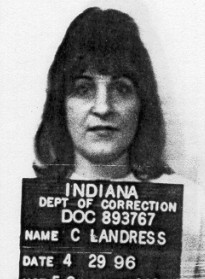
LANDRESS, CINDY LOU # 61
OFF DEATH ROW SINCE 10-15-92
DOB: 01-20-1958
DOC#: 893767 White Female
Lake County Superior Court
Judge Richard J. Conroy
Prosecutor: John J. Burke
Defense: Kevin B. Relphorde, Albert E.
Marshall
Date of Murder: April 23, 1988
Victim(s): Leonard Fowler W/M/46 (Live-In
boyfriend of Landress)
Method of Murder: stabbing with knives
Summary: Landress lived with her
boyfriend, Leonard Fowler. They were joined one morning by Landress'
friend, Julie Lewellen.
All three sat around the kitchen table talking and
drinking. Lewellen suddenly threatened Fowler with a knife and forced
him to the floor. Landress retrieved an extension cord and Lewellen
tied Fowler up and took his wallet, giving it to Landress.
While they were removing the money, Landress told
Lewellen that Fowler had escaped and was in the bedroom loading his
shotgun.
Lewellen ran to the bedroom and began stabbing
Fowler. Landress got a knife from the kitchen and returned to the
bedroom where she says she attempted only to break up the fight.
Landress received a deep cut to her hand and dropped the knife.
Landress then got the keys from Fowler's pocket and
they fled in his car. They were apprehended in California two weeks
later.
The day before the murder, Landress had displayed a
large buck knife and Lewellen had displayed a smaller butterfly knife.
Both had expressed a desire to go "rolling." (knocking someone out and
robbing them). Most all of the above details came from the testimony
of Landress and Julie Lewellen.
Conviction: Felony-Murder (Robbery)
Sentencing: June 26, 1989 (Death Sentence)
Aggravating Circumstances: B (1) Robbery
Mitigating Circumstances: None
Direct Appeal:
Landress v. State, 600 N.E.2d 938 (Ind.
October 15, 1992)
Conviction Affirmed 5-0 DP Vacated 4-1
(Intent to kill of one Defendant cannot be imputed to accomplice)
Krahulik Opinion; Shepard, Debruler, Dickson concur; Givan dissents.
On Remand:
On March 18, 1993 Lake County Superior Court Judge
Richard J. Conroy resentenced Landress to 60 years imprisonment for
Murder in compliance with Indiana Supreme Court Opinion setting aside
death sentence and remanding "for imposition of a new sentence.”
Landress v. State, 638 N.E.2d 787 (Ind.
1994)
(Direct appeal after resentencing and imposition of 60 years
imprisonment - Affirmed).
ClarkProsecutor.org
Supreme Court of Indiana
LANDRESS v. STATE
600 N.E.2d 938 (1992)
Cindy Lou LANDRESS, Appellant,
v.
STATE of Indiana, Appellee.
No. 45S00-8911-CR-837.
October 15, 1992
James F. Stanton,
Crown Point, for appellant.
Linley E. Pearson,
Atty. Gen., Arthur Thaddeus Perry, Deputy Atty. Gen., Indianapolis,
for appellee.
KRAHULIK, Justice
Cindy Lou Landress
was found guilty by a jury of "felony murder", Ind. Code §
35-42-1-1(2), in connection with the death of Leonard Fowler during a
robbery. The jury also recommended the death penalty. Landress was
sentenced to death pursuant to Ind. Code § 35-50-2-9. In this
direct appeal pursuant to Indiana Rules of Appellate Procedure 4(A)(7)
and Ind. Code § 35-50-2-9(h), Landress does not challenge the
jury's determination of guilt, but presents several issues challenging
the imposition of the death penalty.
We believe that one
issue is dispositive and conclude that the evidence is insufficient to
find, beyond a reasonable doubt, that Landress had the intent to kill
required to impose the death penalty.
Facts
The evidence relevant
to this appeal is as follows. In the early hours of April 23, 1988,
Landress and Lewellen were driven to the home of Lewellen's parents by
Lewellen's daughter, Julie. Julie testified that when Lewellen
returned to the car from the house, he showed Julie and Landress a
butterfly knife. Landress said, "That's nothing, look at this," and
showed them a buck knife. Landress indicated that she and Lewellen
planned to go "rolling". Julie understood this to mean that they were
going to knock someone out and take that person's money. On
instructions from Landress, Julie stopped the car near Leonard
Fowler's home where Landress and Lewellen got out. Landress told Julie
not to tell anyone what she had seen or heard that evening. At trial,
Julie identified the buck knife, one of the knives found at the murder
scene, as the one Landress had shown her. Lewellen was found in
possession of the butterfly knife at the time he was arrested.
Landress testified
that after being dropped off, she proceeded to Fowler's home where she
was living at the time. She was awakened by Fowler at about nine
o'clock in the morning on April 23 when Lewellen arrived. Landress got
out of bed and began talking and drinking with Lewellen and Fowler in
the kitchen. She testified that Lewellen suddenly threatened Fowler
with a knife and forced Fowler to lie face down on the floor.
Following Lewellen's instructions, Landress brought an extension cord
and suspenders, which Lewellen used to tie up Fowler. Lewellen removed
Fowler's wallet and handed it to Landress.
Landress went into
the kitchen with the wallet, removed the money from it, and urged
Lewellen to leave the house with her. At that point, she observed that
Fowler had escaped and was in his bedroom loading his shotgun. When
she told Lewellen of this development, he ran to the bedroom and began
stabbing Fowler. Landress attempted to break up the fight, but was
unable to do so. She obtained a knife from the kitchen and returned to
the bedroom. She testified that she did not rejoin the struggle, but
dropped the knife in the doorway. Her intent was to stop the fight
between the two men. At some point, Landress received a deep cut to
the palm of her hand. Lewellen then announced that Fowler was dead,
and instructed Landress to take the keys to Fowler's truck. Landress
removed the keys from a front pocket of Fowler's pants, and the two
left Fowler's home in his truck. Eventually they made their way to
California where they were captured approximately two weeks later.
Leonard Fowler was
found dead in his home. His death was caused by multiple stab wounds
to his abdomen which severed a large artery, causing him to bleed to
death. One knife blade, separated from the handle, and two knives were
recovered at the crime scene. Fowler's daughter identified the blade
as having belonged to a knife missing from the kitchen. Fowler's blood
was identified on this blade. Human blood was found on the blade of
the buck knife, but the police were unable to determine whose blood
was present. There was an indication that blood was present on the
other knife, but it could not be identified.
Landress proceeded to
trial on two counts: Count I charged murder in the perpetration of a
robbery (felony murder), Ind. Code § 35-42-1-1(2), and Count II
sought the death penalty for Landress' participation in an intentional
killing during a robbery pursuant to Ind. Code §
35-50-2-9(b)(1)(G).
Sufficiency of the Evidence on Intent to Kill
Landress claims that
there was not sufficient evidence of her intent to kill necessary to
impose the death penalty. We agree.
Where sufficiency of
the evidence is challenged on review, this Court neither reweighs the
evidence nor determines the credibility of witnesses. Green v.
State (1992), Ind., 587 N.E.2d 1314, 1315. Instead, we look to the
evidence most favorable to the verdict together with all reasonable
inferences therefrom. Id. We then determine whether there is
substantial evidence of probative value from which the trier of fact
might reasonably have found the defendant guilty beyond a reasonable
doubt.
Landress was
originally charged with a knowing or intentional murder, Ind. Code
§ 35-42-1-1(1). The information was amended in December, 1988, by the
addition of a count which sought the death penalty pursuant to Ind.
Code § 35-50-2-9 for an intentional killing during a robbery. In
February 1989, a count for felony murder, Ind. Code §
35-42-1-1(2) was added. On May 15, 1989, the day trial began, the
State moved to dismiss the count charging a knowing or intentional
murder. That dismissal left only the charge of felony murder in the
guilt phase of the trial. Thus, during the guilt phase, the State was
not required to prove that Landress had any intent to kill the victim,
but only that Landress intended to rob and that the victim was killed
during the robbery. Ind. Code § 35-42-1-1(2) and Ind. Code
§ 35-42-5-1. The jury properly was instructed during the guilt phase
that Landress was criminally responsible for the actions of Lewellen
"which were a probable and natural consequence of their common plan
even though not intended as part of the original plan." She was
convicted and the jury was reconvened to consider a recommendation of
death.
The burden of proof
on the issue of intent changed dramatically during the penalty phase
of the trial. In that portion of the trial, the State was required to
prove Landress had the intent to kill, Ind. Code §
35-50-2-9(b)(1)(G); her confederate's intent could not be imputed to
her. Enmund v. Florida (1982), 458 U.S. 782, 102 S.Ct. 3368, 73
L.Ed.2d 1140.
The defendant in
Enmund was the driver of a "getaway car" whose confederates robbed
and killed an elderly farm couple. During the robbery, the defendant
remained in the car, and was not present when the victims were
actually confronted and killed. The defendant was sentenced to death
under Florida statutes. The United States Supreme Court concluded that
the death penalty could not be imposed on one who never intended to
kill. Noting that because there was no evidence that the defendant
intended to participate in or facilitate a murder, the Supreme Court
held that to punish the defendant and his confederates alike by making
the defendant vulnerable to the death penalty on account of his
confederates' actions, would violate the Eighth Amendment. 458 U.S. at
799, 102 S.Ct. at 3377, 73 L.Ed.2d at 1158.
This Court discussed
Enmund in Resnover v. State (1984), Ind., 460 N.E.2d
922, cert. den. 469 U.S. 873, 105 S.Ct. 231, 83 L.Ed.2d 160.
There, we stated that Enmund "dictates the rule that although
vicarious liability for crimes perpetrated by one's confederates can
justify one's conviction for said crimes, the imposition of death upon
a vicariously guilty defendant must be based on his
culpability, not on that of those who committed the robbery and shot
the victims for [the United States Supreme Court] insist[s] on
individualized consideration as a constitutional requirement in
imposing the death sentence." 460 N.E.2d at 935 (citations omitted).
Here, during the
guilt phase of the trial, the jury was instructed that the actions and
intent of Lewellen could be imputed to her for purposes of conviction
for felony murder. This is, of course, proper. Such is not the case,
however, during the penalty phase. As Resnover and its progeny
tell us, during the penalty phase when a defendant is facing the death
penalty, the factfinder's focus must be on that particular defendant's
participation and culpability. Landress claims that the evidence
presented at trial was insufficient to support the conclusion that she
formed the requisite intent to kill. We agree.
Intent to kill need
not be established by direct evidence; circumstantial evidence is
sufficient. Corbin v. State (1990), Ind., 563 N.E.2d 86, 88.
Landress' statement the night before the killing that she and Lewellen
were going "rolling" evidenced her intent to rob, not to kill. Direct
evidence of her intent came from her own testimony in which she denied
having had any such intent to kill, and denied having stabbed Fowler.
She testified that Lewellen and the victim were fighting face to face.
The physical evidence is consistent with this testimony, because the
fatal stab wound was inflicted from the front. There was no direct
evidence that Landress intended to kill and, therefore, we must rely
on inferences to find the requisite intent.
The evidence showed
that the victim's blood was found on the knife blade which Landress
had retrieved from the kitchen. From this fact, the State contends
that an inference of intent to kill may be inferred. The State
correctly notes that the law allows such an inference to be drawn from
the intentional use of a deadly weapon in a manner reasonably
calculated to produce death or great bodily injury. Corbin, 563
N.E.2d at 88. "Where there is substantial evidence in the record from
which the trier of fact could find that the mortal wound was inflicted
upon the victim by a deadly weapon in the hands of the defendant,
intent can be inferred." Brown v. State (1981), Ind., 421
N.E.2d 629, 633. Here, however, there is no direct evidence that
Landress either inflicted a mortal wound or even used the knife in a
manner likely to cause great bodily injury or death.
We agree with the
State that the jury could reasonably have inferred from the evidence
that Landress' knife cut the victim. Having taken that inferential
step, the State argues that such inferred fact can, in turn, support a
second inference of Landress' intent to kill. Thus, from the State's
own argument, it is clear that in order for the jury to have found
that Landress acted with intent to kill, the jury must first have
inferred that she used the knife on the victim, and then inferred that
she used it in a manner likely to cause death.
"The basis of
inferences to support a presumption of fact is probability."
Serrano v. State (1977), 266 Ind. 126, 131, 360 N.E.2d 1257, 1260.
Thus, the jury must have determined the probability that Landress used
the knife, then determined the probability that she used the knife in
a manner likely to cause death, then determined the probability that
she intended to kill. The probability of the second proposition being
true is directly related to the probability of the first proposition
being true, and so on. Thus, the probability of a given inference
being accurate decreases with each inferential building block. The
rule has been announced that "an essential element of an offense
necessary in the proof of the offense and to sustain a verdict of
guilty may not be proved by an inference which is founded solely and
wholly upon another inference." Smith v. State (1928), 200 Ind.
411, 414, 164 N.E. 268, 269 (citations omitted).
In a death penalty
case, where the defendant has been assessed the ultimate penalty, we
carefully examine the evidence to determine whether the penalty is
appropriate to the offender and to the crime. Ind. Code §
35-50-2-9(h); Ind. Appellate Rule 17. Having reviewed the record in
this case, we conclude that the death penalty is too final to permit
it to be applied where, as here, intent to kill necessarily has been
inferred solely and wholly upon another inference. We therefore hold
that the State failed to meet its burden of proving, beyond a
reasonable doubt, that Landress intended to kill the victim. A term of
years is the appropriate punishment.
Conclusion
In view of our
resolution of this issue, we need not address the remaining issues
raised by Landress. Accordingly, the death penalty sentence is vacated
and this matter is remanded for imposition of a new sentence.
SHEPARD, C.J., and
DeBRULER and DICKSON, JJ., concur.
GIVAN, J., dissents,
with separate opinion.
GIVAN, Judge,
dissenting.
I respectfully
dissent from the majority opinion which sets aside the death penalty.
By the appellant's own statements, she and William Lewellen intended
to rob the victim. She aided Lewellen in this endeavor by, among other
things, helping tie up the victim. However, after the victim had been
tied up and while the robbery was still in progress, the victim
escaped from his bonds and went into his bedroom where he obtained a
shotgun and was attempting to load it.
Appellant alerted
Lewellen to that fact and he immediately went to the bedroom and
attacked the victim before he could get the shotgun loaded. Appellant
went to the kitchen and obtained a butcher knife. The victim died of
multiple stab wounds. The butcher knife was found at the scene with
human blood on it but the technicians were unable to type the blood.
Appellant had a cut on her hand at the time of her arrest.
In her testimony at
trial, appellant claimed that she went to the kitchen and obtained the
butcher knife in order to separate the men from fighting. However, in
view of the facts, the jury was entitled to disbelieve this testimony.
There is no question from appellant's own testimony as to whose side
she was on when the fight erupted. To speculate that she obtained the
butcher knife to force Lewellen to cease his attack on the victim
strains credulity.
There is ample
evidence in this case from which the jury could determine beyond a
reasonable doubt that appellant and Lewellen were engaged in a joint
enterprise of robbery, and when the victim was able to place himself
in a threatening position, the robbers joined in an attack upon him
resulting in his death. The inference of appellant's intent to kill
may be based upon the inference of the guilt beyond a reasonable doubt
on the above recited evidence. See Buckner v. State (1969), 252
Ind. 379, 248 N.E.2d 348;
Shutt v. State
(1953), 233 Ind. 169, 117 N.E.2d 892
The majority opinion
cites Enmund v. Florida (1982), 458 U.S. 782, 102 S.Ct. 3368,
73 L.Ed.2d 1140 for the proposition that one who is merely a party to
a robbery which results in death but who did not participate in the
killing can be convicted but should not suffer the death penalty.
There is no question that this is the law today. However, such is not
the factual situation we have in the instant case.
In the case at bar,
the jury was entitled to deduce from the evidence that appellant not
only engaged in the robbery but joined with Lewellen in the attack
upon the victim which resulted in his death. They were entitled to
believe that she joined the attack with the butcher knife she had
obtained from the kitchen. Thus the jury was entitled to find her
intent to kill from the use of a deadly weapon in a manner likely to
cause death. Concepcion v. State (1991), Ind., 567 N.E.2d 784.
I believe there is
ample evidence in the case at bar to support the verdict of the jury.
I would affirm the trial court in all respects.