Murderpedia has thousands of hours of work behind it. To keep creating
new content, we kindly appreciate any donation you can give to help
the Murderpedia project stay alive. We have many
plans and enthusiasm
to keep expanding and making Murderpedia a better site, but we really
need your help for this. Thank you very much in advance.
George
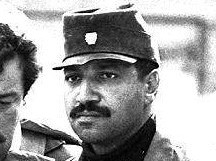
Emil BANKS
Classification: Mass murderer
Characteristics: Former
prison guard - "My people died because I loved them"
Number of victims: 13
Date of murders:
September 25,
1982
Date of arrest:
Same day
Date of birth: June
22,
1942
Victims profile: Sharon Mazzillo (24) / Kissmayu Banks
(5) / Scott Mazzillo (7) / Alice Mazzillo (47) /
Regina Clemens (29) / Montanzima Banks (6) / Susan
Yuhas (23) / Boende Banks (4) / Mauritania Banks
(20 months) / Dorothy Lyons (29) / Nancy Lyons (11)
/ Foraroude Banks (1) / Raymond F. Hall Jr. (24)
Method of murder:
Shooting
(AR-15 semi-automatic rifle)
Location: Wilkes-Barre
City and Jenkins Township,
Pennsylvania, USA
Status: Sentenced to 12 death sentences and one life sentence
on June 22, 1983. Declared
incompetent to be executed on May 12, 2010
Early in the morning, Banks donned military-style
fatigues and packed an AR-15 automatic weapon and killed 13 people in
the Jenkins Township.
Surrendered to police who had surrounded him in a vacant house.
Currently on death row in Pennsylvania.
George Emil Banks
is an American mass murderer, sentenced to death by electrocution, but
later declared by the court to be too psychotic to execute. Banks, a
former Camp Hill prison guard, shot 13 people to death on September 25,
1982 in Wilkes-Barre City and Jenkins Township, Pennsylvania, including
five of his own children.
Banks said he killed his children because he felt
they would be tormented by the cruelty of racial views against mixed
race children. Since his conviction, Banks has tried to kill himself
four times and has gone on hunger strikes that required him to be force
fed. A psychiatric report filed in the case says Banks believes he is in
a spiritual fight with an Antichrist in New York, that Pennsylvania was
controlled by the Islamic religion and he has engaged in a "private war
with President Clinton and Monica Lewinsky".
November 29, 1990, the Pennsylvania State Legislature
barred further use of the electric chair amidst debate that
electrocution was cruel and unusual punishment and approved lethal
injection. December 2, 2004, Banks received a stay of execution. May 12,
2010, Banks was declared incompetent to be executed by Luzerne County
Judge Joseph Augello following a week long competency hearing held the
previous month.
Victims
Killed:
Sharon Mazzillo (24) - Former girlfriend of George
Banks who was engaged in a custody dispute over their son, Kissmayu
Banks. Gunshot wound to the chest.
Kissmayu Banks (5) - The son of Sharon Mazzillo and
George Banks. Gunshot wound to the face.
Scott Mazzillo (7) - Nephew of Sharon Mazzillo.
Kicked, hit with the rifle butt, killed with a gunshot wound to the
face.
Alice Mazzillo (47) - Sharon Mazzillo's mother.
Shot in the face while on the phone with police.
Regina Clemens (29) - Girlfriend of George Banks.
Gunshot wound to the face.
Montanzima Banks (6) - The daughter of Regina
Clemens and George Banks. Gunshot wound to the heart.
Susan Yuhas (23) - Girlfriend of George Banks,
sister of Regina Clemens. Gunshot wound to the head.
Boende Banks (4) - The son of Susan Yuhas and
George Banks. Gunshot wound to the face.
Mauritania Banks (20 months) - Daughter of Susan
Yuhas and George Banks. Gunshot wound to the face.
Dorothy Lyons (29) - Girlfriend of George Banks.
Gunshot wound to the neck.
Nancy Lyons (11) - Daughter of Dorothy Lyons.
Gunshot would to the head.
Foraroude Banks (1) - The son of Dorothy Lyons and
George Banks. Gunshot wound to the head.
Raymond F. Hall Jr. (24) - Bystander who had been
attending a party across the street. Gunshot wound to the liver and
kidney.
Survived:
Keith Mazzillo (13) - Hid in a closet while he
watched his grandmother Alice die due to a gun shot wound to the head.
Angelo Mazzillo (10) - Hid under the bed where his
grandmother Alice died.
James Olsen (22) - Survived a gun shot wound to the
chest.
Unidentified Man that Banks car jacked at gun point.
History
On September 24, 1982 George Emil Banks went to bed
at Schoolhouse Lane in Wilkes Barre Pennsylvania after taking a mixture
of prescription drugs and straight gin. He awoke on September 25, 1982
when he picked up an AR-15 semi-automatic rifle and began what would
turn out to be a 13 person killing spree.
He began his killing spree by killing his girlfriend,
former girlfriends, their family and children he had fathered with them.
The ages of his victims ranged from 20 months to 47 years old. The dead
were seven children and six adults.
George murdered his family in his own home first. He
then dressed in military fatigues and made his way outside. Across the
street, 22 year old Jimmy Olsen and 24 year old Ray Hall, Jr were
exiting a home and the area when George Banks opened fire on them. It is
said that he yelled that they would not tell anyone about this before he
fired. Both men were struck. Mr. Olsen survived but Mr. Hall was killed.
Banks drove off. He went to Heather Highlands mobile
home park to the mobile home of his former girlfriend Sharon Mazzillo
and their son Kissamayu. Banks forced his way in and shot Sharon. He
then placed the gun to the sleeping child’s forehead and shot one shot
killing the boy. Banks then killed Sharon’s mother and brother who were
also in the home. Hiding in the closet was Sharon’s other brother whom
Banks did not see. He was the only survivor and was able to identify
Banks as the shooter.
Police discovered he victims at
Heather Highlands mobile home park and made the connection between the
Olsen and Hall shooting and the Heather Highlands shooting. The
Schoolhouse Lane victims were then discovered.
Police began search for Banks who
abandoned his car and car jacked another vehicle. He abandoned that
vehicle and drove around until he found a desolate area where he laid
down in a grassy area and passed out. Banks awoke and went to his mother’s
house, also in Wilkes Barre. His mother is quoted as saying he was
crying and smelled like liquor. It is stated that Banks told his mother
that she had to take him where he wanted to go or there would be a
shootout. When she asked what happened he said “It’s all over. I did it.
I killed everyone.” She asked who he killed. He replied “I killed them
all, Mom. I killed all the kids and girls. Regina, Sharon, them all.”
Banks' mother called his home hoping
that Banks was just drunk and rambling. When the police answered the
phone Banks grabbed the phone and asked how the children were. The
police, hoping to keep Banks on the phone, replied that they were alive.
Banks screamed that they were lying and said “I know I killed them!” He
hung up the phone, placed three 30-round clips and numerous other rounds
of ammunition into a bag and went to a vacated rental house.
A standoff between Banks and police began. The police
brought his mother and tried multiple tactics to get Banks to surrender
including having a false news report played over WILK radio that the
children were alive and needed blood to survive. The police tried to use
this to draw Banks out of the standoff. Finally a former co-worker,
Robert Brunson, of Banks was able to talk him out. It took 4 hours for
the sandoff to end. As of September 30, 1982 Banks stood accused of 8
counts of murder, attempted murder, aggravated assault, recklessly
endangering another person, sealing a car, robbery and theft.
On June 6, 1983 the trial for Banks began at the
Luzerne County Courthouse in Wilkes Barre Pennsylvania. Banks insisted
on testifying stating that he is not insane. The case consisted of
multiple scene witnesses, Banks family members as well as Mr. Olsen
identifying Banks as he person who shot him and left him for dead.
Closing arguments took place on June 21, 1983.
The jury found Banks guilty of 12 counts of first-degree
murder, 1 count of third-degree murder, attempted murder, aggravated
assault, and one 1 count each of robbery, theft, and endangering the
life of another person. On June 22, 1983, Banks 41st Birthday, the jury
recommended the death penalty for George Banks. George Banks went to the
maximum-security unit at Huntington until November 1985. He was then
sent to the Correctional Institute at Graterford after the US Supreme
Court refused to overturn his verdict.
From 1987 to 2000 Banks continued to
appeal his case. The US Supreme Court refused to hear the argument
regarding mental competency. Then Pennsylvania Governor Tom Ridge twice
signed the death warrant for Banks; however, both times appellate courts
have stayed his execution. In 2001, 2006 and 2008 there were hearings
about the psychological state of Banks questioning if he could be
executed. In 2011 he is still on death row in Pennsylvania although it
is said he is now dying of cancer.
Timeline
September 1982: George Banks is relieved of duty as
a Camp Hill State Prison guard after a conflict with a supervisor, and
is evaluated at a Harrisburg-area hospital for mental-health issues. A
later evaluation in Luzerne County, where he lived, characterizes
Banks as "filled with hate and anger at the world in general." On Sept.
25, Banks kills 13 people, including five of his children, at two
houses in Wilkes-Barre and its suburbs.
March 1983: A three-day hearing results in Banks'
being ruled mentally competent to stand trial.
June 1983: Trial testimony begins in Pittsburgh.
Against his lawyers' advice, Banks testifies, saying police killed as
many as nine of the victims. He is found guilty of killing 13 people,
wounding a 14th, and other offenses. He receives 12 death sentences
and one life sentence.
November 1985: After Banks' county-level appeals
are exhausted, a judge formally imposes the death penalties.
February 1987: State Supreme Court upholds the
verdicts.
October 1987: U.S. Supreme Court declines to take
up the case.
February 1996: Gov. Tom Ridge signs Banks' death
warrant. Banks later receives a stay of execution.
August 1997: An appeal is argued before the U.S.
Court of Appeals for the Third Circuit.
March 1999: Ridge signs another death warrant for
Banks, and a federal judge issues another stay.
October 2001: The Third Circuit reverses the death
sentences based on wording of jury instructions.
May 2002: Prison officials obtain a court order to
force-feed Banks, who had gone more than 16 days on inadequate food
and water.
June 2002: U.S. Supreme Court sends the case back
to the Third Circuit, which later upholds its previous ruling in Banks'
favor. The case is sent back the U.S. Supreme Court.
June 2004: U.S. Supreme Court rules against Banks.
October 2004: Gov. Rendell signs Banks' death
warrant.
Dec. 1, 2004: State Supreme Court halts the
execution and orders a county judge to determine whether Banks is
mentally competent
Wikipedia.org
13 are killed; guard
surrenders
7 children, 6 adults
shot in Pennsylvania
The Boston Globe
September 26, 1982
WILKES-BARRE, Pa. - A prison guard went on a shooting
rampage in two communities yesterday, killing seven children and six
adults before surrendering to police who had surrounded him in a vacant
house, officials said.
Five of the victims apparently were his own children,
and all the others except for two men were either related or known to
him, police said.
Survivor, 9, pleaded
for pet's life
Philadelphia Daily News
September 27, 1982
WILKES-BARRE - As his family was shot to death one by
one by a "mad and cursing" George Banks, Angelo Mazzillo, 9,
pleaded hysterically for the life of his pet parakeet, a witness said.
Victim bought gun
for killer, cops say
Philadelphia Daily News
September 27, 1982
The military-style weapon allegedly used by accused
mass slayer George Banks was a gift to him from one of the victims,
according to authorities investigating the murder Saturday of 13 people
in Wilkes-Barre.
Banks talked of
suicide
Philadelphia Daily News
September 27, 1982
WILKES-BARRE - George Banks, accused of murdering 13
people here Saturday - including three women he lived with and five of
his own children - threatened to kill himself Sept. 6 while on guard
duty at the State Correctional Institution at Camp Hill and was removed
from his post, according to a spokesman for Gov. Thornburgh.
Banks plead innocent
to killing 13
Philadelphia Daily News
December 9, 1982
WILKES-BARRE - Accused mass killer George Banks
pleaded not guilty yesterday to 13 counts of criminal homicide in the
Sept. 25 shooting spree that left six adults and seven children dead.
Home razed of
suspect in Wilkes-Barre killings
Philadelphia Daily News
December 17, 1982
WILKES-BARRE, Pa. - The Schoolhouse Lane home in which
former prison guard George Banks allegedly killed eight of the 13
victims of a Sept. 25 shooting spree is a pile of rubble today.
Ex-guard found
guilty in rifle slayings of 13
The New York Times
June 22, 1983
The 40-year-old defendant, sat impassively, never
flinching as the jury foreman intoned the word "guilty" for
each of the 13 murder charges.
But perhaps the most dramatic moments of the testimony
came as Mr. Banks took the stand, against the protests of his attorneys.
Mr. Banks testified he had killed the women and
children because he loved them, though he contended the death wounds of
several had been inflicted by the police.
He calmly told the jury of shooting each of the three
women who lived with him and of shooting at his sleeping children,
showing little emotion until he described the deaths of two daughters.
Then he bowed his head, wiping his eyes. But he said as he showed
photographs of the slain victims to jurors: "I swear on the souls
of my dead children I am not responsible for the damage you see in these
photographs."
"My people died because I loved them," he
told the jurors. The shootings, he said, were the "culmination of
41 years of racial abuse heaped upon me in this country." They
occurred, he said, after he awoke from a sleep induced by drugs and
alcohol.
"I can't explain what was going on in my mind at
the time," he said. "you wouldn't believe it."
Banks jury sentences
him to death
Philadelphia Inquirer
June 23, 1983
George Banks, who killed 13 people, including five of
his own children, was sentenced to death yesterday by the same jury that
convicted him of the massacre.
Although several of the jurors wept as foreman Thomas
Boory read a sentence of death on each of 12 verdicts of first-degree
murder, Banks, a former prison guard, showed no emotion.
Judge denies mass
killer's appeal
The Centre Daily Times
September 2, 1996
WILLIAMSPORT -- A federal judge denied the appeal of
convicted mass murderer George Banks but continued the stay that
prevented his March 5 execution, so Banks can appeal to the 3rd U.S.
Circuit Court of Appeals.
In his decision Friday, U.S. District Judge James F.
Mc-Clure rejected issues raised by the former Camp Hill prison guard,
who was convicted of killing 13 people -- including five children -- in
Wilkes-Barre on Sept. 25, 1982.
State Supreme Court
denies Banks' appeal
The Times Leader
March 3, 1999
WILKES-BARRE- The state Supreme Court has denied
convicted murderer George Banks' final appeal to that court, said
Luzerne County District Attorney Peter Paul Olszewski Jr.
Pennsylvania Supreme Court Justice Stephen A. Zappala
wrote in his opinion of the ruling that Banks' petition for his
conviction to be overturned was not filed in a timely manner.
Ridge signs death
warrant for George Banks
Attorney for man
convicted of killing 13 people in 1982 shooting spree expects to file
appeal
The Times Leader
March 10, 1999
HARRISBURG- Gov. Tom Ridge on Tuesday signed a second
death warrant for convicted murderer George Banks, who shot and killed
13 people more than 16 years ago in Luzerne County.
Banks' execution is scheduled for 10 p.m. April 20 at
the State Correctional Institution at Rockview in Centre County, near
State College. Banks is to die by lethal injection.
Judge continues
delay in Bank's execution date
The Times Leader
August 20, 1999
WILLIAMSPORT - A judge has refused to speed the
execution of mass murderer George Banks, ruling that an appeals court
could affirm one of Banks' claims.
U.S. Middle District Judge James F. McClure Jr.
Wednesday affirmed a stay of execution he issued March 26.
Gunman kills 13 in a Pennsylvania rampage
WILKES-BARRE, Pa., Sept. 25 - A state prison guard
killed 13 people, including seven children, in a rampage through two
houses early today, the police said. A 14th victim was
critically wounded.
Five of the victims are believed to have been the
gunman's children.
The guard, George Banks, 42 years old, surrendered to
the police this morning after they surrounded a vacant house here where
he had been hiding.
'Like a Horror Movie'
Mr. Banks, who had served seven and a half years in
prison for attempted robbery before he became a prison guard, was
charged in five of the deaths. The police said most of the victims were
taken by surprise as they slept or sat watching television. Eight of the
victims were killed in a house here, another man was killed and a
companion was critically wounded outside the house, and the four others
were found dead in a mobile home in Jenkins Township, about five miles
away.
"It's like something out of a horror movie,"
Robert Gillespie, Luzerne County District Attorney, said after visiting
one of the crime scenes.
For eight hours, a neighborhood in the old hard-coal
town waited in fear as the police from two municipalities and sheriffs'
deputies surrounded a house where the suspect holed up after the
shootings. He was armed with an AR-15 semiautomatic rifle believed to
have been used in the shootings and several clips of 30-caliber
ammunition, the police said.
The police cordoned off the area and evacuated
neighboring houses. The gunman's mother, who was called to the scene,
and several of his friends urged him to surrender. Shortly after 11
A.M., several hours after the siege began, Mr. Banks handed the rifle
out through a window and gave himself up.
Trail of Slaughter
According to the police, the trail of slaughter led
from a trailer camp in Jenkins Township, where two women and two
children were slain, to a home in a quiet, well-kept neighborhood here
in Wilkes-Barre, where nine more victims were found.
"All died as a result of gunshot wounds,"
said the county coroner, George Hudock, at a news conference this
afternoon. "Apparently the adults were surprised as they sat
watching television."
Mr. Hudock said the two young victims at the trailer
court had apparently been sleeping and were shot from behind as they
tried to flee.
Two other children in the mobile home were unharmed,
the police said.
According to police sources, the suspect left the
trailer camp, the Heather Highlands Mobile Home Village, in a pickup
truck and drove to a home on Schoolhouse Lane here, where eight other
persons were killed.
A 13th victim was slain and another man was
critically wounded as they stood on a porch across the street from the
home, the police said. Both were uninvolved passersby, the police said.
"Now I'm going to kill them all," Mr. Banks
said as he left the first crime scene, according to a neighbor who
declined to give her name.
After the shootings, according to police sources, the
suspect drove to a nearby bar, where a car was stolen. It was later
found abandoned.
He next appeared at his mother's home, the police
said, and then drove to still another house here, believed to be the
vacant home of a friend, where he holed up with his rifle and
ammunition.
Motive for Killings Sought
No motive has been found for the slayings, the police
said, although there were repots from neighbors of domestic disputes
between Mr. Banks and at least three of the women, said to have been his
girlfriends.
"We are still trying to determine the exact
relationships between the suspect ad the victims," said Mr.
Gillespie, the District Attorney.
Joseph Shaver, chief deputy coroner, said all the
victims apparently "were interrelated" with the suspect.
"He knew all these people," Mr. Shaver said.
Neighbors described Mr. Banks variously as a
"good father," a highly religious man who had a mail-order
minister's degree, and a man who was fascinated with paramilitary topics
such as weapons and making bombs.
Slain at the trailer camp were Alice Mazzillo, 47
years old; her daughter, Sharon Mazzillo, 24; Kissmayu Banks, 5, and
Scott Mazzillo, 7.
Neighbors said Sharon Mazzillo was Mr. Banks's
girlfriend, and Kissmayu Banks as his son.
Slain in Wilkes-Barre were Dorothy Lyons, 29; Regina
Clemens, 29; Susan Yuhas, 23; Nancy Lyons, 11; Moutanzima Banks, 6;
Bowendy Banks, 4; Foraroude Banks, 1, and Maritanya Banks, 1.
Raymond Hall, 24, was slain as he stood on a porch
across the street from the house. His companion, James Olsen, 22, was
reported to be in critical condition at a nearby hospital.
Guard at State Prison
Mr. Banks, who was wearing military-style fatigues
when he surrendered, was a guard at a state prison at Camp Hill, near
Harrisburg. Kenneth Robinson, a spokesman for the state correctional
system, said supervisors described him as a good employee.
He had served seven and a half years at Pennsylvania's
Graterford Prison for an attempted robbery conviction in 1961, Mr.
Robinson said. He said the state was aware of Mr. Banks's prison record
when it hired him as a guard in February 1980.
Mr. Banks was a tower guard at Camp Hill, but had not
worked since Sept. 2, a spokesman at the prison said.
"We believe he was on sick leave when the
incident occurred," said Chief Swim of the Wilkes-Barre police.
Wilkes-Barre killings: Racial pressures cited
WILKES-BARRE, Pa., Sept. 26 - An image began to emerge
today of the prison guard being held here in the slayings of 13 people:
that of a complex man, seething with resentment against members of the
two races whose heritages he shared.
The picture of George Banks, a 40-year-old Army
veteran, developed from talks with a schoolmate who served time with him
in prison, from neighbors, from a guidance counselor who remembers him
across 25 years and from others, as well as from revelations by his
mother before she went into seclusion.
"George was like, well, it seemed like he was
feeling persecution from both sides," said Leroy De Graffenreid,
who knew him both on Wilkes-Barre's streets and in Luzerne County
Prison, where Mr. Banks was held briefly before he was transferred to
Graterford Prison to serve seven years for a robbery attempt.
The victims of what the police call a rifle rampage
early Saturday morning included four women who were said to have borne
Mr. Banks's children outside of marriage; seven children, including five
who bear his name; the mother of one of the women, and a man who
apparently was standing across the street from a house where eight of
the slayings occurred. A companion of the dead man remained in critical
condition today at a local hospital.
Mr. Banks, who was placed under 24-hour guard at the
Luzerne County Prison after he vowed to commit suicide, has been charged
thus far in five of the slayings, which took place on the outskirts of
the old hard-coal city and in the nearby suburb of Jenkins Township.
Doted on His Children
Mr. De Graffenreid's comments were among the more
revealing among those that pictured a quiet youth on the defensive,
resentful of affronts, a veteran who tried to rob a tavern when he was
unable to find work, who grew into a calmer adult, becoming a father who
seemed to dote on his children but who, according to neighbors,
sometimes battered the women who shared his home and his bed.
"He was a hard-nosed kid who didn't like to be
pushed around," said Mr. De Graffenreid, who grew up in the same
South Wilkes-Barre neighborhood as Mr. Banks before being sent to
prison, he said, as a juvenile delinquent.
"I got the impression he felt he was being
rejected by blacks and whites, and he took pressure from both
sides," he said, recalling that Mr. Banks's mother was white, as
were all the women slain in two homes Saturday, while his father, like
Mr. De Graffenreid, was black.
"He was bolder than I was, but we hung out on the
same streets," Mr. De Graffenreid said. "It didn't seem he
wanted to hurt anybody, but he was ready to fight if he had to. It
seemed like he built up a complex that he had to be ready to
fight."
Boasted of Shooting Man
In prison both men served "on the same
tier," Mr. De Graffenreid said, and it was there, he said, that he
learned of a risk he had run in a clash with Mr. Banks over Mr. De
Graffenreid's sister.
"I pulled her out of his car," he said.
"She was too young to date. He told me he had laid for me outside
with a pipe, but I never came out of the house that night."
"George told me about that robbery," he
said, referring to an attempt in a tavern, for which Mr. Banks was
convicted, in which the owner was wounded by a gunshot. "He said
the man said 'you won't shoot.' He said he said 'get ready for it, you
big slob, because here it comes.'"
But in prison Mr. Banks was a quiet man who had no
trouble with guards, and in the years after his release "he had
calmed down a lot as far as I could see," Mr. De Graffenreid said.
For that reason, he said, "I was as surprised as
anybody when all this happened,"
Albert Sallitt, who was Mr. Banks's guidance counselor
at G.A.R. High School here, said Mr. Banks was "a quiet, thin
boy" who "never got into any serious trouble that I can
remember."
After serving his prison time, Mr. Banks worked at
several jobs, including one at a mining company, one for a Pittston
contractor and one from 1971 to 1979 as a technician with the state's
Department of Environmental Resources. He agreed to leave that job, one
of his former superiors said Saturday because "he apparently was
having domestic difficulties that interfered with his work."
In 1980 Mr. Banks began work as a prison guard at Camp
Hill near Harrisburg.
"There is no law in Pennsylvania or with the
Civil Service which states that ex-offenders may not be hired,"
said Kenneth Robinson, a spokesman for the state correctional system.
"Each ex-offender that applies is considered case by case."
Urged to See Psychiatrist
Mr. Banks apparently also experienced problems on his
prison job before going on leave early this month.
"They told him to come home and see a
psychiatrist," his mother, Mary Yelland, told a reporter here
Saturday before she went into seclusion, protected by another son who
also refused to discuss his brother today. She called her son a good man
but she said she did not know whether he had sought help.
During his leave from the prison job, he sought work
at a local restaurant. The manager of the restaurant said Mr. Banks told
him that he needed a job because of "domestic problems."
"He wanted to be a bouncer," the manager
said.
Among his domestic problems, according to neighbors,
were a dispute with an estranged girlfriend, Sharon Mazzillo, 24, over
custody of their child, Kissmayu Banks, 5. Both were killed in a trailer
park in Jenkins Township, along with Alice Mazzillo, 47, who was Sharon
Mazzillo's mother, and Scott Mazzillo, 7, Alice Mazzillo's grandson by
another daughter. Two other children escaped by hiding in a closet.
The neighbors also reported that Mr. Banks had had
clashes with the three women with whom he shared a house here, Dorothy
Lyons, 29, Regina Clemens, 29, and Susan Yuhas, 23. They were shot to
death, along with Nancy Lyons, 11, Montanzima Banks, 6, Bowendy Banks,
4, Foraroude Banks, 1, and Maritanya Banks, 1.
The 13th victim, Raymond Hall, 24; was
fatally wounded as he stood across the street from the house where eight
victims died. His companion, James Olsen, 22, was critically wounded.
Violent But Doting Father
"I saw him knock one of the girls down and kick
her," said Elaine Monahan, who lives in a well-kept yellow home
across the street from the deteriorating two story house where eight of
the victims were slain, where a string of Christmas wiring with empty
sockets is a poignant reminder of a happier past.
"It was right over there in that side yard where
the pear tree is growing back from that stump," she said. "The
next morning she had her arm in a cast. She said she tripped and fell in
the house."
"I saw him slapping and punching Suzie on the
front porch," said her husband, William Monahan, referring to Susan
Yuhas. "I came in and said, 'my God,' but there are three of them
and they've got a phone if they want to call the police."
"What I can't understand is him killing his
kids," said Mrs. Monahan. "He doted on those kids. He used to
say 'they're all my kids,' and he meant the white kid, too. He took good
care of them, and dressed them nice." One of the victims had a
child by an earlier marriage.
Mrs. Monahan said Mr. Banks had shown her and her
husband a semiautomatic rifle, and, referring to neighbors with whom he
had been having a dispute, had said "he might clean them all out -
he'd be the only survivor." She said she had not taken the threat
seriously.
"He said he didn't want to have anything to do
with white people," said Mrs. Monahan. "I guess he didn't have
much of a start in life. He told me his mother was white. He said people
used to spit on his mother because she was married to a black man."
Lester Scoble, another neighbor, told of similar
comments. "He told me he didn't want white trash in his yard,"
he said. "We didn't bother with him after that. He said he didn't
have much use for his own people either."
Once, Mr. Scoble said, he had seen Mr. Banks
"give a pretty good lacing" to one of the women with a
sawed-off stem of a Christmas tree.
One of the victims, Regina Clemens, had fled to a
shelter for battered women both neighbors said, but had returned to the
home the night of the slayings. No one knew why.
"This used to be a nice neighborhood," Mrs.
Monahan said. "I'm just ashamed that all this ever happened
here."
Man held in deaths sought mental help but was sent
home
WILKES-BARRE, Pa., Sept. 27 - A suicidal guard accused
in the slayings of 13 people had sought help at a mental health unit
eight days before the killings but was not institutionalized because he
did not qualify as homicidal, an official said today.
John Creek, executive director of the Luzerne County
Mental Health-Mental Retardation unit, said that 40-year-old George
Banks went through an initial interview Sept. 17 and had been scheduled
for an appointment today.
Mr. Banks, who served seven years at Graterford State
Prison in the 1960's for attempted armed robbery, was under constant
guard at the Luzerne County Prison after threatening to kill himself
said a source who asked not to be identified.
Mr. Creek said the mental health center could not
commit Mr.Banks to an institution involuntarily because he did not meet
the legal criteria of "overtly suicidal or homicidal."
The state prison at Camp Hill near Harrisburg referred
Mr. Banks to the mental health center in Wilkes-Barre Sept. 6 after he
threatened suicide while on duty as a watchtower guard, said Kenneth
Robinson, a Bureau of Correction spokesman.
Mr. Robinson said other guards talked Mr. Banks out of
his tower and Mr. Banks was "immediately put on leave."
Four of the victims - Sharon Mazzillo, 24; her son,
Kissmayu Banks, 5; her mother, Alice, 47, and her nephew, Scott, 7 -
were buried at the Denison Cemetery in Swoyersville today.
Suspect's mental state a key issue as trial starts
today in 13 deaths
In a courtroom in northeastern Pennsylvania today, an
imported jury is to begin hearing murder charges against George Banks.
And Wilkes-Barre and surrounding Luzerne County will begin reliving the
rampage of rifle slayings that stunned the hard-coal region last
September.
Mr. Banks, 40 years old, a former prison guard who
once served a prison term for a robbery attempt and who seemed to live
in a limbo between two races, is accused of killing 13 people, including
five of his own children. He has pleaded not guilty.
Under an order from Judge Patrick Toole of the
county's Court of Common Pleas, who will try the case, defense and
prosecuting attorney's have refused to comment on the approaching trial,
but all signs point to a defense focusing on Mr. Banks's mental
condition. At the time of the shootings he was on leave from his prison
job after voicing suspicions that his food might be poisoned and
threatening to commit suicide.
One prospective defense witness, Dr. Michael J.
Spodak, chief of psychiatry at Baltimore County General Hospital in
Randallstown, Md., spent about 10 hours examining Mr. Banks early this
year.
Described as 'Sorry'
"He was very sorry for what he had done,"
said Dr. Spodak, in a telephone interview in which he limited his
comments to subjects that he had discussed in testifying about the
suspect's competence to stand trial.
"But the primary thing he talked about," Dr.
Spodak said was a "conspiracy he believes has been plotted against
him."
"He was completely preoccupied with that,"
Dr. Spodak continued. "It overwhelmed his thoughts."
Dr. Spodak also said he had found Mr. Banks
"avoiding certain foods in jail," and he said the suspect had
"lost a lot of weight."
"In my opinion he was completely
irrational," the psychiatrist said. "He had lost touch with
reality on a great many things. He said he thinks someone moved the
bodies around and put extra bullets into them and changed some of the
clothes. They were not rational expressions. That's part of his
illness."
Conflicting Testimony
Dr. Spodak testified Feb. 28 that Mr. Banks was
"terminally paranoid" and incompetent to stand trial. Judge
Toole ruled him legally competent after conflicting testimony by another
psychiatrist, Dr. Robert Sadoff, who had examined the suspect for the
prosecution. Dr. Sadoff said that while Mr. Banks often acted
"bizarre," he understood the nature of the charge against him.
Mr. Banks, the child of a white mother and a black
father, lived with three white women in small, rundown house in a
predominantly white neighborhood of Wilkes-Barre. All three women had
borne him children, although he was legally married to a black woman now
living in Ohio.
In that house on Sept. 25, according to the charges
against him, Mr. Banks opened fire with an automatic rifle, killing the
three women, four of his children, another child and a man on the
street.
At a trailer park outside of town, prosecutors say, he
then killed two other children, including one of his own, and his
child's mother and grandmother. He was in a custody dispute with that
child's mother, who was white.
Accused of Wife Abuse
Mr. Banks was described as a caring father by
neighbors in Wilkes-Barre, but they said he abused the women who lived
with him. His relations with the neighbors were said to be strained.
Later his mother and a former associate of the suspect
said he had suffered a sense of alienation because of his mixed
parentage. The associate, a former prison mate, and others said Mr.
Banks seethed with resentment against the two races whose heritages he
shared.
Because of the notoriety of the crimes, which
preoccupied local newspapers and broadcasters for days after the
shootings, a western Pennsylvania jury has been empanelled in Allegheny
County, which includes Pittsburg, and sent across the state where it
will be sequested during the trial. Testimony from other psychiatrists
is expected.
Children who survived massacre say they saw man
kill relatives
WILKES-BARRE, Pa., June 7 -
Two 10-year-old
stepbrothers testified today that George Banks, accused of killing 13
people including family members, broke into their trailer and shot their
mother, sister and two nephews to death.
Angelo Vital and Keith Mazzillo both said Mr. Banks
broke open the front door to their trailer home last Sept. 25. Angelo
described how a man he said was Mr. Banks shot his mother, Alice
Mazzillo, 47 years old; his sister, Sharon Mazzillo, 23, Sharon's
5-year-old son, Kissmayu Banks, and Scott Mazzillo, 7, Sharon's nephew.
Angelo said he hid under his mother's bed during the
shooting. Keith said he hid in his bedroom closet. Both boys said they
peeked out and saw Mr. Banks kill Scott Mazzillo.
Eight of the victims, including three of Mr. Banks's
girlfriends and four of his children, were killed in a home in
Wilkes-Barre, and a bystander was slain outside. The last four victims,
including a former girlfriend and their child, died in a mobile home in
suburban Jenkins Township.
Attendant Testifies
Earlier today, a filling station attendant testified
that Mr. Banks stole his car at gunpoint and told him he had killed his
children.
"He said, 'Move over, or I'll blow your head
off,' and I moved over," Joseph Yenchaw, 23, testified.
Mr. Yenchaw said Mr. Banks, who he said was wearing
Army fatigues, walked out of the woods and into the parking lot carrying
a semiautomatic rifle and aimed it at his head.
"As we were driving off, he said he had just
killed his children and didn't want any trouble," Mr. Yenchaw
testified. "He asked me if I wanted to get out and I said,
'Yes.'"
Mr. Yenchaw said they had driven less than a quarter
of a mile before Mr. Banks let him go. Mr. Yenchaw said Mr. Banks
"just seemed calm."
"He didn't seem nervous or anything like that and
he talked OK," Mr. Yenchaw said.
Impairment Is Suggested
The prosecution has sought to show that Mr. Banks, 40,
a former state prison guard and former convict, was neither intoxicated
nor on drugs when he went on the shooting rampage. The defense has tried
to show that Mr. Banks was mentally incompetent. Mr. Banks has pleaded
not guilty.
District attorney Robert Gillespie Jr. told the jury
he would prove that Mr. Banks gunned down the victims methodically with
an AR-15 rifle, a semiautomatic version of the military M-16.
The jurors in Luzerne County Common Pleas Court were
selected across state in Pittsburg on orders of the state Supreme Court
because of extensive publicity in northeastern Pennsylvania.
After Mr. Yenchaw, the prosecution called eight
witnesses who set the stage for later evidence about the killings in the
three-bedroom trailer, where Mr. Banks's estranged girlfriend lived with
their 5-year-old son, who was the subject of a custody fight.
Operator Tells of Plea for Aid
Vera Williams, a telephone operator, told the court
about an emergency call she received at approximately 2:30 A.M. on Sept.
25 from a women.
"She said someone was there assaulting her and
her kids. And their was a noise," the operator testified. "It
sounded like a firecracker, and a man's voice shouted, "I'll kill
you,' and then there was silence but the line stayed open. Then I heard
a young male voice whisper, 'He killed my brother and my sister and my
Mom. He shot them all.'"
In previous testimony, four witnesses identified Mr.
Banks as the man who shot Raymond Hall, the slain bystander, and James
Olsen, a bystander who was shot but survived.
George Banks
Mental Illness and Moratorium issues
Pennsylvania
Granted stay of execution
George Banks was a prison guard who, using an assault
rifle, killed 13 people, including seven children, five of them his own;
his three live-in girlfriends; an ex-girlfriend; her mother; and a
bystander in the street. In the early morning of September 25, 1982,
Banks shot to death Dorothy Lyons, Regina Clemens, Susan Yuhas,
Montanzuma, age six, Bowende, age four, Mauritania, age one and
Fararoude, age one, Dorothy's daughter Nancy Lyons, age 11, Sharon
Mazzillo and their son Kismayu, age six, Sharon's mother, Alice, her
nephew, Scott, age seven and a bystander. Banks was subsequently
convicted and sentenced to death for the murder of 13 people.
Mental Illness
Trial testimony indicated that, over time, Banks "developed
a persecution complex and became obsessed with the paranoid delusion of
imminent international race wars and uprisings." Beginning in 1976,
Banks became convinced that a racial war would erupt. He talked about
and wrote numerous stories reflecting his pre-occupation with white
supremacy, and a racial war in which his male sons, Kismayu, Bowende,
and Fararoude would be generals leading an army in a fight against the
systematic elimination of blacks. He prepared for the impending war by
stockpiling supplies in remote mountain locations and purchasing an
AR-15 rifle
In February 1980, Banks began working as a prison
guard at the Camp Hill Pennsylvania State Correctional facility. On
November 25, 1981, Banks wrote in a journal:
"I feel that I am insane. I have the impulse to
take the shotgun out on the catwalk and kill some inmates. I can't
think. I'm writing one word at a time. I beg Allah for help-please.
My young children come from play and in vain, they ask for me. What
has the white man and his senseless racism done to me? Will I live
to see my children grow?"
In August, 1982, Banks told co-workers about a
custody suit involving Sharon Mazzillo and their son Kismayu, stating
that if he wasn't successful in the suit he would kill his family and
himself. He was successful in retaining custody. On September 6, 1982,
Banks was relieved from guard duty at the state prison and transported
to a mental health facility after telling a fellow guard that due to
depression and other family problems that he wanted "to go to the tower
and blow his brains out."
Between September 6 and September 24, Banks underwent
three mental health evaluations. Banks also had to undergo a psychiatric
reevaluation by the state prison psychiatrist before returning to work.
Banks scheduled the appointment for September 22 and then rescheduled it
for September 28. On September 17, eight days before the shootings, one
evaluator noted that Banks was more preoccupied with the racial
situation, (in Wilkes-Barre and the world), than any ongoing marital
difficulty.
On September 24, Banks went to a party with
Dorothy Lyons and Regina Clemens. He left the party and returned
home where he drank gin and took some pills. He subsequently called
Dorothy at the party and told her that he was going to the mountains.
He also told her to bring home the AR-15 rifle that was at her
sister's house. Dorothy, Regina and Susan Yuhas returned home with
the rifle sometime after 1:30 am on September 25.
In the early morning hours of September 25, 1982 at
their home on Schoolhouse Lane in Wilkes-Barre, Banks shot to death
Dorothy Lyons, Regina Clemens and Susan Yuhas, four of his five children,
(Montanzuma, age six, Bowende, age four, Mauritania, age one and
Fararoude, age one), and Nancy Lyons, age 11, the daughter of Dorothy.
Banks' version of the incident began with his
girlfriends waking him and dressing him in a military flight suit. After
he put the bolt in the rifle and loaded it, he passed out. When he
awakened, he became aware that he was dressed in the military outfit
with a gun across his chest and his bandolier of bullets.
Immediately after the shootings, Banks confronted
four teenagers outside his home. Banks testified that he walked towards
them, firing his gun twice, shooting two of the youths, and killing one.
He heard one girl yell "No, No, No" and thought "Maybe there was a life
for them." He raised his gun, turned around and walked down the street.
After stealing a car, he went to Sharon Mazzillo's trailer park. He
broke into her trailer and shot to death his girlfriend, (Sharon
Mazzillo) and their son (Kismayu, age six), Sharon's mother, (Alice),
and her nephew, (Scott, age seven). Alice's two children, (Keith and
Angelo), were unharmed.
The entire shooting spree lasted approximately 45
minutes. Banks then remembered waking up in a ditch, soaking wet,
smelling of gunpowder and seeing a figure in the fog. He felt he had
been involved in a great deal of violence. Police located Banks
later that morning, barricaded in a friend's house in Wilkes-Barre
city.
During the ensuing standoff, Banks told the police
that he killed his children to spare them from the racial prejudice that
he experienced as a child. He repeatedly threatened suicide. The police
used a fake radio broadcast, which aired that his children were still
alive and being treated. This ruse convinced Banks to surrender to
police without further incident.
The defense testimony at trial "presented a profile
of a disturbed and paranoid man." Both prosecution and defense experts
agreed that Banks suffered from a "serious mental defect," specifically,
"paranoia psychosis." Paranoia psychosis is a chronic, rare and severe
mental illness characterized by fixed delusional beliefs. In Banks'
case, the fixed delusions involved racial persecution, violence and
racial conspiracies.
On three separate occasions before trial, defense
counsel raised the issue of Banks' competency. During the first two
hearings, counsel presented psychiatric and lay testimony that Banks
could neither assist counsel in relating a reliable, accurate
account of the incident nor understand the object of the criminal
proceedings.
Defense psychiatrists concluded that Banks had a
fixed delusional, paranoid belief that a white police detective had shot
and mutilated his family, changed their clothing and body locations and
covered up bullet holes with coroner paste. They further concluded that
Banks perceived that the criminal proceedings provided a method to
exhume the bodies and thereby prove the existence of a racially
motivated conspiracy to fabricate and destroy evidence. The state trial
court denied these motions.
Following jury selection, the trial commenced on June
6, 1983. The state trial court permitted defense counsel, over Banks'
objection, to assert an insanity defense. This defense asserted that at
the time of the incident Banks' held a psychotic belief that he had a
right to kill his children to protect them from the racial prejudice he
suffered and to insure that they died pure in the hands of God.
Both the prosecution and defense psychiatrists agreed
that, at the time of the incident, Banks was suffering from paranoid
psychosis. Disagreement centered on whether, as a result of his severe
mental illness, Banks was able to understand the nature and quality of
his acts or able to distinguish between right and wrong with respect to
those acts.
During trial, the state court permitted Banks,
over the objections of his counsel, to personally cross-examine and
direct counsel's cross-examination of witnesses and introduce into
evidence photos of the deceased victims, which the court had
initially suppressed due to their prejudicial content.
In addition, a prosecution psychiatrist testified
that Banks was psychotic and delusional when he testified, and his trial
testimony was, therefore, unreliable. Despite this conduct, the state
trial court summarily denied repeated defense counsel motions
challenging Banks' competency.
Despite being presented with such evidence, the jury
rejected an insanity defense, convicting Banks of twelve counts of first-degree
murder, one count of third degree murder, one count of attempted murder,
and related charges. Of note however, although the court rejected claims
raised on direct appeal related to Banks' mental illness, it stated:
Before we leave the subject of appellant's mental
condition, we wish to make it clear that we are aware that appellant
suffers and has suffered from a mental defect that contributed to
his bizarre behavior both in the courtroom and on September 25,
1982, when thirteen innocent persons were murdered by his hand. His
behavior was inexplicable, and his thought-processes remain
difficult to comprehend.
It should be noted that Banks was diagnosed in the
1980s with paranoid psychosis. Diagnostic categories have since changed
and his attorney indicates the most similar diagnosis now would be
something akin to a delusional disorder.
An additional argument of appeal is that his death
sentence should overturned because jurors might have thought they had to
be unanimous in finding a mitigating circumstance for the crime, such as
mental illness. The Supreme Court has heard argument about whether
Mills v. Maryland is retroactive, as a new rule of constitutional
law. As a new rule, it could only be applied retroactively if it was a "rule[]
of criminal procedure implicating the fundamental fairness and accuracy
of the criminal proceeding." Finding that it was not a watershed rule,
the Court found that it could not be applied retroactively and that the
conviction was constitutional.
Moratorium
The last execution in Pennsylvania was of Gary
Michael Heidnik on July 6, 1999. Indeed, since the re-instatement of the
death penalty in 1976, only three executions have taken place including
that of Mr. Heidnik: On May 2, 1995 Keith Zettlemoyer was executed and
on 15 August, 1995 Leon Moser was executed. Of note, each of these
previous executions involved a volunteer and hence the upcoming
execution of Banks will be the first non-volunteer execution in
Pennsylvania since re-instatement of the death penalty in 1976.
George Emil Banks
The state
Supreme Court December 2004 stopped the execution of mass murderer
George Emil Banks, who was scheduled to die by lethal injection this
month.
The high court ordered the Luzerne County Court to
hold a hearing to determine whether Banks is competent to be executed.
Lawyers said that hearing might not happen for months. The execution
warrant signed by Gov. Ed Rendell expires at midnight.
In a methodical rampage in 1982, Banks killed 13
people, including his five children, their four mothers and four others,
in the Wilkes-Barre area.
He was deemed competent to stand trial, and the jury
rejected his insanity defense, sentencing him to death in June 1983. In
December 2004, the state Supreme Court ordered a hearing on Banks'
mental state to comply with a 1986 U.S. Supreme Court decision. That
ruling says it is unconstitutional to execute defendants who do not
understand the proceedings. Banks' attorneys say he is too mentally ill
to be executed.
A spokesman for the state Department of Corrections
said Banks has not been moved from death row at Graterford state prison
to the State Correctional Institution at Rockview in Centre County,
where the execution was to have taken place. A Luzerne County judge
rejected Banks' appeal Monday, saying it was filed too late.
Michael Wiseman, a lawyer with the Defender
Association of Philadelphia, said Banks, 62, believes God has vacated
his sentence. He said Banks believes he will not be executed and that
the process is just a test of his faith in Jesus. "He doesn't understand
he's going to be executed," Wiseman said.
Wiseman said that even Dr. Robert Sadoff, the
prosecution's psychiatric witness at trial, signed an affidavit stating
Banks needed to be examined to comply with the U.S. Supreme Court ruling.
Banks' brother, John, welcomed the court ruling last
night. "I know the decision the judges had to make wasn't an easy one
either politically or emotionally, but I'm glad they had the strength to
make it and God bless them for it," John Banks said.
But Ray Hall, whose son Raymond F. Hall Jr. was a
passerby who was killed by Banks, told The Associated Press the delay
was a bitter disappointment. Hall planned to witness the execution. "This
is what really has me mad -- I mean, it's enough, you know? How far can
they take it? These courts. I'm sort of sickened," the AP quoted Hall as
saying.
Scott C. Gartley, chief appellate counsel for the
Luzerne County district attorney's office, expressed disappointment. "It's
very unfortunate," he said. "Especially when you remember the case isn't
about George Banks, it's about the 13 people he killed and their
families. It's unfortunate for them being put through the highs and lows
in this case."
Albert J. Flora Jr., Banks' attorney since his 1983
trial, said he expects a competency hearing to take place within 60 to
90 days. "The decision of the state Supreme Court was legally correct
and it affords George Banks his day in court, which every person is
entitled," Flora said.
Banks, a former Camp Hill prison guard, used an
assault rifle to kill his victims. The son of a white mother and black
father, Banks said he killed his children to save them from the racism
he endured as a mixed-race child. All of his girlfriends were white.
Prosecutors said Banks lashed out because he was
losing control of the women, three of whom lived in the same house. Two
of those women were sisters. One girlfriend had left him and another
sought help at a battered women's shelter. Banks was seen slapping
another of the women the week before the slayings.
At trial, Banks thwarted his attorneys' attempts to
present an insanity defense. Although he confessed to killing some of
the victims in a drug-and-alcohol-induced haze, he said police killed
others and mutilated the bodies to make the crime seem worse.
Since his conviction, Banks has tried to kill himself
four times and has gone on hunger strikes that required him to be force
fed. A psychiatric report filed in the case states that Banks believed
he was in a spiritual fight with an anti-Christ in New York, that
Pennsylvania was controlled by the Islamic religion, and that he engaged
in a "private war with President Clinton and Monica Lewinsky."
The state Supreme Court has rejected Banks' appeals
four times. The U.S. Supreme Court has done so twice.
Mass Murder in Eastern Pennsylvania: The True Story of George Emil Banks
by
David Lohr
The "Diamond City"
The
city of Wilkes-Barre is situated along the scenic Susquehanna River in
northeastern Pennsylvania. Settlers from Connecticut, who built the town
around a square, following the New England custom, founded this
picturesque place in 1770. By the turn of the century, the Wilkes-Barre
area boasted a newspaper, post office, and courthouse.
During the late 1800's, thousands of immigrants flocked to the region to
work the growing anthracite coalmines. This transformed the lush green
valley from an isolated farming area into a growing metropolis. The
success of the coal industry brought a steady stream of entrepreneurs
who formed many new businesses. Silk and garment mills quickly became
major employers with companies such as the Empire Silk Mill importing
silk from Japan.
Wilkes-Barre was nicknamed the “Diamond City.” Originally, the city’s
seal contained a diamond, which symbolized the "black diamonds" of
anthracite coal, as well as the diamond-shaped town square. Currently,
the city of Wilkes-Barre, Pennsylvania has a population of nearly 50,000
people. One of those residents was George Emil Banks.
A Tormented Mind Snaps
During the year leading up to the tragedy, George Emil Banks’ mental
state had greatly declined and one can only speculate as to what was
going on in his mind before the carnage. In the early morning hours of
September 25, 1982, Banks awoke from a self-induced haze. The
40-year-old prison guard had taken a cocktail of prescription drugs and
straight gin around 11:30 p.m. the previous night.
Banks
tried to focus his eyes and looked at his surroundings. Lying next to
him was an AR-15 semi-automatic rifle, which he had purchased the
previous year. His four-year-old son, Bowendy, was sleeping next to him
while his girlfriends, 29-year-old Regina Clemens, 23-year-old Susan
Yuhas, and 29-year-old Dorothy Lyons, sat in chairs nearby. Susan,
cradling the couple’s one-year-old daughter Mauritania in her arms,
awoke when George began to stir.
George reached down and picked up the gun, locked and loaded it with a
thirty-round clip. Most likely, his facial expression began to change as
he stroked the military-style assault rifle, his eyes burning with anger
and a scowl tainting his generally handsome features. Lacking
explanation or any apparent compassion, he raised the weapon and shot
Regina Clemens. The bullet pierced her right cheek, sliced downward and
traveled directly through her heart, killing her instantly. Her body
pitched sideways in a lifeless sprawl.
Susan
and Dorothy, frozen with fear, watched in horror as George stood there.
He shot Susan five times in the chest at point blank range as her cries
for mercy fell upon deaf ears. A single bullet entered Mauritania’s left
ear and exited her right eye as her mother Susan had tried in vain to
safeguard her from the hail of bullets. Dorothy must have known that she
was to be next for she shielded her face with her right arm as George
fired two more rounds. The first bullet pierced her arm and chest; the
second entered her neck as she fell forward to the floor, her eyes open
but glazed with the unmistakable luster of death.
Bowendy’s young face turned away from his father when a single shot rang
out; the bullet traveled through his left cheek and exited his right
ear, virtually turning his face inside out. The AR-15 fell abruptly
silent as George stood amidst the carnage he had inflicted upon his
family. Spent cartridges littered the floor and the smell of gunpowder
and death permeated the air. His taste for blood had yet to be quenched.
He was a man on a deadly mission, and there was still much to do. He
made his way up the stairs towards his children’s bedrooms.
Six-year-old Montanzima was sitting up on her bed. Awakened by the
gunfire, she looked up at her father quizzically as he entered the room.
George raised the weapon and shot the child point blank in the chest. As
she fell over, he fired a second shot into her head. Her lifeless body
slumped to the floor.
Moving down the hall, George stopped at eleven-year-old Nancy Lyons’
room. She was sitting up on her bed holding her half-brother
one-year-old Forarounde Banks in her arms. The young girl saw the anger
in his eyes, and attempted to shield her brother as George stood up on
the bed and took aim. There were three shots fired in rapid succession.
Forarounde was shot in the back of the head, the bullet exiting his left
eye. A bullet struck Nancy in the left forearm and one directly in the
face that immediately shattered her skull. Both children lie dead as he
walked out of the room. George made his way to his bedroom, his clothes
splattered with blood, where he donned military style fatigues and a
T-shirt that read, “Kill ‘em all and let God sort ‘em out.”
Across the street from Banks’ house, 22-year-old Jimmy Olsen and
24-year-old Ray Hall, Jr. heard the multiple gunshots and decided to get
out of the area. As they approached their car, George walked out of his
house. Banks immediately ran up to them, “You’re never going to live
to tell anyone about this!” he exclaimed as the gun expelled a
flurry of bullets at the two men. Hall and Olsen were both struck point
blank in the chest and fell to the pavement. Banks stood over their
bodies only momentarily before getting into his vehicle and driving off.
Deadly Results
George drove approximately four miles from the crime scene at School
House Lane to Heather Highlands trailer court in Plains Township. A
former girlfriend, Sharon Mazzillo, along with the couple’s son
Kissamayu Banks, shared a mobile home there with Sharon’s mother, Alice
Mazzillo, her brothers Keith and Angelo Mazzillo, and visiting nephew
Scott Mazzillo. George went to the front door stepping over the various
toys and bicycles that lay scattered about the yard. 24-year-old Sharon
cautiously greeted him at the door. When she saw the rifle in his hand,
she tried to close the door but George forced his way inside.
Quickly tiring of Sharon’s resistance, he raised the weapon and fired.
The bullet ripped through her chest and severed the main blood vessel to
the heart. Her limp body slumped to the ground. George stepped over it
and entered the house. He saw five-year-old Kissamayu sleeping on the
couch with a blanket pulled over his head. George walked up to the
child, placed the barrel of the gun just inches from the boy’s forehead
and fired a single shot.
Sharon’s mother, 47-year-old Alice, had heard the shots and was
desperately trying to phone for help. Her two sons, 10-year-old Angelo
and 13-year-old Keith were looking for a place to hide. Angelo crawled
under Alice’s bed while Keith hid in the closet. George entered Alice’s
room, walked over to her and strategically placed the barrel of the gun
at an angle aiming directly up her nasal passage. He fired one shot. The
combination of the combustion from the discharge and the exiting bullet
caused Alice’s head to explode, scattering brain matter about the room.
Keith
watched in horror through the partly opened closet door as
seven-year-old Scott Mazzillo ran into the room and screamed. When Scott
saw the horrible scene in the bedroom, he ran down the hall. George
grabbed him, kicked him to the ground and punched him repeatedly in the
back. When he stopped struggling, George pulled the sobbing boy up by
the shoulder, placed the barrel just behind the left ear and fired.
George removed his hand and allowed the lifeless child to fall on the
floor. Satisfied that he had left no survivors, George stood up, walked
out the front door and yelled, “I killed them all!” before fleeing the
scene.
A Chilling Discovery
Sometime around 2:30 a.m., Jenkins Township Patrolman John Darski and
Detective Captain Ray McGarry, while on routine patrol, received a call
instructing them to investigate a possible shooting in Heather
Highlands. As the two veteran officers turned into the park entrance,
they had no way of knowing the horror and carnage that they were about
to witness, a memory that would stay with them for the rest of their
lives. Upon reaching lot 188, they immediately noticed that a Caucasian
female, covered with blood, was lying next to the steps of the home. She
had no vital signs and it was apparent that she had died as a result of
at least one gunshot wound.
Upon
a cautious and defensive entrance of the home, the officers discovered
Kissamayu on the couch, Scott face down in the hallway and the
decapitated body of Alice in the bedroom. Realizing they were no longer
in danger, Keith and Angelo came out from hiding. Officers on the scene,
while sick to their stomach from the bloody massacre, were relieved that
at least two children had survived. Alice’s sons, while in a state of
shock, were able to tell investigators that George Banks was the man who
had committed the appalling crimes. The officers put out an all-points
bulletin for Banks’ arrest.
At
about the same time Jenkins Township police officers were arriving at
Heather Highlands, Wilkes-Barre Police Lt. John Lowe, en route to a
similar call, discovered the bodies of two Caucasian males lying next to
the street on Schoolhouse Lane. Lowe immediately called for backup
before exiting his vehicle to evaluate the situation.
Uncertain as to whether the perpetrator was still in the general
vicinity, Lowe walked up to a small white house across from the victims’
bodies and cautiously stepped inside. Hoping to spot the gunman in the
home, he shined his light around the interior. A nightmarish scene
greeted Lowe. The smell of fresh gunpowder still saturated the air and
there were corpses scattered about the rooms.
Paramedics dispatched to the scene immediately treated James Olsen and
Raymond Hall. Both men had sustained serious injuries and were in
critical condition upon their arrival at Wilkes-Barre General Hospital.
While the paramedics were treating the wounded, the local police
department was just arriving at the scene. Wilkes-Barre Detective
Tino Andreoli was one of the first investigators to arrive at 28 School
House Lane. Detective Patrick Curley greeted him solemnly as he walked
up to Banks’ front door:
Curley: “We have
a homicide.” Andreoli: “How many?” Curley: “I lost track.”
Detective Andreoli was
horrified as he entered the home; in all of his years on the force he
had never encountered anything like the slaughter that now presented
itself. The rooms were blood-splattered and riddled with bullets. The
detectives wondered to themselves how a person could murder young,
innocent children in such a heinous cold-blooded manner?
Police had cordoned off
all routes out of the city and were desperately trying to find their
murder suspect. George was well aware of the manhunt and decided to
change vehicles to elude police. After deserting his vehicle, he stopped
a motorist near the Cabaret Lounge in Wilkes-Barre. George put his gun
to the man’s head and forced him out of his vehicle. He drove the man’s
’72 Chevy to the east-end section of the city and then abandoned it.
Still feeling the effects of the alcohol and drugs that he had consumed
earlier, George walked into a desolate area, lay down in the grass and
passed out.
At Wilkes-Barre General
Hospital at 3:30 a.m., Raymond Hall, Jr. was pronounced dead. A Life
Flight helicopter rushed James Olsen to Geisinger Medical Center in
Danville when his condition deteriorated.
Chaos and Confusion
Police were still
searching for Banks. Patrol cars spread out through the city shining
lights in back yards and alleyways hoping to catch a glimpse of the
dangerous fugitive. Around 5:30 a.m. George awoke, still wearing his
military fatigues, his rifle at his side. Uncertain what to do, he ran
to the home of his mother, Mary Banks Yelland, located at 98 Metcalfe
Street. George was crying and smelled like liquor when his mother opened
the door:
Banks: “Mom, if
you don’t take me where I want to go, there will be a shootout here and
you will be hurt.” Yelland: “George, what’s wrong?” Banks: “It’s all over, Mom. It’s all over. I did it. I killed
everyone.” Yelland: “Who did you kill, Georgie? Who did you kill?” Banks: “I killed them all, Mom. I killed all the kids and girls.
Regina, Sharon, them all.” Yelland: “Georgie, no!” Banks: “It’s all over, Mom. It’s all over.”
Following the
conversation with his mother, George sat down at her kitchen table and
began writing a crude will leaving her all of his possessions. Mary
Banks Yelland was in a state of shock and decided to phone George’s home
in the hopes that what he had confided in her was simply part of his
drunken imagination. Chief County Detective Jim Zardecki answered the
phone at School House Lane when it rang. George grabbed the phone from
his mother and identified himself:
Banks: “This is
George Banks, how are the kids?” Zardecki: “They are alive, George” Banks: “You’re lying, I know I killed them!”
Banks hung up the
telephone. Zardecki had hoped that if George thought the children were
still alive, he could keep him on the phone long enough for police to
locate him. He was wrong. Banks placed three 30-round clips and numerous
other rounds of ammunition into a bag and asked his mother to drive him
to a friend’s recently vacated rental house at 24 Monroe Street. Yelland
did as George requested, dropped him off in front of the house and drove
away. When she got home, she was greeted by a phalanx of police and
hesitantly told them where she had just taken her son.
To Lure a Killer
By 7:20 a.m., the Wilkes-Barre
Police Department, Luzerne County Sheriff’s Department, and Pennsylvania
State Police had the house on Monroe Street surrounded with officers.
Banks had barricaded the doors with furniture and kicked out a first
floor bedroom window of the two-story home when he saw officers arriving
at the scene. Approximately 110 law enforcement officers prepared
themselves for a possible shoot-out with Banks.
Wilkes-Barre Detective
Patrick Curley and Luzerne County Chief Detective James Zardecki took
turns on a loud speaker attempting to get George to surrender and urging
him not to do anything that would endanger himself or others. Banks
screamed back about living in a racist community and not wanting his
kids to grow up in a racist world. Whenever he noticed an officer’s
position, he would call it out and threaten to shoot. Detectives Harold
Crawley and Jerry Dessoye were hidden across the street from Banks’
location and on several occasions noticed that they would be able to get
a clear shot at Banks whenever he came near the window to yell out.
However, upon radioing in for permission, they learned that Chief John
Swim would not authorize any such action, “If you fire a shot and miss,
or just wound him, God knows what will happen.”
At approximately 8:15
a.m. Chief Detective Zardecki went to a nearby phone and called Banks,
attempting to use the ploy that his children were still alive again.
“George, you’ve got to care about your kids. They need your blood to
survive. Come out, George, you’ve got to take care of your children.”
Banks replied that he might consider coming out but that he doubted any
of the children were still alive. Just before slamming the receiver down,
Banks informed Zardecki that he wanted a transistor radio so he could
listen to news reports regarding the events.
Shortly after 9:00 a.m.,
police brought George’s mother to the scene with hopes that she could
talk him out. Mrs. Yelland spoke to her son over the police loudspeaker:
Yelland: “Come
out for my sake Georgie. I love you. Please son, please. None of your
children is dead. Believe me.” Banks: “I want them to kill me!” Yelland: “No, you’ve been taking that medicine.” Banks: “I’m tired. I want them to kill me.”
In an effort to end the
drama, District Attorney Robert Gillespie asked local radio station WILK
for help. Convinced that if Banks heard a newscast that his children
were still alive, he would give himself up. WILK News Director Pat Ward
agreed to Gillespie’s plan to go on the air and report the erroneous
facts that Banks’ children were not dead although “seriously injured.” A
radio was brought to the scene at 9:58 a.m. Officers began playing it
over a police loud speaker. Following the newscast, Banks informed
officers that he did not believe the report and was not going to
surrender.
Wilkes-Barre policeman
Dale Minnick attempted to talk Banks out of the house shortly after the
false radio broadcast. “You heard the broadcast over the radio,” Minnick
conveyed to Banks over a bullhorn. “Throw out your gun and come out. We
wouldn't lie to you. You can go down to the hospital and see your kids.
It’s been a long day for you and us. Throw your gun out the window. You
heard it on the radio, what more do you want from us?” Minnick's words
had no affect on Banks, who kept quiet during the entire one-sided
conversation.
A Hero in the Midst
Robert Brunson, a
resident of Wilkes-Barre, friend and former co-worker of George Banks,
heard reports on the news of the standoff on Monroe Street and felt
compelled to help. The unemployed and divorced 36-year-old man quickly
drove to the scene, and asked the permission of Wilkes-Barre Chief of
Police John Swim to talk with Banks, “I feel I can talk to him and would
like a chance to try,” Brunson told Swim. With few options left on the
table, Swim agreed. Brunson, escorted to a point only a few yards from
the home, called out to Banks:
Brunson: “George, can I
talk to you before you die? If you came here to die, so be it. But let
me talk to you before you do it.”
Banks: “It’s a
good day to die!” Brunson: “No, there are people that care. I cared enough to come
down here to talk to you.” Banks: “No, man, they are using you.” Brunson: “No, I want to be here. If you fire one shot, the police
will shoot you, just like you or I would do if we were in the (prison)
tower. Take the first step, man. I’ll be there to walk every step with
you.” Banks: “I have problems I can’t deal with. I want to be treated
with dignity.” Brunson: “George, listen man. Everybody needs a crutch sometimes.
I’ll be yours. I’ll put my body between you and these men with guns. But
you have to trust the man (police).”
Following the
conversation with Brunson, Banks remained silent, contemplating his
situation. Finally, four hours after the standoff began, at 11:17 a.m.,
Banks agreed to come out. He smashed out a rear window in the house and
asked that the officers on the scene hold their fire. He was then
instructed to hand his weapon to Patrolman Donald Smith through the
broken window and surrender himself out the front door of the home into
the custody of police. Banks complied.
During an initial search
of the home, investigators discovered three 30-round clips and
approximately 300 rounds of ammunition. Also noted was that Banks had
barricaded all of the windows with furniture and large appliances, and
had a mirror set up in order to watch the front and rear doors from a
second floor vantage point.
This was a siege like no
other in local history. The city of Wilkes-Barre was left in a state of
shock following the bloody massacre. Many residents could not understand
why Banks, an outwardly stable man, decided to systematically kill 13
innocent human beings for no apparent reason.
Beginning to an End
George Emil Banks was
born on June 22, 1942. Born and raised in Wilkes-Barre, he was the son
of a white woman and a black man. Banks’ parents never married and the
racial mix seemed to torment him throughout his life. He was educated at
St. Mary’s Catholic School, where he was an underachiever, despite
having been tested with an IQ of 121. George believed that he was
shunned and abused by both whites and blacks throughout his childhood
because of his bi-racial status.
“I’ve dealt with racial
cowards all my life. A lot of things happened during that time,” said
Banks referring to his childhood. “There was this kid named Bones who
punched me in the back of the head and kept harassing me just to see if
I had enough nerve to fight,” Banks stated.
According to Banks, his
problems seemed to get worse as he grew older. During his late teens,
racist problems amplified and Banks felt he was constantly harassed. “In
1959, I almost got lynched for drinking a soda and eating a doughnut on
a sidewalk.”
While in his early
twenties, George saw the military as a possible way of escaping his
troubled youth and signed up for a tour of duty in the United States
Army. This dream, however, was short lived as he was discharged just two
years later in 1961 because he “couldn't get along with the officers.”
Following his “general discharge” from the Army, Banks’ life continued
on a downward spiral.
During the early morning
hours of September 9, 1961, Banks and two accomplices attempted to rob
the Brazil and Roche bar on Pittston Avenue in south Scranton. The crime
was doomed from the start. Saloonkeeper Thomas Roche was doing some late
night work at the tavern. When confronted by the assailants, Roche
refused to cooperate. Angered, Banks pulled out a pistol, shot Roche
directly in the chest and fled empty-handed with his two accomplices.
Shortly after the tavern robbery, the Wilkes-Barre and Kingston police
apprehended the suspects. For his part in the crime, Banks earned a
sentence of six-to-fifteen years in prison. He was sent to the State
Correctional Institution (SCI) in Graterford, Pennsylvania to serve his
time.
In March of 1964, Banks
escaped SCI Graterford while on farm detail. Apprehended just three
hours later, George received an additional term of one and one-half to
five years for the escape. Paroled on March 28, 1969, after serving
seven and one-half years behind bars, Banks was now a free man.
Following his release, Banks held a number of jobs and married long-time
friend Doris Jones, a black woman with whom he had two daughters.
In 1971, Banks acquired
a position as a technician with the bureau of Water Quality of the State
Department of Environmental Resources (DER) regional office in Wilkes-Barre.
The job was the most notable one George had ever held and paid quite
well. Banks filed a request in 1974 for commutation of the maximum term
of his sentence. Former Pennsylvania Governor Milton Shapp granted the
release, thereby ending Banks’ days on parole.
Perpetual domestic
arguments and continued infidelity on George’s part caused him and his
wife to separate in 1976. Doris took the children and moved to Ohio.
Surprisingly, it was George not Doris who filed for the couple’s
ultimate divorce.
A Bizarre Lifestyle
Following the separation
with Doris, Banks purchased a home at 28 Schoolhouse Lane in Wilkes-Barre
and began to accumulate a harem of girlfriends. All were white, at least
ten years younger than Banks, and easily manipulated. Some were homeless
and saw George as their only way off the streets. George lived a cult-like
lifestyle, quickly amassing four girlfriends simultaneously, two of
which were sisters. They all lived together and all bore him at least
one child.
Regina (Duryea) Clemens,
Banks’ first lover, became pregnant prior to Banks’ separation with
Doris and had a daughter, Montanzima Banks, in 1976. Sharon Mazzillo
moved in with Banks and Clemens shortly after Montanzima’s birth. She
had a son, Kissamayu Banks, on October 6, 1976. Regina Clemens’ sister
Susan (Duryea) Yuhas moved in with the trio shortly after Kissmayu's
birth. She became pregnant by George the following year and bore a son,
Bowendy Banks, in 1978.
Following the births of
his children and the added responsibilities brought on by them, Banks’
mental state began to deteriorate. The State Department of Environmental
Resources (DER) asked Banks to resign in 1979. “He was an average worker
but we came to a mutual agreement that he should leave,” said James
Chester, former Regional Director of the DER in Wilkes-Barre. “His work
began to suffer because of his personal problems and the bureau thought
that it would be best to conclude the relationship.”
Living in a
predominately white neighborhood and being involved in a series of
interracial relationships brought its own share of problems to Banks’
home. Banks claimed that his white neighbors “intimidated the women and
called the children African niggers.” His home was once firebombed.
“They attempted to burn my house, smashed several windows, squirted my
babies with water when they were in the yard and intimidated the girls
and children.” During a separate incident, while standing at the corner
of McCarragher and High streets, Banks said “because I was walking on
the sidewalk they hit me with a beer bottle, called me racist names and
chased me down the street. I had to grab a pipe to hold them off until
police came. Before it was over, about 100 spectators had gathered to
watch the whole thing.”
“This is the kind of
thing I have had to live with my entire life," Banks said. "They behave
in a cowardly fashion. They look down their nose at me, but they’re out
there abusing innocent people who have nothing to do with this. They’re
out there damaging my property and harassing my family.”
A former neighbor,
Lester Scoble said, “He (Banks) didn’t want nobody to bother him. He
didn’t want our kids to play in his yard. He didn‘t like them (Banks'
girlfriends) talking to other people. I don‘t even think any of them
went out. I guess they all were one-man women.”
In 1980, despite Banks’
prior arrest record, he obtained a job as a prison watchtower guard at
the State Correctional Institute in Camp Hill, Pennsylvania. Dorothy
Lyons, moved in with the growing family. She brought along her daughter
from a previous marriage, Nancy Lyons, age nine. Within months Dorothy
was pregnant by Banks and on January 25, 1981 gave birth to a son,
Foraroude Banks. Shortly after Foraroude's birth, Susan Yuhas had a
second child by Banks, a daughter, Mauritania Banks. Sharon Mazzillo,
tired of Banks and his growing harem, left the Banks' household and
moved in with her mother a short time later.
Prelude to Mayhem
George's mental state
continued to worsen in late 1981. He had obtained a mail-order
ordination from the Universal Life Church; however, he became angry
after being rejected for religious tax exemptions by the state and
picketed city hall in rebuttal. He began to keep a meticulous diary of
his thoughts and ideas. He compiled his own list of heroes, including
cult leaders Jim Jones, who directed a mass suicide; Charles Manson, who
orchestrated a mass murder; and serial killer John Gacy. Banks also had
begun to collect survivalist magazines and news accounts on murder and
racism. Perhaps the most ominous of all his new hobbies was his desire
to build a stockpile of guns and ammunition. A former neighbor stated
that Banks "read paramilitary magazines like Solider of Fortune,
had books about making bombs, and talked frequently about starting a war.”
By the summer of 1982,
Banks had begun talking to fellow guards at work about committing mass
killings, preparing his children for warfare, and going into the
watchtower and blowing his brains out. Upon learning this, on September
6, 1982 prison officials sent Banks home on extended sick leave to seek
psychiatric help. Camp Hill authorities then contacted Luzerne-Wyoming
County’s Mental Health-Mental Retardation Center in Wilkes-Barre,
requesting assistance for Banks. They scheduled a psychiatric evaluation
for September 29, 1982. Kenneth Robinson, a former spokesman for Camp
Hill, stated, “He was removed and put on sick leave by the institution
as a reaction to the incident (suicide threat).”
By September 24, 1982,
George was teetering on the breaking point. He was bitter over his
forced leave from work, and even more so by the custody dispute he was
having with Sharon Mazzillo over Kissamayu Banks. He wanted full control
and custody over the child and was angered that Sharon would not comply.
Banks had told the judge during a preliminary custody hearing that, “she
(Sharon) can come and see him anytime she wants, I just want the
ultimate control over his future, as far as his education and stuff is
concerned.” Judge Chester B. Muroski ruled that Banks would retain
custody of the child with liberal partial custody granted to Sharon.
However, even after the ruling that made Banks the child's primary care
giver, Sharon would not comply with the order and kept the child to
herself. By the early morning hours of September 25, George Banks,
waking from a self-induced drunken/drugged haze, lost whatever control
he had left.
Dissertations of Madness
Not until Banks was in
custody at Wilkes-Barre police headquarters did most of the officers
that were on the scene feel the impact of what had occurred. “I looked
at him, handcuffed to a chair,” former Chief Detective Jim Zardecki
recalled, “and I felt like a balloon that had suddenly been pricked. I
started to quiver. My eyes watered. I thought, what really happened here?
My God, what happened? Until then, we’d been reacting. We hadn’t time to
think about it. We were more lucky than good. He could have blown
anybody away.”
Following his arrest,
Banks told investigators that he “wanted to die,” and that if he had
known for certain his children were dead, he would have stuck the rifle
into his mouth and blown himself away. George avoided direct questions
about the murders, although he did admit to them. He was uncertain as to
how many he had actually committed. Most of the time police questioned
him, he ranted about racism and discrimination rather than his crimes.
Shortly after 4:00 p.m.,
Banks was arraigned before District Magistrate Joseph Verespy and
charged with five counts of criminal homicide, with other charges to be
filed later in the week. Verespy ordered Banks be held without bail in
the Luzerne County Prison to await a preliminary hearing scheduled for
October 6, 1982. Banks remained calm and motionless during the entire
proceeding.
After just a few days in
the county lockup, Banks began threatening others and talking about
suicide. During one altercation with a prison guard, Banks warned, “I’ve
already killed seven people. One more body won’t make a difference.”
Following the incident, a prison official placed Banks on a round-the-clock
suicide watch. Not permitted to interact with other inmates or
participate in any prison activities, Banks’ depression deepened.
Attired in a tan coat
and dark trousers, Banks appeared before District Justice Robert Verespy
for his preliminary hearing in early October. Banks, with tears
streaming down his face, entered pleas of “not guilty” to 13 counts of
aggravated murder; two counts of robbery; and one count each of the
following: attempted murder, aggravated assault, recklessly endangering
another person, and theft. Following the plea, Banks requested a jury
trial to determine his ultimate fate.
On January 15, 1982, Dr.
Anthony Turchetti examined Banks at the request of the defense and
deemed him fit to stand trial. “He (Banks) can understand the nature of
criminal proceedings and can assist in his own defense,” Turchetti's
report stated. Following Banks' request for a change of venue, the
Pennsylvania Supreme Court on February 26, 1983 ordered that the jury
for Banks trial to be selected from Pittsburgh, Pennsylvania,
approximately 250 miles from Wilkes-Barre. Jury selection began on May
23, 1983, and was completed just four days later with five men, seven
women and six alternates.
Revelations Heard
On June 6, 1983, at
approximately 9:15 a.m., the trial for accused mass murderer George
Banks began at the Luzerne County Courthouse behind locked doors. A
prosecution team consisting of District Attorney Robert Gillespie and
Assistant District Attorneys Lawrence Klemow and Michael Bart was chosen
to represent the state. Public Defender Basil Russin and two assistants,
Joseph Sklarosky and Al Flora, Jr., were present to represent Banks.
The prosecution had many
advantages during the trial: Banks’ partial confession, the murder
weapon, over 100 photographs of the victims, and more than 40 witnesses.
Banks’ attorneys, against their client’s wishes, had prepared an
insanity defense and planned to bring up Banks’ peculiar lifestyle and
abnormal behavior.
One of the first to
testify was Dr. Michael K. Spodak, a psychiatrist for the defense.
Spodak testified that during his first interview with Banks, the
defendant appeared paranoid, delusional, and suicidal. Throughout that
interview, Banks indicated to Spodak that he was a victim of a
conspiracy in which the district attorney, judge, police, defense
attorneys, and city officials were involved. During the cross-examination,
Gillespie asked Spodak if he felt Banks was faking a mental disorder.
Spodak replied, “I have confidence he was not trying to be deceptive in
the interview.”
During the trial, Banks
continued to insist that he was not mentally ill and demanded to testify.
Banks’ attorneys worried that the jury would consider him sane if he
testified. Still, Banks ignored them and took the stand, saying his
testimony was the only chance he had “to pull the mask off the devil.”
Sometimes standing,
sometimes sitting, Banks coolly and comfortably launched into a rambling,
disjointed account of the night of the killings. He voiced his opinion
that the police, in a racist conspiracy against him, fired the fatal
bullets into some of the victims after he had left them wounded. To
prove this theory, Banks wanted to exhume the bodies of the victims for
forensic examination. Then he showed the jury the gruesome photographs
of the victims, photographs that his attorneys had fought to keep out of
the jury's view. The pictures, Banks said, would “prove my theory of a
police conspiracy.” During Banks’ testimony, Assistant Public Defender
Al Flora, Jr., lowered his head and wept in frustration.
Before wrapping up, the
defense called upon Banks’ mother, brother, and religious advisor, in an
attempt to show the jury that George was, in fact, suffering from mental
abnormalities, and did not understand the consequences of his actions.
This testimony, however, came a little too late following Banks’ own
damaging admissions to the jury.
When it came time for
the prosecution to present its side, James Olsen, sole survivor of the
bloody shooting spree was called to the stand. Olsen testified that
George Banks was the man that shot him on September 25, 1982 and left
him for dead. Following Olsen’s testimony, the prosecution called
detectives and medical examiners to further strengthen the case against
Banks. Each detective present at the crime scenes came forward and
recounted his/her version of the events. At one point, County Coroner
Dr. George Hudock, Jr., while describing the murder scene, said, “I’m
still sick to my stomach.”
Final Stage
On June 21, 1983,
closing arguments in the case began. Attorney Sklarosky, presented his
arguments to the jury in a voice hardly audible at times, displayed
particular emotion in addressing the panel, and pointed out that the
defendant was in store for numerous restless nights and horrible
memories during the balance of his lifetime. The defense lawyer noted
“the terrible crimes committed by Banks,” but reminded the jury that the
defendant “was, and still is, very sick.” Sklarosky challenged the jury
to display courage, remembering the fact that, “One person can save his
(Banks’) life.”
District Attorney
Gillespie countered the defense’s passionate appeal with unemotional
arguments. The prosecuting attorney focused the jury on the legal issues,
arguing that the evidence showed three possible aggravating
circumstances. First was Banks’ prior record; second, his actions
endangered others at the time of the killings; and last, that not one,
but 13 intentional murders took place at his hands. Gillespie said the
evidence showed a "significant history" of violent crimes, stating, “He
has graduated now. He no longer assaults with intent to kill. He kills
13 times.”
Following arguments by
the attorneys, Judge Toole instructed the jurors for 25 minutes before
releasing them for deliberations. The jury of eight women and four men
wasted little time in reaching their verdict. George Banks was found
guilty of 12 counts of first-degree murder, one count of third-degree
murder, attempted murder, aggravated assault, and one count each of
robbery, theft, and endangering the life of another person. Banks said
nothing as the jurors, polled individually by request of the defense,
affirmed their vote. Following the verdicts, Judge Toole set sentencing
for the next day and adjourned the court.
June 22, 1983, Banks, on
his 41st birthday, waited in his cell for the jury to decide his fate.
As the day wore on, reporters, broadcasters, and spectators kept a vigil.
Among those in attendance was Raymond Hall, Sr., the father of victim
Raymond Hall, Jr. “Nothing’s going to help us with what we’ve lost,”
said the elder Hall as he waited to hear the verdict.
After just five and half
hours of deliberation, the jury returned with their verdict. Banks stood
emotionless and expressionless as the jury foreman spoke, “We the jury
find that the defendant, George Emil Banks, has committed state or
federal offenses for which a life or death sentence can be imposed.” The
foreman then read aloud the jury’s decree that Banks was to die by
execution. As was done the previous day, the jurors were polled
individually by request of the defense, affirming their votes. As the
second jurist, a 24-year-old woman, affirmed her vote, she was overcome
with emotion. Following her statement, Banks blurted out, “It’s not your
fault, ma’am. You were lied to. A two-hour exhumation would clear me.”
The young woman sank into the arms of a fellow juror as she took her
seat.
Following the jury poll,
Judge Toole explained to Banks that the sentence would be reviewed by
the Supreme Court as required by law, adding, “I sincerely hope that God
has touched you and hopefully God will forgive you for what you have
done. From this moment on, your life is in the hands of God and the
appellate courts.”
After Banks left the
courtroom, Toole told the jury, “The legal journey that you embarked
upon has ended. I am sure everyone present, hopefully, understands the
pressure and awesome responsibility you have all shouldered.” Judge
Toole then said that rather than attempting to express his admiration
and gratitude via a lengthy dissertation, he would just say, “Thank you.”
He then dismissed the jury.
In the aftermath of
sentencing, Al Flora, Jr. stated his reaction, “I think the jury
displayed more courage than I ever would have. I’m sure, to them,
justice has been served. It’s a decision I will always respect and never
second guess.” District Attorney Gillespie appeared to have mixed
feelings following the verdict. “There is no great surge of joy when the
death penalty is achieved, my heart goes out to the members of the jury.
They are the ones that should be congratulated. They truly were
courageous,” said Gillespie.
Following the trial,
George Banks was remanded to the maximum-security unit of the State
Correctional Institute at Huntington where he remained until November of
1985, when he was transferred to the State Correctional Institute at
Graterford following a refusal by the U.S. Supreme Court to overturn his
verdict.
Profile of a Mass Murderer
George Emil Banks was a
mass murderer. What is it that drives a man to the edge? What causes him
to kill? Scholars and criminologists have debated over questions such as
these for decades. One common point they all seem to agree on is
pressure. History seems to suggest that a series of compounded events
over a period of time cause these violent men to explode in a blur of
insanity. For Banks, these pressures drove him to kill 13 people who
became a burdensome responsibility, opposed him or got in his way during
his murderous rampage.
Typical mass murderers
are usually conservative, middle-aged, white males from relatively
stable, lower-to-middle-class backgrounds. These individuals usually
aspire to more than they can achieve, and when they see their ambitions
thwarted, they blame others for their failures. They feel exclusion and
develop an irrational, and eventually, homicidal hatred of anyone they
consider a hindrance to their own aspirations. Quite often, they choose
to die in an eruption of violence directed at these perceived oppressors.
Banks fit the profile in some ways. He felt persecuted by society,
failures in employment, and yet until he snapped, he appeared to many to
be living a stable, if atypical life.
There are three common
types of mass murderers: family annihilators, paramilitary enthusiasts,
and disgruntled workers. Social areas of dysfunction, such as
unemployment, loneliness, a family breakup, or an argument with a
supervisor, can trigger their deadly rage.
However often crimes
like this occur today, the city of Wilkes-Barre, Pennsylvania was
completely unprepared for the massacre that erupted there in the early
1980’s. Even though it has been almost 20 years since George Banks went
on the killing spree that left 13 people dead, residents of Wilkes-Barre
still remember the horror that gripped their city. Some townsfolk
compare the murders to the Kennedy shooting, “You remember exactly where
you were and what you were doing when you first heard about it.”
Aftermath
Banks continued to try
for an appeal of his case from 1987 to 2000. The United States Supreme
Court refused to hear the argument that Banks was not mentally competent
to stand trial for his crimes. Pennsylvania State Governor Tom Ridge has
twice signed Banks’ death warrant since his trial; however, both times
appellate courts have stayed his execution.
George’s home no longer
stands, an arson fire destroyed the home shortly after his arrest. The
Russian Orthodox Church bought the empty lot in 1987 from George’s
brother, with plans of building a church on the location. However, the
lot remains vacant to this day. George Banks currently resides at the
Pennsylvania State Institution in Green, reportedly dying of liver
cancer. Banks was moved from the State Correctional Institute at
Graterford in order to obtain better medical treatment.
As of March of 2001, the
Third Circuit Court of Appeals is set to decide if Banks deserves a new
trial. The latest appeal was heard in April of 2001, and centered on two
contentions -- that the 1983 trial court erred when it instructed Banks’
jury about mitigation of the death penalty, and that Banks did not
knowingly and voluntarily waive his right to legal counsel when he acted
as his own attorney and admitted photographs into evidence that had
previously been tossed out by the court. Attorney Scott Gartley,
appellate counsel for the Luzerne County District Attorney’s office, is
countering that Banks never gave up his right to legal counsel, and that
his attorneys stood by him throughout the 1983 trial. Banks is still
awaiting a decision by the Third Circuit Court as of this writing.
Bibliography
Serial and Mass
Murder - Theory, Research, & Policy, by Thomas O'Reilly-Fleming,
June 1996, Canadian Scholars Pr; ISBN: 1551300664
The Killers Among Us
- Motives Behind Their Madness, by Colin Wilson, Damon Wilson (Contributor),
October 1996, Warner Books; ISBN: 0446603279
The Killers Among Us
- Sex, Madness & Mass Murder - Book II, Colin Wilson, Damon Wilson (Contributor),
March 1997, Warner Books; 0446603899
Mass Murder -
America's Growing Menace, by Jack Levin and James Allen Fox (Photographer),
April 1988, Perseus Pr; ISBN: 0306419432
List of victims:
• Sharon Mazzillo, 24, gunshot wound to the chest. She
was a former girlfriend of George Banks and was engaged in a custody
dispute over their son, Kissmayu Banks.
• Kissmayu Banks, 5, shot in the face as he slept. He
was the son of Sharon Mazzillo and George Banks.
• Scott Mazzillo, 7, shot in the head. He was the
nephew of Sharon Mazzillo. George Banks hit him with a rifle butt,
kicked him, and accused him of using a racial slur against one of Banks'
sons. Then Banks shot him.
• Alice Mazzillo, 47, shot in the face while calling
police. She was Sharon Mazzillo's mother.
• Regina Clemens, 29, shot in the face. She was a
girlfriend of George Banks, sister of Susan Yuhas, and mother of
Montanzima Banks.
• Montanzima Banks, 6, gunshot wound to the heart. She
was the daughter of Regina Clemens and George Banks.
• Susan Yuhas, 23, shot in the head. She was a
girlfriend of George Banks, sister of Regina Clemens, and mother of
Boende Banks and Mauritania Banks.
• Boende Banks, 4, gunshot wound in the face. He was
the son of Susan Yuhas and George Banks.
• Mauritania Banks, 20 months, shot in the face. She
was the daughter of Susan Yuhas and George Banks.
• Dorothy Lyons, 29, gunshot wound to the neck. She
was a girlfriend of George Banks, and the mother of Nancy Lyons and
Foraroude Banks.
• Nancy Lyons, 11, shot in head as she tried to
protect her baby brother. She was the daughter of Dorothy Lyons, and the
half-sister of Foraroude Banks.
• Foraroude Banks, 1, shot in the head. He was the son
of Dorothy Lyons and George Banks, and half-brother of Nancy Lyons.
• Raymond F. Hall Jr., 24, gunshot wound to the liver
and right kidney. He was a bystander who had been attending a party
across the street from the second murder site.