Murderpedia has thousands of hours of work behind it. To keep creating
new content, we kindly appreciate any donation you can give to help
the Murderpedia project stay alive. We have many
plans and enthusiasm
to keep expanding and making Murderpedia a better site, but we really
need your help for this. Thank you very much in advance.
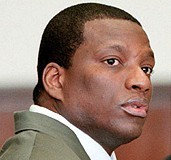
Alfred J. GAYNOR
Classification:
Serial killer
Characteristics:
Rape - Robberies for
drug money
Number of victims: 9
Date of murders: 1995 - 1998
Date
of arrest:April 10,
1998
Date of birth: 1967
Victims profile: Vera E. Hallums, 45 / Amy Smith,
20 / Jill Ann Ermellini, 34 / Robin M. Atkins, 29 / JoAnn C. Thomas,
38 / Yvette Torres, 33 / Loretta Daniels, 38 / Rosemary Downs,
42 / Joyce Dickerson-Peay, 37
Method of murder: Strangulation
Location: Springfield, Massachusetts, USA
Status: Sentenced to life in prison on May 19, 2000
SPRINGFIELD, Mass. (AP) - A serial killer from
western Massachusetts added an eighth murder to his record Tuesday,
admitting that a woman he strangled in 1995 was his first killing.
Alfred Gaynor's guilty plea Tuesday to another
murder places the 43-year-old among the most prolific serial killers
in recent Massachusetts history, according to prosecutors.
Vera Hallums, a 45-year-old mother of four, was
tied with electrical cords, beaten and strangled in her Springfield
apartment in April 1995. She was the first of several women killed in
Springfield over the next few years, many of whom met Gaynor in their
mutual quest for crack cocaine.
Prosecutors and police say he robbed other women
for drug money, raped most of his victims and often posed their bodies
grotesquely to shock whoever found them. In several cases, they were
discovered by the victims' young children.
Gaynor was convicted in 2000 of four murders. He
pleaded guilty last month to three more.
The details he gave prosecutors about the killings
left some victims' family members in tears.
"That's all I have left to give, is the truth,"
Gaynor said Tuesday in court as he was sentenced to an eighth life
term. "Without my truth, they have nothing."
Oletha Wells, 40, one of Hallums' daughters, called
her mother's death and the aftermath, including Gaynor's confession
about the details, "nothing but a nightmare."
"If anything, it made things worse," Wells said
Tuesday. "We really don't have any understanding of why he did it. ...
This is not nowhere near closure."
Gaynor's new admissions come as part of a plea deal
for his nephew.
The nephew, Paul Fickling, is serving time on a
manslaughter conviction - reduced from a murder charge - for his role
in the 1996 deaths of his ex-girlfriend, Amy Smith, and her toddler,
who was left to die alone with her mother's body in their sweltering
apartment.
Gaynor has confessed to killing Smith, but he has
not been indicted in that case.
Police and Assistant District Attorney Carmen
Picknally said Tuesday they cannot comment on the status of the case,
though District Attorney William Bennett said last month they expect
to be "taking further action" on it.
Picknally said Gaynor's eight convictions are the
most murders known to be committed by one person in Springfield
history, and among the most they know of statewide.
"It's a sad occasion for the family to have to
relive the torment of 15 years ago," he said Tuesday. "However, we
felt it's important that the lives of these women be vindicated by the
harshest sentence that the commonwealth allows to be applied in each
of their cases."
Gaynor was convicted in 2000 for the murders of
JoAnn Thomas, Loretta Daniels, Rosemary Downs and Joyce Dickerson-Peay.
In addition to Hallums, this fall's guilty pleas came in the murders
of Yvette Torres, Jill Ermellini and Robin Atkins.
Serial killer Alfred Gaynor
pleads guilty to three new murder charges
By Buffy Spencer - The Republican
October 26, 2010
SPRINGFIELD – For more than a decade
only Alfred J. Gaynor knew what horrors the last moments of life held
for Jill Ann Ermellini, Yvette Torres and Robin Atkins.
Now their families know what happened to the three
Springfield women – all made vulnerable to Gaynor’s homicidal actions
by addiction to crack – in those final, terror-filled moments.
On Tuesday Gaynor admitted raping and killing the
three women in 1997, and family members of Torres and Ermellini heard
a prosecutor relate details that Gaynor told investigators in his
confession two weeks ago.
Hampden district attorney William M. Bennett said
the guilty pleas attested to skill and determination of investigators
assigned to the Gaynor case since the mid-1990s.
The hearing Tuesday also offered a glimpse of the
“havoc he’s caused, the lives he’s destroyed."
“It’s really an unbelievable situation,” Bennett
added. “I doubt there’s ever been a defendant like Alfred Gaynor in
the history of the commonwealth.”
Hampden Superior Court Judge Peter A. Velis
sentenced Gaynor to concurrent life terms without the possibility of
parole for the rape and murders of Atkins, Ermellini and Torres.
Gaynor confessed to the murders of the three as
well as of Vera Hallums several weeks ago during plea-bargaining in a
related case involving his nephew. First-degree murder convictions
carry no possibility of parole.
Gaynor’s guilty pleas will gain him no more time in
prison; he’s already serving consecutive life terms for the slayings
of four other women who a jury convicted him of killing in 2000.
Gaynor initially entered an innocent plea as a
formality Tuesday to Hallums April 1995 murder. He confessed to her
murder two weeks ago and is expected to plead guilty later to the
murder. He is scheduled to be brought back to court Nov. 23 to deal
with that case.
Assistant District Attorney Carmen W. Picknally
related the facts of each death. Then Velis asked Gaynor, represented
by lawyer Peter L. Ettenberg, if he did those things, and in each case
Gaynor said he did.
Picknally said that on June 16, 1997, Ermellini’s
body was found inside an abandoned truck at 406 Oak St. in Indian
Orchard.
The body was badly decomposed, her clothing had
been removed, cocaine was found in her system. Because of the state of
the body, the cause of death was undetermined, Picknally said.
Picknally said Gaynor said he was walking home from
work.
“Jill Ermellini was a passenger in a car driven by
a man,” Picknally said. The driver asked Gaynor if he knew where to
get cocaine and the three went to do cocaine.
“At that point Mr. Gaynor and Ms. Ermellini decided
to get some cigarettes. They went to the store and Ms. Ermellini went
in to get cigarettes and Mr. Gaynor picked up two white stones from
the ground that looked like cocaine,” Picknally said.
She came out of the store, Gaynor showed her the
stones and they went to the abandoned vehicle to use the crack.
Ermellini discovered Gaynor didn’t have crack.
“Mr. Gaynor then proposed they have sex, she
refused, she attempted to leave the truck,” he said. “He choked her
until she passed out,” Picknally said, saying that Ermellini “tried a
variety of methods to stop him.”
“He removed her clothes, raped her and choked her
to death,” Picknally said.
On Nov. 15, 1997, at about 6:30 a.m. police were
called to Yvette Torres’ Indian Orchard home where she was found dead
on the bathroom floor wearing only a shirt.
“She had been found in the bathroom floor that
morning by her 11-year-old son,” he said. When Torres was found she
had some bruising on her chin and lip.
She had a large amount of cocaine in her system and
the medical examiner listed the cause of death as undetermined and the
manner of death as acute cocaine intoxication.
Gaynor now admits to choking and raping Torres,
leaving her dead in the bathroom and stealing a video cassette
recorder and other items from her apartment to trade for crack.
In the case of the third victim, Picknally said
that no relatives of Robin Atkins were in court Tuesday, but that was
because they were grieving privately.
“It is not a sign of a lack of affection, it is not
a sign that their grief is not deep,” he said.
Picknally said that Atkins, who had a high level of
cocaine in her system, found dead on Oct. 25, 1997, in an alley next
to 19 Spring St.
“Her lower body was not covered except for a sock
on one foot. The other sock was used as a gag and tied in a knot
behind her head,” he said.
Her hands were bound behind her back with the laces
of one of her boots.
A wad of compressed paper was found in her mouth
extending down to her epiglottis. Abrasions were found on her face and
neck and bruises were found on her knees.
Gaynor told investigators two weeks ago that he was
looking for crack and had bumped into Atkins with another male and all
three looked for crack, bought some, used it and separated.
“Mr. Gaynor ran into Ms. Atkins a while later that
evening. He told her he had more crack. They went down into an alley
to use crack. When she learned he had none she turned to leave,”
Picknally said.
He choked her from behind and wanted to rape her,
Picknally said. She was choked unconscious. He tied her hands. “He
also recalls shoving a sock in her mouth,” Picknally said. Gaynor then
raped Atkins, then took money from her purse and used it to pay for a
bus ride home.
Gaynor is expected to be indicted in the 1996
deaths of Amy Smith and her 22-month-old daughter, Destiny. Smith,
beaten and choked, died of asphyxiation in her Dwight Street Extension
apartment in June 1996, and her daughter died of starvation and
dehydration before anyone discovered her mother’s body.
It was the prosecution of Gaynor’s nephew, Paul L.
Fickling, which precipitated the plea negotiations that resulted in
Gaynor’s new admissions.
Bennett said indictments will be sought in the
Smith case once the murders of the Hallums, Atkins, Ermellini and
Torres are addressed.
Gaynor in 2008 provided a jailhouse confession that
led to the granting of a new trial for Fickling. Fickling last week,
on the eve of a new trial, pleaded to reduced charges of manslaughter
in the deaths of Smith and her daughter.
Fickling had been convicted by a jury in 1998 of
first-degree murder in the deaths of the mother and child, but sought
a new trial on the basis of Gaynor’s confession that he had acted
alone.
Bennett said earlier that Fickling hit Smith, put
her in a headlock and squeezed her neck.
Gaynor bound the woman’s hands, shoved a sock in
her mouth and left her body in a closet, according to the district
attorney.
Fickling, who, like his uncle, had been serving a
life sentence, was sentenced to a 19- to 20-year state prison term, of
which he has already served 14.
Gaynor was convicted at trial in 2000 for the
murders of JoAnn C. Thomas, Loretta Daniels, Rosemary A. Downs and
Joyce L. Dickerson-Peay.
Gaynor has now admitted he is responsible for the
deaths of nine woman and one child, although he has not formally
pleaded guilty to all.
In a December 2008 interview with Bennett and a
city detective and in a Sept. 2009 court hearing, Gaynor described
himself in various ways.
He said he was sorry for what he did, and that his
actions in raping and killing five women (those killing for which he
had taken responsibility at that time) were spurred by an addiction to
crack cocaine and alcohol.
He said, “I know it’s hard to understand but I
truly am a good person.”
He said that he did not want to admit to his guilt
in any murders because he didn’t want to hurt his mother who died in
2006.
“I just couldn’t destroy everything she believed
in,” he said.
“Nothing was going to separate me from my drugs,”
Gaynor said. For an addict, he said, “Crack cocaine is your first and
last love.”
At a Sept. 2009 hearing on Fickling’s motion for a
new trial Gaynor said he took so long to admit he killed Amy Smith and
others because, “I was embarrassed and I didn’t want it to appear that
I was a monster, but I came to conclusions that I am."
Springfield serial killer Alfred
Gaynor admits killing total of 9 women
By Buffy Spencer - The Republican
October 18, 2010
SPRINGFIELD - Serial killer Alfred J. Gaynor now
admits that his first murder was the killing of Vera E. Hallums in
April 1995.
By the time he was arrested three years later, he
had killed eight other women, and the toddler daughter of one of his
victims had been left with her mother’s body to die of starvation and
dehydration in the family’s South End apartment.
Gaynor’s admissions were made public on Monday by
Hampden District Attorney William M. Bennett, confirming long-held
suspicions by law enforcement that Gaynor was the man responsible for
a lengthy string of murders that terrorized the city in the mid-1990s.
Though he was convicted in 2000 for four of the slayings, Gaynor went
off to prison proclaiming, “I’m innocent.”
Bennett announced Gaynor’s admissions during a
hearing in Hampden Superior Court at which the killer’s nephew, Paul
L. Fickling, pleaded guilty to reduced charges of manslaughter for the
1996 deaths of Amy Smith and her daughter, Destiny Smith.
“We hope that solving these cases will bring some
dignity to the deaths and that that will be comfort to the families,”
Bennett said.
Fickling admitted he was with his uncle when Amy
Smith, his one-time girlfriend, was killed; his pleas came as he was
on the verge of facing a new trial because of Gaynor’s 2008 jailhouse
confession to killing Smith. Gaynor claimed in that confession that he
had been alone and Fickling was not involved, and it served as the
basis for setting aside Fickling’s 1998 jury conviction on murder
charges.
Gaynor’s admissions to the additional homicides
were part of the plea-bargaining agreement which resulted in Fickling
receiving a 19- to 20-year state prison term, the district attorney
told Judge C. Brian McDonald. Fickling has served 14 years of the
sentence.
Fickling had been convicted at trial in 1997 in
part on the basis of a statement he gave police at the time of his
arrest, and Bennett told The Republican, “If Fickling had been
completely truthful with police I am quite confident Gaynor would have
been arrested and locked up at that time.” Seven of the victims were
killed after Amy Smith’s death.
Bennett said he now plans to present evidence to a
grand jury to seek indictments for Gaynor on murder charges for the
deaths of Smith and her child as well as four other women, including
Vera E. Hallums, Jill Ann Ermellini, Robin M. Atkins and Yvette
Torres, all of whom were killed between April 1995 and November 1997.
Gaynor is serving consecutive life sentences in
state prison for the murders of JoAnn C. Thomas, Loretta Daniels,
Rosemary A. Downs and Joyce L. Dickerson-Peay.
In a September 2009 hearing in the Fickling case,
Gaynor told a judge he now sees himself as a “monster” and has said
that everything evil that he did was fueled by his addiction to
cocaine and crack.
Bennett said that aside from the deaths of Amy and
Destiny Smith, since Amy Smith was not a drug user, the connection the
other eight women may have had to Gaynor was crack cocaine.
“There are those who say that drug crimes are non-violent,”
Bennett said. “This is a good illustration that drugs are very violent.
Many lives, neighborhoods and communities have been destroyed because
of drugs. People commit crimes while using drugs.”
Fickling’s lawyer, Joseph A. Franco, appointed
recently for the plea negotiations, said Fickling grew up in the same
house as Gaynor and was always frightened of his uncle, who was
abusive to him. Even during Fickling’s first trial, Gaynor was in the
halls or courtroom, and Fickling feared him, Franco said.
Fickling initially told police he was at the
apartment and choked Smith, but he said another man was with him and
that man stayed in the apartment after he left. Fickling gave police a
name, but that man was never charged and found not to be there that
night.
Bennett said the prosecution moved forward with the
plea agreement because his office could not be sure of the result from
a jury if they proceeded with a new trial.
Fickling’s long-time defense lawyer Greg T.
Schubert in December 2008 sought the new trial based on Gaynor’s
confession. During recent DNA testing in preparation for the new trial,
it was found that Fickling was not the child’s father, although he
thought he was the father of Destiny Smith.
Bennett provided McDonald with details of the Smith
deaths, telling him that police, dispatched to the woman’s apartment
at 280 Dwight St. Extension on July 11, 1996, found the body of the
child on a mattress on the living room when they first arrived.
Destiny Smith was believed to have been dead for several days, the
district attorney said. The body of the child’s mother, believed dead
for about a week, was found in a closet.
Fickling, who was then 19, admitted he went to the
apartment with Gaynor, then 29. “While they were there, (Fickling)
argued with Smith, got angry, struck her, placed her in a headlock,
squeezed her neck for approximately two to three minutes,” Bennett
said.
Bennett said Fickling stated it was Gaynor who tied
Smith’s hands, placed her in a closet and put a sock in her mouth.
Bennett said Smith died as a result of asphyxiation either by the
chokehold, the sock or a combination of both.
“Knowing that Amy Smith was dead the defendant ran
out of the apartment, and, after a while Gaynor followed. Destiny
Smith was left in the apartment alone with her mother, and incapable
of caring for herself,” Bennett said.
Gaynor, in his confession, said Smith was alive
when he raped her and he then choked her to death so she would not
identify him.
Bennett, who has said over the past few years he
doubted the veracity of Gaynor’s confession to killing Amy Smith, said
Monday that a number of detectives have spoken with Gaynor over the
last two years and they were convinced that Gaynor was involved in Amy
Smith’s death.
“It’s reasonable to assume Mr. Gaynor played a
significant role in what happened,” the district attorney said.
Bennett said DNA on a hair on the sock put in Amy Smith’s mouth was
consistent with Gaynor’s DNA.
“Based on all that, your honor, the commonwealth
has a different perception of Mr. Fickling’s role in the events today
than it did back in 1996, and we’ve taken that into consideration in
making our recommendation today,” Bennett said.
Members of Smith’s family were present for the plea
hearing, and Bennett said they still believe the jury’s verdicts from
the trial were the correct outcome for the case and are upset “that
that has not been maintained.”
“The family did not know Mr. Gaynor so that when
his name came up in this they were completely surprised,” Bennett said.
“They did know Mr. Fickling, and they knew about his relationship with
Amy Smith, and so for 14 years the focus on the family had been on Mr.
Fickling, and now to have Mr. Gaynor part of the situation is a very
difficult proposition for them to come to grips with,” he said.
Bennett said he knows of no connection between
Gaynor and a number of other unsolved homicides of Springfield women
found dead between 1990 and Alfred J. Gaynor’s arrest on April 8,
1998. The women are Shana R. Price, 17, of 73 Dartmouth St., found
strangled, beaten and sexually assaulted at Blunt Park on Dec. 26,
1990; Myrtle Marrett, 90, found beaten Jan. 20, 1991, in her Union
Street apartment; Lisa DiSilva, 21, found strangled in her apartment
at 26 Tracy St. on April 1, 1991; Corine L. Lee, 32, found strangled
in a downtown location on May 25, 1992; and Celestina Perez, 24, found
strangled and beaten June 2, 1995, in Gurdon Bill Park.
Details of Gaynor’s murders
Here are the women who Alfred J.
Gaynor was convicted by a jury of killing and those who he has
confessed to killing:
Vera E. Hallums: 45, found tied, beaten and
strangled in her apartment at 31 Leland Drive on April 20, 1995.
Amy Smith: 20, thought to have been dead for
a week when she was found her in apartment at 280 Dwight St. Extension
on July 11, 1996; her 22-month-old daughter, left with her mother’s
body, died of starvation and dehydration.
Jill Ann Ermellini: 34, found June 16, 1997,
in the cab of a truck in an Indian Orchard auto body yard.
Robin M. Atkins: 29, found strangled, bound
and gagged in a downtown alley on Oct. 25, 1997.
JoAnn C. Thomas: 38, found in her 866
Worthington St. home on Nov. 1, 1997.
Yvette Torres: 33, her partially clothed
body was found propped against the bathroom door of her Healy Street
apartment on Nov. 15, 1997.
Loretta Daniels: 38, found in an alley
beside the Mason Square post office on Feb. 2, 1998.
Rosemary Downs: 42, found in her 5 Lionel
Benoit Road home on Feb. 11, 1998.
Joyce Dickerson-Peay: 37, found March 11,
1998, outside an empty restaurant on East Columbus Avenue.
Source: Office of
Hampden District Attorney William M. Benne
Convicted killer's art offered for sale on the Internet
November 14, 2005
Springfield, Mass. (AP) — The Hampden district
attorney is furious that a man convicted of raping, strangling and
killing four women in the Springfield area in the late 1990s is
being allowed to offer his art work for sale on the Internet.
"Will they be showing pictures of the women he
murdered at the same time?" Hampden District Attorney William
Bennett said.
Alfred J. Gaynor's crayon drawing depicts Jesus
kneeling against a rock in prayer with a cactus and mountains in the
background.
Bidding on the drawing, entitled "A Righteous
Man's Reward," will start at $15 on Monday at a Web site of an
advocacy group for prisoners.
State laws do not prohibit criminals from
profiting from their notoriety.
Gaynor, 38, was convicted in 2000 of killing
JoAnn Thomas, 38; Loretta Daniels, 38; Rosemary Downs, 42; and Joyce
Dickerson-Peay, 37. He is serving four consecutive life sentences at
the state's maximum security Souza-Baranowski Correctional Center in
Shirley.
"The deaths created a great deal of fear in our
community," Bennett told the Boston Herald.
Gaynor's artwork is one of 287 pieces of work for
sale and could even be one of 130 selected for a show called "Insider
Art: The New Outsider Art" in December at a Manhattan gallery.
The president of the Fortune Society defended the
sale of the drawing and other inmate art.
"We believe strongly that in addition to the
punishment, there should be rehabilitation," said JoAnn Page.
People who view the artwork online or at the
gallery will not be told of the crimes the artists committed.
"We don't want to look at the worst thing a
person ever did as being their whole self," said show organizer and
Chelmsford resident Kristen Kidder. "We never know, for the most
part, what these people have done unless they choose to share it.
They're just so happy to have the opportunity to express themselves
in another way. It shows their humanity."
There is no formal art program at Souza-Baranowski,
but Gaynor is allowed to draw in his cell using approved art
supplies he pays for himself, said state Correction Department
spokeswoman Diane Wiffin.
There is also no chance he will receive a
furlough if his work is selected for the Manhattan show, she said.
There have been no furloughs from Souza-Baranowski since 1995, she
said.
Selling and buying inmate art is not a good idea,
said John Kelly of New Jersey-based Stalk Inc., a serial killer
profiling service.
"By reinforcing their fame by buying whatever
they are selling, it's sending the wrong message to society," he
said.
Gaynor's bid for a new trial was denied by the
Supreme Judicial Court earlier this year. His lawyers appealed on
several grounds, including a judge's denial of defense motions to
suppress evidence, and the decision to hold a single trial for all
four murders.
The defense also appealed the decision to try
Gaynor, who is black, before an all-white jury in Berkshire County.
The defense sought to have the case moved to Boston, which has a
larger minority population. All of Gaynor's victims were also black.
New
trial for serial killer rejected
2005_01_12
The state's highest court yesterday upheld the conviction of a
serial killer in Springfield, dismissing key defense arguments that
police used trickery in obtaining evidence and that it was wrong to
join the cases at trial.
In
a 42-page decision written by Associate Justice Francis X. Spina,
the state Supreme Judicial Court refused to order a new trial for
Alfred J. Gaynor, who is serving four consecutive life sentences.
Gaynor, 37, was convicted in 2000 of raping and killing four
Springfield women in 1997 and 1998 in the city.
The court also rejected Gaynor's request to reduce the verdicts.
Hampden District Attorney William M. Bennett yesterday praised the
work of Springfield police and Assistant District Attorney Marcia B.
Julian, who argued the case in front of the high court on Oct. 7.
"DNA was a key," Bennett said yesterday. "We did every DNA test
available ... The results all came up the same way: Gaynor ... Once
we got his sample, we couldn't exclude him."
Gaynor was found guilty of killing JoAnn Thomas, Loretta Daniels,
Rosemary Downs and Joyce Dickerson-Peay between Nov. 1, 1997 and
early 1998.
Gaynor's lawyer argued that Springfield Sgt. Mark Rolland and
Detective Eugene Dean fooled Gaynor into voluntarily giving a blood
sample that provided the DNA. The sample was later used to build a
genetic profile that connected Gaynor to all four murders.
Gaynor said he provided the sample on Feb. 27, 1998 without a search
warrant because police misled him into believing that the test
results would be used only to compare with blood found inside the
fourth murder victim's car. Police later told Gaynor that his blood
did not match the blood in the car.
But Spina ruled that police never stated that Gaynor's blood would
be used solely for comparison to the blood in the car. Police do not
have to tell a defendant all the purposes for extracting blood,
Spina wrote.
Gaynor's lawyer on appeal, Kenneth J. King of Boston, said yesterday
he was disappointed by the decision, but couldn't comment in detail.
King said he needed more time to read the ruling.
On
appeal, King said the trial judge, Daniel A. Ford, erred in joining
the four murder and rape charges at a single trial. King said the
cases shared common features, but did not constitute parts of a
single scheme or plan.
Bennett said it was the first and only time serial murders were
joined for a single trial in a state court. Bennett was the trial
lawyer for the cases and moved for the lone trial.
Spina said the circumstances of the cases don't need to be identical
for one trial.
"Here, powerful DNA and other evidence linked the defendant to the
victims at the times of death," Spina wrote. "The judge correctly
concluded that the circumstances of the cases were sufficiently
similar to show that the defendant was acting pursuant to a common
scheme and were relevant to questions of his intent and motive."
During the Oct. 7 hearing in front of the high court, Julian said
DNA evidence connected Gaynor to all four murders.
Julian also cited some factual similarities in the murders. Each
victim was black, in her 30s and connected to Gaynor through the use
of crack cocaine. Three of the victims were strangled to death, she
said. A fourth victim was found with a sock in her mouth and was
ruled to have choked to death, though evidence indicated she was
also strangled, Julian said.
Spina also rejected Gaynor's claim that the trial judge made a
mistake in failing to select jurors from a "fair cross section" of
the community where the crimes occurred.
Gaynor, who is black, was convicted by an all-white jury in
Berkshire County after the judge refused his request to move the
trial to Boston to help obtain a racially diverse jury.
The trial judge said it would be more convenient for witnesses and
lawyers to keep the trial in Western Massachusetts. The judge
granted Gaynor's request to move the trial from Hampden County
because of widespread publicity about the murders.
"When a defendant moves for a change of venue, he waives his right
to be tried by a jury drawn from a pool that is representative of
the venue where the crime occurred," Spina wrote. "He has no state
constitutional right to have his case transferred to a county having
a minority population at least as great as the county where the
crime took place."
Convicted serial killer denied a new trial
2005_01_11
A
man convicted of raping and killing four women in a case that spread
fear through the city and set off one of its largest manhunts ever
has lost his bid for a new trial.
The state's Supreme Judicial Court on Tuesday denied an appeal by
Alfred Gaynor, who is serving four consecutive life sentences for
sodomizing and strangling the women over a 3-month period in 1997
and 1998.
Gaynor, 37, of Springfield, was convicted of aggravated rape and
murder. His lawyers appealed on several grounds, including Superior
Court Judge Daniel Ford's denial of defense motions to suppress
evidence, and the decision to hold a single trial for all four
murders.
The defense also appealed the decision to try Gaynor, who is black,
before an all-white jury in Berkshire County. The defense had sought
to have the case moved to Boston, which has a larger minority
population. All of Gaynor's victims were also black.
However, Justice Francis X. Spina wrote in the decision that "when
a defendant moves for a change of venue, he waives his right to be
tried by a jury drawn from a pool that is representative of the
venue where the crime was committed.''
He also pointed out that Ford had considered racial issues and found
"no allegation that race was a motivating factor in any of these
crimes and no reason to suppose the case is racially charged.''
The justices also found that the similarities among the killings and
DNA evidence indicating the victims had died shortly after having
intercourse with Gaynor warranted a single trial.
They also rejected arguments by Gaynor's lawyer, Kenneth King, that
Gaynor had been tricked into providing police with blood samples for
DNA tests. Gaynor said detectives had led him to believe his DNA
would only be compared to that found at the scene of one of the
killings.
Police are under no obligation to inform a defendant of all purposes
for which his blood tests might be used,'' Spina said.
King did not immediately return a call seeking comment. Hampden
District Attorney William Bennett, who prosecuted Gaynor, also did
not return a call for comment.
The victims were Loretta Daniels, JoAnn Thomas, Joyce Dickerson, and
Rosemary Downs.
The first to be killed was Thomas, 38, who was found strangled on
her living room couch on Nov. 1, 1997.
The partially clad body of Daniels, 38, was found in an alley beside
a post office on Feb. 2, 1998. Downs, 42, was found naked and dead
in the bedroom of her downtown Springfield apartment on Feb. 11,
1998, and Dickerson's frozen body was found March 11, 1998, near a
vacant restaurant in downtown Springfield, three weeks after the
37-year-old mother of two disappeared from her home.
Alfred Gaynor
used to have a specialty: He sodomized women and then strangled them
to death.
Gaynor was convicted of the rape
and murder of four women in Springfield, Massachusetts. The crimes
occurred during a three-month killing spree in 1997-1998 that
terrified the town. He is serving four consecutive life sentences.
No longer able to pursue his main
interests, Gaynor is now producing craptacular prison drawings like
this absurd crayon/pencil rendering of a one-legged cartoon Jesus
apparently visiting Arizona.
An inmate advocate group called
the Fortune Society has chosen Gaynor's masterwork for its upcoming
prison-art show and auction, which takes place online beginning Nov.
15.
The sex murderer's art may also
hit the big time in New York, the Boston Herald reports:
A Massachusetts
serial sex slayer's crayon drawing of Jesus will be auctioned online
starting tomorrow and could reap the cultured killer a handsome
windfall while he awaits word on whether he'll be showcased in a
Manhattan art show next month.
"Will they be showing pictures of
the women he murdered at the same time?" an angry Hampden District
Attorney William Bennett asked on behalf of Alfred J. Gaynor’s
victims: JoAnn Thomas, Loretta Daniels, Rosemary Downs and Joyce
Dickerson-Peay.
Massachusetts Man Convicted of 4 Murders
May 20, 2000 - The New York Times
A handyman and auto body
repairman was convicted of four counts of
murders today and sentenced to four life
terms without parole.
The handyman, Alfred
Gaynor, had been accused of the rape and
killing of four Springfield women from
November 1997 to February 1998.
The prosecution said Mr.
Gaynor offered the victims cocaine, then
sodomized them and choked them to death.
The trial hinged largely
on DNA tests that linked Mr. Gaynor to
physical evidence found on or near the
bodies of the four women.
Mr. Gaynor continued to
deny his guilt after the verdicts, telling a
television news crew from Springfield that
he was innocent just before he was taken
away in a van.