Murderpedia has thousands of hours of work behind it. To keep creating
new content, we kindly appreciate any donation you can give to help
the Murderpedia project stay alive. We have many
plans and enthusiasm
to keep expanding and making Murderpedia a better site, but we really
need your help for this. Thank you very much in advance.
Peter GRIFFITHS
A.K.A.: "The Blackburn baby murderer"
Classification: Murderer
Characteristics: Kidnapping from a hospital - Rape
Number of victims: 1 +
Date of murder:
May 14,
1948
Date
of arrest:August 13,
1948
Date of birth: 1926
Victim profile: June Ann Devaney (female, 4)
Method of murder: Banging her head against a wall
Location: Blackburn,
Lancashire, England, United
Kingdom
Status: Executed by hanging
at Walton Gaol
on November 19, 1948
This case is unique in the fact that it involved the
fingerprinting of the entire adult, male population of Blackburn,
Lancashire. It was 12.45 on 14 May 1948, nurse Humphreys was doing her
rounds of Ward CH3, of Blackburn's Queen's Park Hospital. When she
reached the cot of four-year-old June Ann Devaney she was horrified to
find the child was missing.
Under the cot was a Winchester bottle and on the
highly-polished floor were the impressions of stockinged, adult
footprints. The police were called and a search was made of the building
and grounds. The childs body was discovered about 300 feet away in the
grounds, huddled against a wall. She had been raped and it looked as if
the killer had beaten her head against the wall.
The bottle found under the bed had some clear
fingerprints on it and examination of the footprints showed that they
had been made by the socks of an adult. By 15th June 2,017 people had
been processed and eliminated from the inquiry. It was at this point
that the police decided that the only way they were going to catch this
man would be to widen the search. it was decided to fingerprint the
whole adult, male population of Blackburn.
Going from house to house and using the electoral
register as a guide, the police slowly fingerprinted every male over the
age of 16. This included people who had since left the area or had
travelled abroad.
It was on 12th August that all the hard work finally
paid off. It was fingerprint set number 46,253 and belonged to Peter
Griffiths of Birley Street. He was a 22-year-old packer at a flour-mill.
He was arrested the following night and soon admitted his guilt. He had
once served in the Welsh Guards, was of low intelligence and beleived to
be schizophrenic. On the fatal night he had been out drinking and had
set out to 'get sobered up'. He made no mention about the rape and
killing but said that he picked the girl out of the cot and she had put
her arms around his neck.
Peter Griffiths was charged and tried at Lancaster
Assizes. It took the jury only 23 minutes to return a verdict of guilty
and he was hanged at Walton Gaol on 19th November 1948 by Albert
Pierrepoint.
greggmanning.scstamps.co.uk
A brutal murder begins an unusual investigation
May 14, 1948
History.com
Three-year-old June Devaney, recovering from
pneumonia at Queen's Park Hospital in Blackburn, England, is kidnapped
from her bed. Nurses discovered her missing at 1:20 a.m. the next day,
and police were immediately summoned to investigate. Two hours later,
her body was found with multiple skull fractures. The medical examiner
determined that Devaney had been raped and then swung headfirst into a
wall.
Two significant clues were found in the children's
ward that would prove helpful in catching the killer: footprints on the
freshly cleaned floor and a water bottle that had been moved. Although
there were several fingerprints on the bottle, police were able to
account for all but one set. These prints also failed to match any of
those in the police's database of known criminals.
Investigators fingerprinted over 2,000 people who had
access to the hospital. Still, they couldn't find a match. Detective
Inspector John Capstick then went even further: He decided that every
man in the town of Blackburn, a city with more than 25,000 homes, would
be fingerprinted.
A procedure such as this would be impossible in the
United States where Fourth Amendment protections prevent searches
without probable cause. But the plan went into effect in Blackburn on
May 23, with police assurances that the collected prints would be
destroyed afterward. Two months later, the police had collected over
40,000 sets of prints yet still had not turned up a match. Checking
against every registry they could find, authorities determined that
there were still a few men in town who hadn't provided their prints.
On August 11, police caught up with one of these men,
Peter Griffiths. His footprints matched the ones found at the scene.
When his fingerprints also came back a match, he confessed to the awful
crime, blaming it on alcohol.
Griffiths was found guilty of murder and was executed
on November 19, 1948.
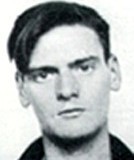
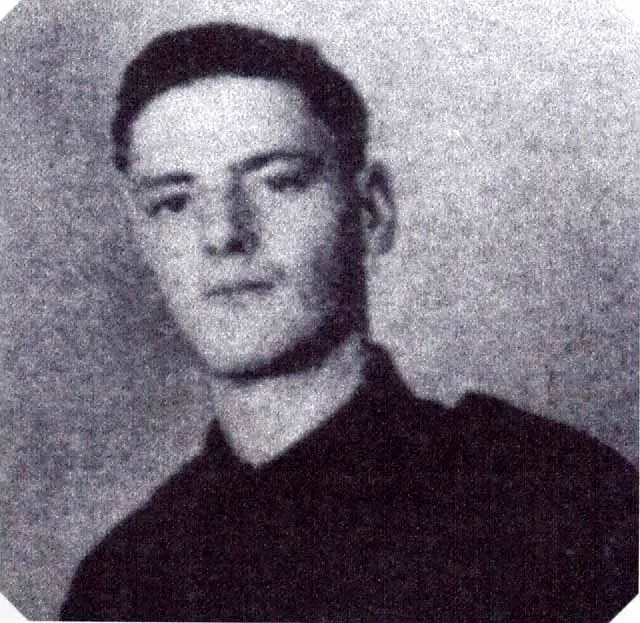
Peter Griffiths
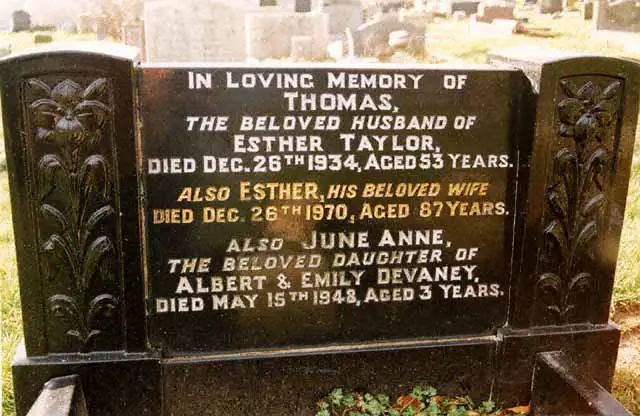
The grave of June Anne Devaney. This is a small black headstone in a
far corner of the cemetery. She was murdered on the 15th May 1948. She
was three years old and murdered in the grounds of Queen's Park
Hospital. A 22-year old ex-Guardsman Peter Griffiths was caught after
46,000 males over the age of 16 were finger printed.