Murderpedia has thousands of hours of work behind it. To keep creating
new content, we kindly appreciate any donation you can give to help
the Murderpedia project stay alive. We have many
plans and enthusiasm
to keep expanding and making Murderpedia a better site, but we really
need your help for this. Thank you very much in advance.
Henry
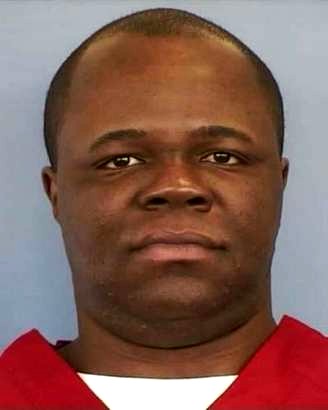
Curtis JACKSON Jr.
Classification: Mass murderer
Characteristics:
Attempt
to steal money kept in his mother’s safe in her home
Number of victims: 4
Date of murders: November 1, 1990
Date of arrest:
4 days after (surrenders)
Date of birth: October 17, 1964
Victims profile: Dominique, 5, Antonio, 3, Shunterica, 2, and Andrew, 2 (his
nieces and nephews)
Method of murder:
Stabbing with knife
Location: Leflore County, Mississippi, USA
Status:
Sentenced to death on September 14, 1991. Executed by lethal
injection in Mississippi on June 5, 2012
The United States Court
of Appeals For the Fifth Circuit
Henry Curtis Jackson murdered four
children, two of his nieces and two of his nephews, in an attempt to
steal money kept in his mother’s safe in her home.
On the evening of November 1, 1990, Jackson’s
mother, Martha, and four of her older grandchildren went to church.
Martha’s daughter, Regina Jackson, stayed home with her two daughters,
five-year-old Dominique whom Jackson murdered that night, two-year-old
Shunterica whom Jackson murdered, and four other of their nieces and
nephews, three-year-old Antonio whom Jackson murdered and two year-old
Andrew whom Jackson murdered, and eleven-year-old Sarah and
one-year-old Andrea who were severely injured during these murders but
survived.
Summary:
Mrs. Jackson and four of her older grandchildren left her home near
Greenwood, Mississippi for church. Her daughter, Regina Jackson,
stayed at home with her two daughters and four other nieces and
nephews. Regina's older brother, Henry Curtis Jackson, arrived,
knocked on the door, and came inside. When Regina asked Jackson what
he wanted, he told her that he had come to get the safe that was kept
in Mrs. Jackson's bedroom closet, and that he came to kill all of them
tonight. When he was finished, four children were stabbed to death,
Regina was stabbed in the neck and seriously injured, and 11 year old
Sarah was also stabbed and survived.
Jackson admitted to the stabbings when arrested by
police He stated that, knowing his mother would be at church, he had
gone to her house to get the safe because he needed more money to pay
his bills. He had brought a kitchen knife with him that was in the car
and when he heard someone in the house, went around the back to cut
the telephone line. After stabbing Regina and the children, he tried
to move the safe and to find a second safe she had mentioned. Noticing
lights at the house across the street, he then climbed out the
bathroom window and fled to his car, which was parked about two blocks
away.
Citations:
Jackson v. State, 684 So.2d 1213 (Miss. 1996). (Direct Appeal) Jackson v. State, 860 So.2d 653 (Miss. 2003). (PCR) Jackson v. Epps, 447 Fed.Appx. 535 (5th Cir. 2011). (Habeas)
Final/Special Meal:
None.
Final Words:
None
ClarkProsecutor.org
Mississippi Department of Corrections (Offender
Data Sheet)
Inmate: HENRY JACKSON
MDOC# 25585
Race: BLACK
Sex: MALE
Date of Birth: 10/17/64
Height: 6' 1"
Weight: 228
Complexion: DARK
Build: LARGE
Eye Color: BROWN
Hair Color: BLACK
Entry Date: 11/27/90
Mississippi Department of Corrections (Media
Kit)
Factual Background of the Case
On March 12, 1991, Henry Curtis Jackson, Jr. was
indicted by a grand jury of the Leflore County Circuit Court in
connection with the November 1, 1990 stabbing deaths of his four young
nieces and nephews and aggravated assaults upon his sister and another
niece while he was in search of money kept in a safe in his mother's
home near Greenwood, Mississippi.
Jackson’s seven indictments were: four counts of
capital murder, two counts of aggravated assault and one count of
armed robbery. Under Counts 1 through 4, Jackson was charged with the
deaths of two-year-old Shunterica Lonnett Jackson, five-year-old
Dominique Devro Jackson, three-year-old Antonio Terrell Jackson and
two-year-old Andrew Odutola Kuyoro, Jr. In each count, he was charged
with killing while engaged in the commission of the crime of felonious
abuse and/or battery of a child. Counts 5 and 6 charged Jackson with
the armed robbery of Regina Jackson and with "unlawfully, willfully,
feloniously and purposely causing bodily injury to Regina Jackson, a
human being, by stabbing said Regina Jackson with a deadly weapon, to
wit: a knife." Under Count 7, Jackson likewise was charged with the
stabbing of Sarah Denise Jackson. After a change of venue to Copiah
County, a jury found him guilty on all counts and sentenced him to
death for each of the four capital murder charges; thirty years in the
custody of the Mississippi Department of Cor-rections for each of the
two counts of aggravated assault; and twenty years in the custody of
the MDOC on one count of armed robbery.
Facts of the Case:
Mrs. Jackson and four of her older grandchildren
left her home in the Rising Sun community, south of Greenwood,
Mississippi, for church at the Sweet Home Church of God in Christ at
around 7:00 p.m. on November 1, 1990. Her daughter, Regina Jackson,
stayed at home with her two daughters, five-year old Dominique and
two-year old Shunterica, and four nieces and nephews, eleven-year old
Sarah, three-year old Antonio, two-year old Andrew and one-year old
Andrea. While they were watching an hour-long Cosby Show special on
television, Regina's older brother, Henry Curtis Jackson, known to the
family as "Curtis," knocked on the door and came inside. He asked
Regina for a cigarette and then ran to the bathroom, ask-ing her to
fix him something for an upset stomach. Sarah recalled that Jackson
asked if her Uncles Greg or Johnny were coming over and then put a
glove over his hand and wiped clean the knob of the living room door.
When Regina asked Jackson what he wanted, he told
her that he had come to get the safe that was kept in Mrs. Jackson's
bedroom closet. Regina testified that he really wanted the combination
but my niece, Sarah, kept telling him to get the safe and go ahead. He
said, naw, cause he came to kill us that Thursday and didn't kill us
and he came to kill us that Saturday and he didn't kill us and he said
he was going to kill all of us tonight. He then took Regina into a
room and tried to open the footlocker where he had been told the
combination was kept. At that point, Regina testified, he began
stabbing Sarah in the neck and took them into the little boys' room
where he told them to let him tie them up. Regina, who had already
been stabbed several times, picked up some iron rods that Jackson had
brought in from the bathroom and started hitting him with them. He
then picked up the baby, Andrea, and used her as a shield. Regina
re-linquished the rods and let him tie her up with a belt. He stabbed
her again in the neck. While she watched, he picked up her daughter,
two-year old Shunterica, by the hair, stabbed her and laid her on one
of the beds. Jackson started dragging the safe down the hall, which
awakened fiveyear old Dominique. She came down the hall, calling for
her mother, at which time, Regina testified, Jackson told her that he
loved her, stabbed her and threw her on the floor. He walked over to
Regina and again "drilled the knife" in her neck. Regina pretended she
was dead until she heard him go into the bathroom and out the window.
In his statement given to police, Jackson stated
that he began stabbing Regina in the side while they were arguing.
After that, referring to Sarah and the children, he said, "they all
was coming at me and I just was stabbing." Elaborating, he stated:
After I stabbed Regina, she kept coming and Sarah came in and I
couldn't see her from the back. I know I stabbed her back there and
they both got in front of me. I don't know if I stabbed her, but I was
hitting back. Regina had a rod or something on hand, I guess up to the
window or something. I know I seen her reach up to the window and pull
something out. Regina was fighting at me with the rod. I . .. Yeah, it
was a rod, an iron rod. I was stabbing at her. Sarah was at the back.
Her and the other little kids were hollering and --- I guess they
thought me and Regina was just into it, at first. She was hitting me
with something. I don't know what Sarah had. He had no specific
recollec-tion of stabbing the children.
Angelo Maurice Geens, Mrs. Jackson's cousin and
neighbor, returned to his home at about 8:30 p.m. that night. Sarah
ran to him from the bushes where she had been hiding and told him that
Regina and the oth-ers were in the house; her uncle had killed them.
Geens carried her into his mother's house and called the police and an
ambulance. Deputy Sheriff J.B. Henry and Deputies Tindall, Berdin and
Fondren arrived at the scene and discovered the children's bodies.
Meanwhile, Jackson had become the subject of an extensive manhunt.
While still at the Jackson residence, Deputy Sheriff Tindall received
a call from the Highway Patrol regarding a wrecked car in Eupora just
fifty yards from the site where the Eupora Police Department had been
conducting a routine license check. The 1977 green Monte Carlo bore a
license tag registered to Martha Jackson's 1973 brown Ford station
wagon. A wallet containing Jackson's identification was found on the
front console and his own license tag as well as a long, dark trench
coat were found in the trunk of the vehicle.
Jackson had abandoned his car when he saw the
roadblock and taken off on foot through the woods. Eluding canine
search teams, he jumped a train from Eupora to West Point. On November
5, 1990, he turned himself in to the West Point Police Department. At
that time, Jackson gave a statement to Leflore County Sheriff Ricky
Banks, who had been summoned to West Point. He stated that, knowing
his mother would be at church, he had gone to her house to get the
safe because he needed more money to pay his bills. He had brought a
kitchen knife with him that was in the car and when he heard someone
in the house, went around the back to cut the telephone line. After
stabbing Regina and the children, he tried to move the safe and to
find a second safe she had mentioned. Noticing lights at the house
across the street, he then climbed out the bathroom window and fled to
his car, which was parked about two blocks away at Rising Sun High
School.
Jackson was arraigned on April 29, 1991. He entered
pleas of not guilty on all seven counts of the indict-ment. On August
29, 1991, the circuit court entered an order changing venue to Copiah
County and set-ting the trial for September 9, 1991. A jury trial then
was held in the Copiah County Circuit Court. The jury found Jackson
guilty on all seven counts and sentenced him to death on each of the
four capital murder counts.
Execution by Lethal Injection
In 1998, the Mississippi Legislature amended
Section 99-19-51, Mississippi Code of 1972, as follows: 99-19-51. The
manner of inflicting the punishment of death shall be by continuous
intravenous administration of a lethal quantity of an ultra
short-acting barbiturate or other similar drug in combination with a
chemical para-lytic agent until death is pronounced by the county
coroner where the execution takes place or by a licensed physician
according to accepted standards of medical practice.
Mississippi Death Row Demographics
Youngest on Death Row: Terry Pitchford, MDOC
#117778, age 26
Oldest on Death Row: Richard Jordan, MDOC #30990, age 65
Longest serving Death Row inmate: Richard Jordan, MDOC #30990 (March
2, 1977: Thirty-Four Years)
Total Inmates on Death Row = 55
MALE:53
FEMALE: 2
WHITE:23
BLACK: 31
ASIAN: 1
Mississippi State Penitentiary
The Mississippi State Penitentiary (MSP) is
Mississippi’s oldest of the state’s three institutions and is located
on approximately 18,000 acres in Parchman, Miss., in Sunflower County.
In 1900, the Mississippi Legislature appropriated $80,000 for the
purchase of 3,789 acres known as the Parch-man Plantation. The
Superintendent of the Mississippi State Penitentiary and Deputy
Commissioner of Institutions is E.L. Sparkman. There are approximately
868 employees at MSP. MSP is divided into two areas: AREA WARDEN UNITS
Area I - Warden Earnest Lee Unit 29 Area II - Warden Timothy Morris
Units 25, 26, 28, 30, 31, and 42 The total bed capacity at MSP is
currently 4,648. The smallest unit, Unit 42, houses 56 inmates and is
the institution’s hospital. The largest unit, Unit 29, houses 1,561
minimum, medium, close-custody and Death Row inmates. MSP houses male
offenders classified to all custody levels and Long Term Segregation
and death row. All male offenders sentenced to death are housed at
MSP. All female offenders sentenced to death are housed at the Central
Mississippi Correctional Facility in Pearl, Miss. The majority of the
farming activity involving Agricultural Enterprises takes place at
MSP. Programs offered at MSP include alcohol and drug treatment, adult
basic education, inmate legal assistance, pre-release, therapeutic
recreation, religious/faith programs and vocational skills training.
Mississippi Prison Industries operates a work program at the MSP and
utilizes more than 296,400 inmate man-hours in its textile, metal
fabrication and wood working shops. On a monthly average, 190 inmates
work in these shops.
Lethal injection is the world’s newest method of
execution. While the concept of lethal injection was first pro-posed
in 1888, it was not until 1977 that Oklahoma became the first state to
adopt lethal-injection legislation. Five years later in 1982, Texas
performed the first execution by lethal injection. Lethal injection
has quickly be-come the most common method of execution in the United
States. Thirty-five of thirty-six states that have a death penalty use
lethal injection as the primary form of execution. The U.S. federal
government and U.S. mili-tary also use lethal injection. According to
data from the U.S. Department of Justice, 41 of 42 people executed in
the United States in 2007 died by lethal injection.
While lethal injection initially gained popularity
as a more humane form of execution, in recent years there has been
increasing opposition to lethal injection with opponents arguing that
instead of being humane it results in an extremely painful death for
the inmate. In September 2007 the United States Supreme Court agreed
to hear the case of Baze v. Rees to determine whether or not
Kentucky’s three drug-protocol for lethal injections amounts to cruel
and unusual punishment in violation of the Eighth Amendment to the
United State Constitution. As a result of the Supreme Court’s decision
to hear this case, executions in the United States came to a brief
halt in late September 2007. On April 16, 2008, the Supreme Court
ruled in Baze holding that Kentucky’s three-drug protocol for
administering lethal injections does not violate the Eighth Amendment.
The result of this ruling was to lift the de facto moratorium on
executions in the United States. The State of Georgia became the first
state to carry out an execution since the Court’s Baze decision when
William Earl Lynd was executed by lethal injection on May 6, 2008.
Chronological Sequence of Events of Execution
48 Hours Prior to Execution The condemned inmate
shall be transferred to a holding cell.
24 Hours Prior to Execution Institution is placed in
emergency/lockdown status.
1200 Hours Day of Execution Designated media center at institution
opens.
1500 Hours Day of Execution Inmate’s attorney of record and chaplain
allowed to visit.
1600 Hours Day of Execution Inmate is served last meal and allowed to
shower.
1630 Hours Day of Execution MDOC clergy allowed to visit upon request
of inmate.
1730 Hours Day of Execution Witnesses are transported to Unit 17.
1800 Hours Day of Execution Inmate is escorted from holding cell to
execution room.
1800 Witnesses are escorted into observation room.
1900 Hours Day of Execution A post execution briefing is conducted
with media witnesses.
2030 Hours Day of Execution Designated media center at institution is
closed.
Death Row Executions
Since Mississippi joined the Union in 1817, several
forms of execution have been used. Hanging was the first form of
execution used in Mississippi. The state continued to execute
prisoners sentenced to die by hanging until October 11, 1940, when
Hilton Fortenberry, convicted of capital murder in Jefferson Davis
County, became the first prisoner to be executed in the electric
chair. Between 1940 and February 5, 1952, the old oak electric chair
was moved from county to county to conduct execu-tions. During the
12-year span, 75 prisoners were executed for offenses punishable by
death. In 1954, the gas chamber was installed at the Mississippi State
Penitentiary, in Parchman, Miss. It replaced the electric chair, which
today is on display at the Mississippi Law Enforcement Training
Academy. Gearald A. Gallego became the first prisoner to be executed
by lethal gas on March 3, 1955. During the course of the next 34
years, 35 death row inmates were executed in the gas cham-ber. Leo
Edwards became the last person to be executed in the gas chamber at
the Mississippi State Penitentiary on June 21, 1989.
On July 1, 1984, the Mississippi Legislature
partially amended lethal gas as the state’s form of execu-tion in §
99-19-51 of the Mississippi Code. The new amendment provided that
individuals who com-mitted capital punishment crimes after the
effective date of the new law and who were subsequently sentenced to
death thereafter would be executed by lethal injection. On March 18,
1998, the Mississippi Legislature amended the manner of execution by
removing the provision lethal gas as a form of execution.
Mississippi State Penitentiary in Parchman,
Mississippi
The Mississippi State Penitentiary (MSP) is
Mississippi’s oldest of the state’s three institutions and is located
on approximately 18,000 acres in Parchman, Miss., in Sunflower County.
In 1900, the Mississippi Legislature appropriated $80,000 for the
purchase of 3,789 acres known as the Parch-man Plantation. The
Superintendent of the Mississippi State Penitentiary and Deputy
Commissioner of Institutions is E.L. Sparkman. There are approximately
868 employees at MSP.
MSP is divided into two areas: AREA WARDEN UNITS -
Area I - Warden Earnest Lee Unit 29, Area II - Warden Timothy Morris
Units 25, 26, 28, 30, 31, and 42. The total bed capacity at MSP is
currently 4,648. The smallest unit, Unit 42, houses 56 inmates and is
the institution’s hospital. The largest unit, Unit 29, houses 1,561
minimum, medium, close-custody and Death Row inmates. MSP houses male
offenders classified to all custody levels and Long Term Segregation
and death row.
All male offenders sentenced to death are housed at
MSP. All female offenders sentenced to death are housed at the Central
Mississippi Correctional Facility in Pearl, Miss. The majority of the
farming activity involving Agricultural Enterprises takes place at
MSP. Programs offered at MSP include alcohol and drug treatment, adult
basic education, inmate legal assistance, pre-release, therapeutic
recreation, religious/faith programs and vocational skills training.
Mississippi Prison Industries operates a work
program at the MSP and utilizes more than 296,400 inmate man-hours in
its textile, metal fabrication and wood working shops. On a monthly
average, 190 inmates work in these shops.
Death Row Executions
Since Mississippi joined the Union in 1817, several
forms of execution have been used. Hanging was the first form of
execution used in Mississippi. The state continued to execute
prisoners sentenced to die by hanging until October 11, 1940, when
Hilton Fortenberry, convicted of capital murder in Jefferson Davis
County, became the first prisoner to be executed in the electric
chair. Between 1940 and February 5, 1952, the old oak electric chair
was moved from county to county to conduct execu-tions. During the
12-year span, 75 prisoners were executed for offenses punishable by
death.
In 1954, the gas chamber was installed at the
Mississippi State Penitentiary, in Parchman, Miss. It replaced the
electric chair, which today is on display at the Mississippi Law
Enforcement Training Academy. Gearald A. Gallego became the first
prisoner to be executed by lethal gas on March 3, 1955. During the
course of the next 34 years, 35 death row inmates were executed in the
gas cham-ber. Leo Edwards became the last person to be executed in the
gas chamber at the Mississippi State Penitentiary on June 21, 1989.
On July 1, 1984, the Mississippi Legislature
partially amended lethal gas as the state’s form of execu-tion in §
99-19-51 of the Mississippi Code. The new amendment provided that
individuals who com-mitted capital punishment crimes after the
effective date of the new law and who were subsequently sentenced to
death thereafter would be executed by lethal injection. On March 18,
1998, the Mississippi Legislature amended the manner of execution by
removing the provision lethal gas as a form of execution.
Supreme Court of Mississippi
Jackson v. State
Henry Curtis JACKSON, Jr. v. STATE of Mississippi.
No. 98-DR-00708-SCT.
August 07, 2003
EN BANC.
David P. Voisin, Robert Ryan, Jackson, attorney for
petitioner.Office Of The Attorney General by Marvin L. White, Jr.,
attorney for respondent.
¶ 1. Henry Curtis Jackson, Jr., was convicted in
the Leflore County Circuit Court in 1991 of capital murder and
sentenced to death for the stabbing deaths of four children, his
nieces and nephews. This Court affirmed his conviction and sentence
on direct appeal. Jackson v. State, 684 So.2d 1213 (Miss.1996),
rehearing denied, 691 So.2d 1026 (Miss.1996), cert. denied, 520 U.S.
1215, 117 S.Ct. 1703, 137 L.Ed.2d 828 (1997).1
Jackson has filed a Petition for Post Conviction Relief in the
Circuit Court of Leflore County and an application for leave to file
motion to vacate conviction and/or death sentence which are presently
before this Court. His petition and application are denied.
Facts
¶ 2. Jackson murdered four children, two of his
nieces and two of his nephews, in an attempt to steal money kept in
his mother's safe in her home.2
On the evening of November 1, 1990, Jackson's mother, Martha, and
four of her older grandchildren went to church. Martha's daughter,
Regina Jackson, stayed home with her two daughters, five-year-old
Dominique whom Jackson murdered that night, two-year-old Shunterica
whom Jackson murdered, and four other of their nieces and nephews,
three-year-old Antonio whom Jackson murdered and two-year-old Andrew
whom Jackson murdered, and eleven-year-old Sarah and one-year-old
Andrea who were severely injured during these murders but survived.
¶ 3. While Regina and the children were at the
house watching television, Jackson parked his car two blocks away,
walked to the house, and cut the outside telephone line. He then
knocked on the door and was allowed inside. While inside, he picked
up the phone and indicated it was not working. Regina headed to a
neighbor's house to place a call to check the phone. Before going
very far, Jackson told Sarah to call Regina back. Regina came back
in and, followed by her daughter Shunterica, sought Jackson in the
kitchen. Jackson told Regina to take Shunterica back into the
television room. She did so and upon her return to the kitchen
Jackson grabbed her from behind. With one hand around her neck and
one around her waist, he walked her down the hall to the boys' room.
He asked for her paycheck. Regina told him she had no money.
Jackson then asked for the combination to his mother's safe. When
Regina said she did not know it, he pulled out knives and shoved them
into her throat and waist. Regina yelled for eleven-year old Sarah,
who came running and jumped on Jackson's back. The three struggled,
during which Jackson told him that he had to kill them. Sarah begged
him to just get the safe and leave.
¶ 4. Meanwhile, the smaller children had followed
Sarah down the hall, and Jackson called them into the room where they
obediently remained. He then took Regina into an adjacent room and
tried to open the footlocker where he believed the combination to the
safe was kept. Jackson then began stabbing Sarah in the neck, then
took Regina and Sarah into the boys' room where he tried to tie them
up. Regina, who had already been stabbed several times, picked up
some iron rods that Jackson had brought in from the bathroom, and
started hitting him with them. Jackson then went and picked up the
baby, one-year old Andrea, and used her as a shield. Regina
relinquished the rods and let him tie her up with a belt. He stabbed
her again in the neck. While Regina watched, Jackson picked up her
daughter, two-year old Shunterica, by the hair, stabbed her, killed
her, and laid her on a bed.
¶ 5. While Regina and Sarah were struggling to stay
alive, Jackson started dragging the safe down the hall which awakened
five-year old Dominique. Dominique came down the hall calling for
her mother, at which time, as Regina testified, Jackson told Dominique
that he loved her, but then stabbed her, killed her and threw her on
the floor. After killing Dominique, Jackson walked over to Regina
and again shoved a knife in her neck. Regina then pretended she was
dead.
¶ 6. Sarah tried to comfort her baby sister,
Andrea, and told three-year old Antonio to run for help. Jackson
called Antonio back. Regina had fainted by this time and Jackson was
trying to wake her up. He then grabbed Sarah again and began
stabbing her in the neck. After the knife broke off in her neck, he
ran to the kitchen, retrieved another knife, stabbed her again and
threw her on a bed. Sarah, too, then pretended she was dead. She
heard Antonio yelling for help and saw Jackson kneeling over him.
While Sarah did not actually see Jackson stabbing him, she testified
that “I saw his hand moving when he was over him. I didn't see but I
knew he was doing something cause my little brother was hollering.”
She likewise did not witness the stabbing of two-year old Andrew, but
when she saw him, “[h]e was on the bottom of the bed and his eyes were
bulging and his mouth was wide open.” Sarah was able to jump from
the bed and escape out the front door. She hid behind a tree across
the street and watched as Jackson came outside, looked around, and
went back inside.
¶ 7. Upon Jackson's last view of the room, Regina
and Andrea appeared dead, and the four children, five-year-old
Dominique, three-year-old Antonio, two-year-old Shunterica and
two-year-old Andrew, were all dead.
¶ 8. Shortly after the murders, Angelo Geens,
Martha Jackson's cousin and neighbor, returned to his home at about
8:30 p.m. Sarah ran to him from where she had been hiding and told him
that Regina and the others were in the house and that her uncle
Jackson had killed them all. Geens carried her into his house and
called the police and an ambulance. Deputy Sheriff J.B. Henry and
Deputies Tindall, Berdin and Fondren arrived at the scene and
discovered the bodies of the four children. Leflore County Coroner
James R. Hankins pronounced the four children dead at the scene.
From the house, the bodies of Shunterica, Dominique, Andrew, and
Antonio were sent to the Deputy State Medical Examiner for forensic
pathology examinations.
¶ 9. Meanwhile, Jackson had become the subject of
an extensive manhunt. While still at the Jackson residence, Deputy
Sheriff Tindall received a call from the Highway Patrol regarding a
wrecked car in Eupora just fifty yards from the site where the Eupora
Police Department had been conducting a routine license check. The
car, a 1977 green Monte Carlo, bore a license tag registered to Martha
Jackson's 1973 brown Ford station wagon. A wallet containing
Jackson's identification was found on the front console, and his own
license tag as well as a long, dark trench coat were found in the
trunk. Jackson had abandoned the car when he saw the roadblock and
took off a foot. Eluding police, Jackson jumped a train from Eupora
to West Point.
¶ 10. On Monday morning, November 5, 1990,
Jackson turned himself in to the West Point Police Department.
Jackson gave a statement to Leflore County Sheriff Ricky Banks, who
had been summoned to West Point. Jackson stated that, knowing his
mother would be at church, he had gone to her house to get the safe
because he needed more money to pay his bills. He had brought a
kitchen knife with him that was in the car and when he heard someone
in the house, went around the back to cut the telephone line. After
stabbing Regina and the children, he tried to move the safe and to
find a second safe she had mentioned. Noticing lights at the house
across the street, he then climbed out the bathroom window and fled to
his car.
¶ 11. Dr. Steven Hayne, who performed autopsies
on the children, testified that Shunterica suffered three stab wounds
to the neck and two shoulder abrasions. Her jugular vein was
severed, leading Dr. Hayne to opine that she ultimately bled to death.
Andrew sustained three stab wounds to the neck. The first cut
through the carotid artery and the jugular vein. Another missed the
trachea, but went into his backbone and severed the spinal cord. Dr.
Hayne opined that such an injury “would require a considerable amount
of strength” and noted the presence of a pinpoint hemorrhage caused by
force on the child's neck. Dominique, too, died of multiple stab
wounds to the neck. Three of the four stab wounds cut her jugular
vein and trachea. Antonio suffered four stab wounds and two slash
wounds which cut through his trachea. Dr. Hayne determined, however,
that Antonio died from a stab wound that cut through his heart.
¶ 12. Sarah underwent surgery for five serious
stab wounds to her abdomen, chest and neck, including a lacerated
windpipe. Regina suffered five stab wounds to her neck.
One-year-old Andrea suffered a single penetrating stab wound to her
neck which caused a tracheal injury and severely damaged her spinal
cord. As a result, she is unable to walk and has no fine motor
control in her arms.
¶ 13. On March 12, 1991, Jackson was indicted on
four counts of capital murder, two counts of aggravated assault and
one count of armed robbery by a grand jury of the Leflore County
Circuit Court. Under counts one through four, Jackson was charged
with the deaths of two-year-old Shunterica, five-year-old Dominique,
three-year-old Antonio and two-year-old Andrew. In each count,
Jackson was charged with killing while engaged in the commission of
the crime of felonious abuse and/or battery of a child in violation of
Section 97-5-39(2), Mississippi Code Annotated of 1972, as amended, or
in any attempt to commit such felony; in violation of Section
97-3-19(2), Mississippi Code Annotated of 1972, as amended. Counts
five and six charged Jackson with the armed robbery of Regina Jackson
and with “unlawfully, wilfully, feloniously and purposely caus[ing]
bodily injury to Regina Jackson, a human being, by stabbing said
Regina Jackson with a deadly weapon, to wit: a knife.” Under Count
seven, Jackson was likewise was charged with the stabbing of Sarah.
Jackson was arraigned on April 29, 1991, and entered pleas of not
guilty on all seven counts of the indictment.
¶ 14. Trial was set for August 26, 1991. During
voir dire, Jackson's attorney and the court questioned the jurors
regarding their exposure to the media coverage of the murders,
especially during the days immediately before the trial. Based on
the responses, the court advised Jackson's attorney that if he sought
a change of venue it would be considered. On August 29, 1991, the
court entered an order changing venue to Copiah County and setting the
trial for September 9, 1991. The Copiah County jury found Jackson
guilty on all seven counts and sentenced him to death on each of the
four capital murder counts. On direct appeal we affirmed Jackson's
conviction and sentence. Jackson v. State, 684 So.2d 1213
(Miss.1996), rehearing denied, 691 So.2d 1026 (Miss.1996), cert.
denied, 520 U.S. 1215, 117 S.Ct. 1703, 137 L.Ed.2d 828 (1997)
¶ 15. Jackson collectively raises in his petition
and application twenty alleged violations of his federal and state
constitutional rights. Duplicative claims are incorporated
accordingly.
Standard of Review
¶ 16. Under the Mississippi Uniform
Post-Conviction Collateral Relief Act, Miss.Code Ann. §§ 99-39-1 to
-29 (Rev.2000 & Supp.2002), post-conviction review “provide[s]
prisoners with a procedure, limited in nature, to review only those
objections, defenses, claims, questions, issues or errors which in
practical reality could not be or should not have been raised at trial
or on direct appeal.” Id. § 99-39-3(2) (Supp.2002); Cabello v.
State, 524 So.2d 313, 323 (Miss.1988). When claims which could have
been but are not presented to the trial court or to the Supreme Court
on direct appeal, the claims will not be heard on post conviction
review absent cause and actual prejudice. Lockett v. State, 614 So.2d
888, 893 (Miss.1992). Additionally, “[t]he doctrine of res judicata
shall apply to all issues, both factual and legal, decided at trial
and on direct appeal.” Miss.Code Ann. § 99-39-21(3) (Supp.2002). In
Lockett, this Court reiterated:
The procedural bars of waiver, different theories,
and res judicata and the exception thereto as defined in Miss.Code
Ann. §§ 99-39-21(1-5) are applicable in death penalty PCR
Applications. Irving v. State, 498 So.2d 305 (Miss.1986); Evans v.
State, 485 So.2d 276 (Miss.1986). Rephrasing direct appeal issues
for post-conviction purposes will not defeat the procedural bar of res
judicata. Irving v. State, 498 So.2d 305 (Miss.1986); Rideout v.
State, 496 So.2d 667 (Miss.1986); Gilliard v. State, 446 So.2d 590
(Miss.1984). The Petitioner carries the burden of demonstrating that
his claim is not procedurally barred. Miss.Code Ann. §§ 99-39-21(6)
(Supp.1991); Cabello v. State, 524 So.2d 313, 320 (Miss.1988).
However, “an alleged error should be reviewed, in spite of any
procedural bar, only where the claim is so novel that it has not
previously been litigated, or, perhaps, where an appellate court has
suddenly reversed itself on an issue previously thought settled.”
Irving v. State, 498 So.2d 305, 311 (Miss.1986).
¶ 17. This Court has made clear that a petitioner
seeking post-conviction relief cannot be allowed to relitigate the
same issues, nor may issues not raised on direct appeal or at the
trial court be reviewed. Such claims are procedurally barred.
¶ 18. Excepted from this prohibition, however,
are:
those cases in which the prisoner can demonstrate
either that there has been an intervening decision of the Supreme
Court of either the State of Mississippi or the United States which
would have actually adversely affected the outcome of his conviction
or sentence or that he has evidence, not reasonably discoverable at
the time of trial, which is of such nature that it would be
practically conclusive that had such been introduced at trial it would
have caused a different result in the conviction or sentence.
Miss.Code Ann. §§ 99-39-23(6) & -27(9) (Supp.2002).
In grounds 1, 2, and 15, Jackson alleges claims based on an
intervening change in the law that did not become ripe until after his
direct appeal was decided.4
These issues will be addressed accordingly.
¶ 19. Finally, Jackson has raised ineffective
assistance of counsel claims, the standards of reviewing which are
also well-settled. As this Court stated in Woodward v. State, 843
So.2d 1 (Miss.2003):
“The benchmark for judging any claim of
ineffectiveness [of counsel] must be whether counsel's conduct so
undermined the proper functioning of the adversarial process that the
trial cannot be relied on as having produced a just result.”
Strickland v. Washington, 466 U.S. 668, 686, 104 S.Ct. 2052, 2064, 80
L.Ed.2d 674 (1984). A defendant must demonstrate that his counsel's
performance was deficient and that the deficiency prejudiced the
defense of the case. Id. at 687, 104 S.Ct. at 2064. “Unless a
defendant makes both showings, it cannot be said that the conviction
or death sentence resulted from a breakdown in the adversary process
that renders the result unreliable.” Stringer v. State, 454 So.2d
468, 477 (Miss.1984), citing Strickland, 466 U.S. at 687, 104 S.Ct. at
2064. The focus of the inquiry must be whether counsel's assistance
was reasonable considering all the circumstances. Id.
Judicial scrutiny of counsel's performance must be
highly deferential. (citation omitted) ․ A fair assessment of attorney
performance requires that every effort be made to eliminate the
distorting effects of hindsight, to reconstruct the circumstances of
counsel's challenged conduct, and to evaluate the conduct from
counsel's perspective at the time. Because of the difficulties
inherent in making the evaluation, a court must indulge a strong
presumption that counsel's conduct falls within the wide range of
reasonable professional assistance; that is, the defendant must
overcome the presumption that, under the circumstances, the challenged
action “might be considered sound trial strategy.” Stringer, 454
So.2d at 477, citing Strickland, 466 U.S. at 689, 104 S.Ct. at 2065.
Defense counsel is presumed competent. See Finley v. State, 725
So.2d 226, 238 (Miss.1998), quoting Foster v. State, 687 So.2d 1124,
1130 (Miss.1996). See also Johnson v. State, 476 So.2d 1195, 1204
(Miss.1985).
Then, to determine the second prong of prejudice to
the defense, the standard is “a reasonable probability that, but for
counsel's unprofessional errors, the result of the proceeding would
have been different.” Mohr v. State, 584 So.2d 426, 430 (Miss.1991).
This means a “probability sufficient to undermine the confidence in
the outcome.” Id. The question here is whether there is a reasonable
probability that, absent the errors, the sentence-including an
appellate court, to the extent it independently reweighs the
evidence-would have concluded that the balance of the aggravating and
mitigating circumstances did not warrant death. Strickland, 466 U.S.
at 695, 104 S.Ct. at 2068.
There is no constitutional right then to errorless
counsel. Cabello v. State, 524 So.2d 313, 315 (Miss.1988); Mohr v.
State, 584 So.2d 426, 430 (Miss.1991) (right to effective counsel does
not entitle defendant to have an attorney who makes no mistakes at
trial; defendant just has right to have competent counsel). If the
post-conviction application fails on either of the Strickland prongs,
the proceedings end. Neal v. State, 525 So.2d 1279, 1281 (Miss.1987);
Mohr v. State, 584 So.2d 426 (Miss.1991). Davis v. State, 743 So.2d
326, 334 (Miss.1999), citing Foster v. State, 687 So.2d 1124, 1130
(Miss.1996).
843 So.2d at 7.
Law And Analysis
1. Whether Jackson was entitled to an
instruction on the lesser included offense of manslaughter.
¶ 20. Jackson claims he was entitled to a
manslaughter instruction. This claim was raised on direct appeal in
two separate propositions and decided adversely to Jackson. See 684
So.2d at 1226-28, 1228-29. Therefore, the claim is res judicata and
cannot be relitigated. Miss.Code Ann. § 99-39-21(3). However,
Jackson claims that this Court's decision in Kolberg v. State, 704
So.2d 1307 (Miss.1997), is an intervening decision which allows him to
raise the claim again.
¶ 21. In Jackson's direct appeal, this Court,
relying on Butler v. State, 608 So.2d 314 (Miss.1992), decided
adversely to Jackson on the manslaughter instruction issue. In
Butler, this Court held that failure to give manslaughter instruction
was overwhelmingly prejudicial where jury ultimately found that
defendant had caused child's death, but not that he either attempted
to kill child or intended death. Id. at 320. Butler was charged
with the murder of her child after the child presented to the hospital
with severe internal injuries and died several days later. Butler
argued that the CPR efforts caused the child injuries. Experts
disagreed. Butler was indicted for capital murder under the felony
child abuse statute. In Jackson's direct appeal, this Court
distinguished Butler and held that “[a] lesser-included offense
instruction is required only ‘where a reasonable juror could not on
the evidence exclude the lesser-included offense beyond a reasonable
doubt.’ ” Jackson, 684 So.2d at 1228 (citing Mackbee v. State, 575
So.2d 16, 23 (Miss.1990); Boyd v. State, 557 So.2d 1178, 1181
(Miss.1989)).
¶ 22. Following Jackson, this Court again relying
on Butler ruled in Kolberg, a case almost factually identical to
Butler, that a trial court's failure to provide a manslaughter
instruction in addition to the child abuse/capital murder instruction
was reversible error because the elements of each crime were
identical. 704 So.2d at 1315. Specifically, the jury ultimately
found that Kolberg had caused the child's death, but it did not find
that he had either attempted to kill the child, or intended that it
should happen. Thus, it was apparent that the jury found the
elements of the crime of manslaughter. However, they were not given
that option at the guilt phase because the trial court erroneously
refused to give a manslaughter instruction. Id. at 1316.
¶ 23. Kolberg announced no new rule of law that
would adversely affect the conviction or sentence in the present case.
It is not an intervening decision. It represents, rather, an
application of existing law, Butler. Butler and Kolberg are almost
factually identical, two cases in which manslaughter instructions were
appropriate based on the facts; the present case is entirely
distinguishable. Id. at 1315. The Butler precedent was available at
the time Jackson's case was considered on direct appeal; it was
employed by this Court. This Court distinguished Butler from the
factual situation in Jackson's case and denied relief.
¶ 24. Further, this Court has since limited the
reach of Butler to cases where there is a request by the defendant and
there is evidence of manslaughter. See Berry v. State, 703 So.2d
269, 279-80 (Miss.1997). While there was a request in the present
case for a manslaughter instruction, there was no evidence of
manslaughter.
Jackson's statement to police indicates that he
planned the robbery believing that his mother and the rest of the
household would be at church. His attorney conceded that the only
evidence to support a heat of passion manslaughter instruction was
that Jackson had gotten into a fight with Regina because she did not
know the combination to the safe. However, although he used Andrea
as a shield while he and Regina were struggling, there is no evidence
that he stabbed the baby or killed the children at that time.
Especially in light of the comment to Regina that he had come to kill
them previously and was going to kill them that night, we find no
basis for the requested instruction.
Jackson, 684 So.2d at 1228. As this Court found,
there was no evidence of manslaughter on which to base granting
Jackson a manslaughter instruction. For this and the above cited
reasons, Kolberg is not an intervening decision that would allow the
relitigation of a claim that is res judicata. Jackson's claim for
relief on this ground is without merit and is therefore denied.
2. Whether Jackson's death sentence violates the
Eighth and Fourteenth Amendments of the U.S. Constitution and
analogous provisions of the Mississippi Constitution and Miss.Code
§ 99-19-107(7).
¶ 25. Jackson submits that since the jury did not
find that he “intended” to kill, he was not death eligible, and
therefore his death sentence is unconstitutional pursuant to Enmund v.
Florida, 458 U.S. 782, 102 S.Ct. 3368, 73 L.Ed.2d 1140 (1982), and
West v. State, 725 So.2d 872 (Miss.1998), and, that it violates
Miss.Code Ann. § 99-19-101(7) (Rev.2000).
¶ 26. This claim was not raised at trial or on
direct appeal and is therefore barred by the provisions of Miss.Code
Ann. § 99-39-21(1). See Wiley v. State, 517 So.2d 1373, 1377-78
(Miss.1987). Therefore, this claim cannot be raised for the first
time in a post conviction application unless Jackson can show cause
and actual prejudice. Miss.Code Ann. § 99-39-21(4) & (5).
¶ 27. Alternatively, the claim is without merit.
In Enmund, the United States Supreme Court held:
[I]t is for us ultimately to judge whether the
Eighth Amendment permits imposition of the death penalty on one such
as Enmund who aids and abets a felony in the course of which a murder
is committed by others but who does not himself kill, attempt to kill,
or intend that a killing will take place or that lethal force will be
employed. We have concluded, along with most legislatures and
juries, that it does not.
458 U.S. at 797, 102 S.Ct. 3368 (emphasis added).
¶ 28. This holding was reiterated in Schad v.
Arizona, 501 U.S. 624, 659, 111 S.Ct. 2491, 115 L.Ed. 555 (1991),
stating that “in order for the death penalty to be imposed for felony
murder, there must be a finding that the defendant in fact killed,
attempted to kill, or intended that a killing take place or that
lethal force be used. Enmund v. Florida, 458 U.S. 782, 797, 102 S.Ct.
3368, 73 L.Ed.2d 1140 (1982).” Additionally, these requirements have
been reiterated in numerous Supreme Court cases since. The finding
of one of these four factors is all that is required by Enmund. To
satisfy the Eighth and Fourteenth Amendments following the decision in
Enmund, the Mississippi Legislature enacted Miss.Code § 99-19-101(7)
(Rev.2000). See Russell v. State, 670 So.2d 816, 834 (Miss.1995)
(this section was enacted in 1983 in obvious response to Enmund v.
Florida ). Miss.Code Ann. § 99-19-101(7) (Rev.2000) provides:
In order to return and impose a sentence of death
the jury must make a written finding of one or more of the following:
(a) The defendant actually killed;
(b) The defendant attempted to kill;
(c) The defendant intended that a killing take
place;
(d) The defendant contemplated that lethal force
would be employed.
¶ 29. Jackson contends that pursuant to this
Court's decision in West v. State, 725 So.2d 872 (Miss.1998), however,
the jury was required to find not only that he “actually killed” but
“intended to kill” to justify the imposition of the death penalty.
In West, this Court held that “to the extent that the capital murder
statute allows the execution of felony murderers, they must be found
to have intended that the killing take place or that lethal force be
employed before they can become eligible for the death penalty,
pursuant to Enmund v. Florida, 458 U.S. 782, 796, 102 S.Ct. 3368, 73
L.Ed.2d 1140 (1982).” West v. State 725 So.2d at 895. Further, “the
jury cannot return a death sentence at all if it cannot conclude that
a capital defendant intended the death of his victim.” Id.
¶ 30. We observe that this language is contrary
to the requirements of Enmund, Section 99-19-101(7), and the other
case law of this Court interpreting this statute. This Court has
held prior to West, and following West, that the State is required to
prove at least one of the factors enumerated beyond a reasonable doubt
during the sentencing phase of the trial. Jordan v. State, 786 So.2d
987, 1030 (Miss.2001); Smith v. State, 724 So.2d 280, 297
(Miss.1998); Holland v. State, 705 So.2d 307, 327 (Miss.1997). And
this is all that Enmund requires.
¶ 31. The Jackson jury found that Jackson
“actually killed the victim,” and that he “attempted to kill the
victim.” Under Miss.Code. Ann. § 99-19-101(7) and the decisions of
this Court as well as the Supreme Court of the United States, this was
enough to impose the death penalty in the present case. This Court
has held that the jury can be instructed on all of these factors at
the conclusion of the sentencing phase and may properly find one or
all. Jordan v. State, 786 So.2d at 1026. This was made absolutely
clear in this Court's decision in Watts v. State, 733 So.2d 214
(Miss.1999), decided after West. Id. (Defendant could be sentenced to
death based on finding that defendant actually killed victim, and jury
did not have to make any further finding that defendant attempted to
kill, intended to kill, or contemplated use of lethal force. Code
1972, §§ 99-19-101(7)).
¶ 32. Inasmuch as Jackson's cited portion of West
is regarded as legal precedent, rather than dicta, it misstates the
law. We clarify that neither Enmund nor Section 99-19-101(7) nor the
according decisions of this Court require that the jury find that the
defendant “intended” to kill in order to impose the death penalty upon
a felony murder conviction.
¶ 33. Jackson further contends that if this Court
does not grant relief on this point it would be a violation of his due
process and equal protection rights. No capital defendant, including
West, however, has ever obtained relief from this Court on the
misstatement of the law in West.
¶ 34. This claim is barred for failure to raise
the claim at trial and on direct appeal. Miss.Code Ann.
§ 99-19-21(1). It cannot be raised here for the first time.
Alternatively, the claim is without merit. Jackson's request for
relief on this basis is therefore denied.
3. Whether Jackson's eligibility for the Death
Penalty based on felonious abuse and/or battery of a child violated
his Eighth and Fourteenth Amendment rights under the U.S.
Constitution.
¶ 35. Jackson next contends that the Mississippi
death penalty scheme, as a whole, and the provisions relating to child
abuse/battery capital murder are unconstitutional because they fail to
narrow the death eligible class as required by Zant v. Stephens. 462
U.S. 862, 877, 103 S.Ct. 2733, 77 L.Ed.2d 235 (1983) (states' death
penalty schemes “must genuinely narrow the class of persons eligible
for the death penalty and must reasonably justify the imposition of a
more severe sentence on the defendant compared to others found guilty
of murder.”).
¶ 36. Miss.Code Ann. § 97-3-19(2)(f) provides in
pertinent part:
(2) The killing of a human being without the
authority of law by any means or manner shall be capital murder ․
(f) [w]hen done with or without any design to
effect death, by any person engaged in the commission of the crime of
felonious abuse and/or battery of a child․
Miss.Code Ann. § 97-3-19(2)(f) (Rev.2000).
Specifically, Jackson asserts that the Mississippi scheme is too broad
in that it makes death eligible one who kills negligently or
accidentally as long as the killing occurred during a felony. Under
the child abuse/battery capital murder provision, one is death
eligible regardless of intent to kill. Additionally, Jackson
contends that the felony child abuse/battery provision
unconstitutionally authorizes the death penalty in circumstances in
which it is disproportionate to the crime.
¶ 37. As with the previous claim, this claim is
barred because it was not raised at trial or on direct appeal. Nor
can Jackson show cause and actual prejudice to overcome this bar.
Further, this claim as it relates to the use of the underlying felony
as an aggravating factor was decided against Jackson on direct appeal.
684 So.2d at 1235-36. Thus, this portion of this claim is barred
as res judicata and cannot be relitigated here. Miss.Code Ann.
§ 99-39-21(3).
¶ 38. Alternatively, on the merits, this Court
has repeatedly held that “Mississippi's capital sentencing scheme, as
a whole, is constitutional.” Simmons v. State, 805 So.2d 452, 496-97
(Miss.2001). See also Puckett v. State, 737 So.2d 322, 363
(Miss.1999); Woodward v. State, 726 So.2d 524, 528 (Miss.1997).
Further, this Court held in 1999 that Section 97-3-19(2)(f) is
constitutional notwithstanding that it does not require deliberate
design. Miller v. State, 748 So.2d 100, 103 (Miss.1999). This claim
is without merit.
4. Whether Jackson was denied his rights to an
independent, conflict-free, reliable and competent mental health
evaluation.
¶ 39. Jackson next claims that since Michael
Whelan, Ph.D., was employed by the Mississippi Department of
Corrections (MDOC) and had treated Jackson for depression previously,
that he was laboring under a conflict of interest. Jackson contends
therefore that Dr. Whelan could not produce an independent, reliable
and competent examination. Jackson also raises this issue in his
Application for Leave to file Motion to Vacate Conviction and or Death
Sentence in issues one and two therein.
¶ 40. This claim was raised at trial, after which
Jackson was granted his motion for an additional mental evaluation.
This claim was also raised on direct appeal in the context of
Jackson's claim that the trial court erred in failing to grant a
continuance to obtain an independent examination. This Court found
no error on direct appeal. This claim, having been raised and
addressed on a different legal and factual theory is nonetheless
barred from relitigation. Miss.Code Ann. § 99-39-21(2). Further,
since the trial court granted relief on the claim that there was a
conflict, there can be no error. This claim cannot be relitigated.
¶ 41. Alternatively, on the merits, in Brown v.
State, 798 So.2d 481 (Miss.2001) this Court held upon a similar claim
that a petitioner “is not constitutionally entitled to the effective
assistance of an expert witness. Wilson v. Greene, 155 F.3d 396,
401(4th Cir.1998). The issue is without merit.” 798 So.2d at 499.
¶ 42. As to Dr. Whelan's competence, he has been
qualified, recognized and accepted as psychology expert by the courts
of this State. Jackson has produced the affidavit of Dr. Chris Lott,
however, who states that Dr. Whelan's reports were ineffective in that
they did not have sufficient family input to adequately assist in
developing mitigation evidence. However, Dr. Whelan suggested three
areas of possible mitigation in his report and Dr. Lott does not even
suggest any other possible area.
¶ 43. This present claim is likewise without
merit.
5. Whether Jackson was compelled to incriminate
himself by submitting to an examination by Dr. Whelan.
¶ 44. Jackson claims he was compelled to
incriminate himself by submitting to Dr. Whelan's evaluation. This
claim was not raised at trial or on direct appeal and is therefore
barred from consideration here. Miss.Code Ann. § 99-39-21(1).
Further, Jackson has not demonstrated any cause and actual prejudice
in attempting to overcome this bar.
¶ 45. Alternatively on the merits, Jackson's
claim is based merely on Dr. Whelan's conclusion that Jackson's story
about how he ended up in Greenwood the night of the murders was a
falsehood. The transcript makes clear that this conclusion was not
based upon Dr. Whelan's prior treatment of Jackson. Having told the
doctor why he was in Greenwood that night once, and, having repeated
the same story on other occasions, is not self incrimination. Dr.
Whelan clearly states in the record that he based his conclusion on
the statement of the victims and Jackson's confession given to law
enforcement.
¶ 46. Jackson is not entitled to relief on this
claim.
6. Whether Jackson was denied affective
assistance of counsel on direct appeal in connection with his Petition
for Rehearing.
¶ 47. Jackson claims that attorney C. Jackson
Williams, who filed the petition for rehearing in this case, was
ineffective in failing to point out that footnote four of this Court's
opinion on direct appeal was incorrect as it related to Dr. Whelan's
employment with the Department of Corrections, and that this Court
failed to address the issue of Jackson being in his prison attire in
front of the jury venire.
¶ 48. As to Dr. Whelan's employment status, at
trial, Dr. Whelan testified that he worked for the MDOC. On direct
appeal, counsel for Jackson challenged the circuit court's refusal to
allow him to question Dr. Whelan as to whether any complaints that Dr.
Whelan had about Jackson stemmed from Jackson's reluctance to
cooperate with an employee of the MDOC. This Court denied relief on
this claim and added a footnote in its opinion stating that the
“circuit court clarified that Dr. Whelan was not employed by the
Department of Corrections,” 684 So.2d at 1231 n. 4, when in fact he
was. This discrepancy notwithstanding, Jackson fails to demonstrate
deficient performance and actual prejudice in counsel's failure to
raise an issue about it. Having failed to prove both of these
factors, Jackson cannot sustain a claim of ineffective assistance of
counsel under Strickland v. Washington, 466 U.S. 668, 104 S.Ct. 2052,
80 L.Ed.2d 674 (1984). Jackson therefore is not entitled to relief
on this claim.
¶ 49. Although raised, the prison attire issue
was not addressed in the direct appeal opinion. Jackson now argues
that his trial attire precipitated a “substantial danger of
destruction in the minds of the jury of the presumption of innocence.”
(quoting Hickson v. State, 472 So.2d 379, 383 (Miss.1979)) (concerning
a handcuffed defendant). However, there is no merit to this claim as
Jackson was not dressed in attire that would necessarily conjure up
the image of “prisoner.” The Supreme Court of the United States has
stated that prejudicial attire is “distinctive, identifiable attire,”
that may affect a juror's judgment. Estelle v. Williams, 425 U.S.
501, 504-05, 96 S.Ct. 1691, 1693, 48 L.Ed.2d 126, 131 (1976).
Further, a constitutional violation may occur where a judge compels a
defendant to wear such attire, thus resulting in prejudice. Id. The
record reveals that Jackson's attire consisted of ordinary navy pants
and a blue chambray shirt. Jackson's counsel objected at trial since
the clothing was provided by the Department of Corrections, but was
overruled on the basis that the clothing was not distinguishable from
ordinary, everyday clothing. Further, the trial judge did not deny
Jackson the opportunity to change his clothing, but recognized and
explained on record that no other clothing was available.
¶ 50. While counsel who filed the petition for
rehearing may have had a duty to point out that the Court failed to
address this claim, Jackson fails to demonstrate both deficient
performance and actual prejudice as a result as required by
Strickland, 466 U.S. at 693, 104 S.Ct. 2052. We cannot conclude that
had he been in alternative nondescript clothing, the outcome of his
trial and sentence would be different. This claim is without merit.
Jackson is not entitled to relief.
7. Whether Jackson was denied effective
assistance of counsel regarding his mental health examinations and the
withdrawal of an insanity defense.
¶ 51. Jackson claims that trial counsel was
ineffective in failing to obtain an independent, competent and
reliable mental health evaluation at an earlier date that would
substantiate Jackson suffered from “brain-damage,” which he now
alleges led to the murders and attempted murders. He contends that
this Court so found on direct appeal. Jackson cites the following
from the opinion:
Given the five-month time frame in which Jackson's
attorney could have filed a notice of insanity defense, voiced his
objections to the evaluations by the court-appointed doctors or taken
other measures to secure evaluations by psychiatrists or psychologists
of his choice, and the fact that he found it necessary to withdraw the
insanity defense after obtaining Dr. Summers' evaluation, we cannot
say that manifest injustice resulted from the refusal to grant a
continuance.
684 So.2d at 1222.
¶ 52. Jackson contends that had trial counsel
objected more promptly, explained the alleged conflict of interest
regarding Dr. Whelan's employment with the MDOC, and, inter alia,
moved earlier to have an independent evaluator appointed, then “Mr.
Jackson would have a winning claim on direct appeal with respect to
the continuance issue or would have been able to present experts at
trial who had sufficient time to conduct a reliable mental health
evaluation.”
¶ 53. On August 21, 1991, in response to the
motion for continuance, the State maintained that the defendant's
psychiatrist or psychologist are not constitutionally required. The
State also noted, “[i]n this case there is no suggestion of insanity.
I have, in fact, asked that question. No notice has been filed.”
Jackson, in fact, did not raise an insanity defense; it was abandoned
because he was unable to present any evidence to create a M'Naghten
question.
¶ 54. Jackson also raises in his Motion to Vacate
Death Sentence that the effectiveness of counsel was interfered with
when the trial court failed to appoint defense mental health experts
or timely authorize funds to hire “defense” mental experts or grant a
continuance. This claim is based on the assumption that Ake v.
Oklahoma, 470 U.S. 68, 105 S.Ct. 1087, 84 L.Ed.2d 53 (1985), requires
the appointment of “defense” mental experts of Jackson's choice. In
Ake, the Supreme Court held that:
[W]hen a defendant demonstrates to the trial judge
that his sanity at the time of the offense is to be a significant
factor at trial, the State must, at a minimum, assure the defendant
access to a competent psychiatrist who will conduct an appropriate
examination ․ This is not to say, of course that the indigent
defendant has a constitutional right to choose a psychiatrist of his
personal liking or to receive funds to hire his own.
470 U.S. at 83, 105 S.Ct. 1087. As mentioned,
Jackson abandoned his insanity defense because he was unable to
present any evidence create a M'Naghten question. Dr. Whelan, Dr.
McKinley and Dr. Summers all stated that Jackson was not insane under
this test. And Jackson admits this in his Memorandum in Support of
Application for Leave to File Motion to Vacate Conviction and/or Death
Sentence. This being so, Jackson was entitled to the court-appointed
psychologist and psychiatrist according to constitutional standards,
which he was provided. And indeed, the record shows that Jackson was
provided with several competent mental health experts to examine him.
The fact that they could not say he was insane nor that the
M'Naghten test could not be met is not a flaw in defense counsel's
performance. Defense counsel cannot force a physician to come to any
particular medical or scientific conclusion. Jackson cannot
therefore show deficient performance of counsel nor, by virtue of that
inability, any resulting prejudice. Morever, this very issue was
addressed on direct appeal and is therefore procedurally barred.
This bar notwithstanding, the claim is without merit.
8. Whether Jackson's trial counsel failed to
develop and present evidence in mitigation of punishment.
¶ 55. Jackson next contends that trial counsel
was ineffective in failing to produce additional mitigation evidence
during the sentencing phase of trial. Jackson contends that trial
counsel should have introduced evidence of his “chaotic family
history, his solid employment history and other evidence that would
have garnered sympathy.”
¶ 56. This claim is without merit. Trial
counsel called seven mitigation witnesses including Dr. Whelan and
Jackson's probation officer. These witnesses testified as to
Jackson's self elected choice to turn himself in, his remorse, his
anger disorder, potential metabolic disorders, toxic disorders and
traumatic brain injury, Jackson's I. Q.-being in the low eighties-that
Jackson was intellectually slow, and, inter alia, that prior to
Jackson's crime he did not have a persuasively criminal or anti-social
personality.
¶ 57. Family members testified indicating their
love for and forgiveness of Jackson, that they knew of several head
injuries he sustained, and something was mentally wrong with Jackson.
Jackson's sister, the mother of two of the murdered children,
testified that she was hurt and angry, that Jackson should be
punished, but not put to death. She stated that she met with Jackson
following the murders, that she had forgiven him and that she still
loved her brother.
¶ 58. Jackson's mother testified to numerous
childhood head injuries related to sports and work. She testified to
how supportive Jackson had been of her financially, that he would
often buy her groceries and supplies. She testified that Jackson
should be punished but not sentenced to death.
¶ 59. Finally, Dr. Summers was called to testify.
He testified to numerous head injuries, blackouts, major depression,
intermittent explosive episodes of anger, that Jackson had complex
partial-seizure disorder and potential adverse pharmaceutical
reactions.
¶ 60. Given this testimony, we are unpersuaded
that had any other witnesses been called, the outcome of Jackson's
sentence would be different. Indeed, Jackson fails to demonstrate a
reasonable probability that the result of the sentencing phase would
have been different had there been any other mitigation evidence.
Therefore, Jackson does not demonstrate deficient performance of
counsel and actual prejudice as required by Strickland and Wiggins v.
Smith, 539 U.S. 510, 123 S.Ct. 2527, 156 L.Ed.2d 471 (2003). Jackson
therefore is not entitled to relief on this claim.
9. Whether Jackson was denied effective
assistance by counsel's failure to object to the testimony of the
court-appointed expert on an ultimate issue of law.
¶ 61. Jackson contends that trial counsel was
ineffective for failing to object to a comment on responsibility by
Dr. Whelan during the State's cross-examination during the sentencing
phase. Specifically, the prosecutor attempted to get Dr. Whelan to
distinguish between his opinion that Jackson was responsible for his
actions and the mitigating factors he suggested in his report. He
was not, in doing so, making a comment on the ultimate issue of
responsibility as Jackson contends and as the record reveals:
By Mr. Crook: If I am understanding your report to
the Court and your testimony, his actions and emotions that you found
to be present had nothing to do with his responsibility is that
correct?
A. Not in a legal sense, no. Neither you nor Mr.
Walls has really asked me to explain my psychological testing and why
that led him to do what he did. But in a legal sense, no. He is
responsible for what he did.
Q. Well, in mitigating factors, if I understand you
correctly, are that his history prior to arrest is relatively stable,
means he doesn't have any problems as far as-
A. He is married for several years, three of four
years and is raising a family, had his own children, had a steady job,
that is what I mean by that. He wasn't going out and robbing stores
and beating up people.
As to responsibility, in any case, the jury had
already found Jackson guilty. Moreover, trial counsel raised the
underlying claim on direct appeal and this Court held it barred for
failure to object at the time. See 684 So.2d at 1231. The claim
remains barred.
¶ 62. Alternatively, Jackson does not show
deficient performance and actual prejudice as required to establish a
claim for ineffective assistance in counsel's failure to object to the
comment. We conclude there is no reasonable probability therefore
that but for the failure to object, the result of the sentence phase
would have been different. Jackson fails to satisfy Strickland on
this claim and is not therefore entitled to relief.
10. Whether Jackson was competent to stand trial
and, in the alternative, whether trial counsel was ineffective for
failing to object to this issue below.
¶ 63. Jackson next contends that because he was
too depressed to complete a neuropsychological screening test that he
was incompetent to assist his attorneys and therefore incompetent to
stand trial. This claim was not raised at trial or on direct appeal
and is therefore barred under Miss.Code Ann. § 99-39-21(1).
¶ 64. Alternatively, Jackson was examined by two
experts and found competent to stand trial. Although one doctor
found him not, there is no mention in that doctor's report for
purposes of this application that Jackson was not competent. The
report of the two doctors that found Jackson competent are sufficient
to overcome this claim on the merits. Jackson is not entitled to
relief on this claim.
11. Whether Jackson was denied his right to be
present during trial and personally confront the witnesses against him
and, in the alternative, whether trial and appellate counsel were
ineffective in handling these issues.
12. Whether the trial court erred in not holding
a hearing to determine whether Jackson was competent to waive his
right to be present and, in the alternative, whether trial and
appellate counsel were ineffective for not raising the issue.
¶ 65. These issues are closely related and are
therefore addressed together. First, Jackson claims he was denied
his right to be present at trial. Second, he claims that the trial
court should have held a competency hearing to determine whether he
was competent to waive his presence at trial. Neither of these
claims were raised at trial or on direct appeal and are therefore
barred by Miss.Code Ann. § 99-39-21(1), and cannot be raised for the
first time in this application for post-conviction relief.
¶ 66. Alternatively on the merits and as to
effective assistance, the record reflects that Jackson left the
courtroom of his own free will in each instance. The record also
makes clear that he was competent to waive his right to be present as
all of his departures resulted from trial times during which evidence
or testimony was presented illustrating the damage he caused his
victims. The trial court discussed the matter with Jackson and
Jackson's counsel and allowed him to leave upon presentation of this
often gruesome evidence. Further, the trial court stated that it
would instruct the jury that Jackson had the right to leave and that
no inference should be drawn from his absence.
¶ 67. Following the testimony of Officer Bowles,
trial counsel reported that Jackson was sick and vomiting. The court
requested that Jackson brought into the courtroom to be questioned.
Jackson said he had not eaten, that he however did not need a doctor,
and waived his presence. After the next witness, counsel moved to
continue, which the court denied because Jackson had waived his
presence. Jackson's departures from the courtroom were consistently
related to the presentation of evidence regarding his victims. And
the record reflects consistent court inquiry each time.
¶ 68. Finally, the record shows that Jackson
voluntarily absented himself during the reading of portions of his
confession. The trial court stated:
BY THE COURT: The court watched him and he left
voluntarily. I was looking at him. He left on Page 13 and 17. I
noted it and put that in the record. And he has left several times.
He has informed the Court that he wished to at certain points leave.
The Court gave him that permission and told him that it was his
absolute right to be there but I could not require him to be there.
¶ 69. Jackson claims that trial and appellate
counsel were ineffective in failing to raise these issues. Based on
the record of Jackson's voluntary departures from the courtroom,
however, this claim is without merit. Jackson cannot show deficient
performance or actual prejudice; and there is no reasonable
probability that had Jackson been present at every moment of the
trial, the outcome of his trial or appeal would be different.
¶ 70. These two claims are barred from
consideration for the first time here. Jackson has not established
the required cause and actual prejudice to overcome this bar.
Jackson is not entitled to relief on these claims.
13. Whether Jackson rights were violated due to
improper prosecutorial argument and, in the alternative, whether
counsel was ineffective for failing to object to the allegedly
improper arguments.
¶ 71. Jackson claims that the prosecution made
improper jury arguments based on the Bible and biblical teachings.
Specifically, the claim is that the prosecutor improperly asked the
jury to follow God's law, citing it as “extrajudicial authority,” and
as such the prosecutor engaged in an impermissible “misstatement of
the law.” The record reveals that the prosecutor related to the jury
the story of the ancient King Herod who, according to the Bible,
ordered that every child under the age of two be put to death.
Additionally, the prosecutor stated that “God's law in the beginning
was, if you commit a willful murder, that you should be put to death.”
No objection was raised at trial or on direct appeal. Therefore
this claim is barred by Miss.Code Ann. § 99-39-21(1) and cannot be
raised here for the first time.
¶ 72. Alternatively, this Court has held that
arguments with scriptural, religious or biblical references are proper
subjects for comment during closing, especially when they are
responsive to those of defense counsel. Berry v. State, 703 So.2d
269, 281 (Miss.1997); Carr v. State, 655 So.2d 824, 853 (Miss.1995);
Hansen v. State, 592 So.2d 114, 139-40 (Miss.1991); Shell v. State,
554 So.2d 887, 899 (Miss.1989) rev'd on other grounds, 498 U.S. 1, 111
S.Ct. 313, 112 L.Ed.2d 1 (1990); Nixon v. State, 533 So.2d 1078,
1100-01 (Miss.1987), overruled on other grounds, Wharton v. State, 734
So.2d 985 (Miss.1998). During the defense closing, the record
reflects that Jackson's counsel made religious-based arguments.
Jackson's claim that counsel was ineffective therefore in failing to
object to the biblical references is without merit.
14. Whether other prosecutorial arguments and
comments violated Jackson's rights and misinformed and misdirected the
jurors on the law; in the alternative, whether counsel was
ineffective for not objecting to the prosecutorial misconduct.
¶ 73. Jackson claims the prosecutor improperly
commented on Jackson's failure to take the stand and testify, gave an
incorrect explanation of the nature of mitigation, misled the jury as
to mitigating factors, offered her personal opinion on the quality and
credibility of defense witnesses during the sentencing phase, and that
trial counsel was ineffective for failing to object to the statement
that Jackson had been convicted of kidnaping.
¶ 74. Jackson correctly notes that this Court
barred these claims on direct appeal since no objection was raised at
trial. See 684 So.2d at 1226. This being so, the claims are still
barred by Miss.Code. Ann. § 99-39-21(1). Further, since this Court
has decided these claims on direct appeal, although on the basis of
the procedural bar, they are now res judicata under Miss.Code. Ann.
§ 99-39-21(3) and cannot be relitigated.
¶ 75. Attempting to overcome this bar under the
cause and prejudice standard, Jackson claims counsel was ineffective
by not objecting to the prosecutor's conduct. Jackson has not shown,
however, that counsel was deficient and that he suffered actual
prejudice as required by Strickland.
a. Comment on the failure to testify.
¶ 76. On direct appeal, this Court addressed the
merits of this claim and found “no such allusions in the portions of
the trial transcript cited by the appellant.” 684 So.2d at 1226.
This claim has been addressed and should not therefore be addressed
again on the merits here.
b. Explanation of nature of mitigation.
¶ 77. Jackson claims the prosecutor incorrectly
informed the jurors of the law of child abuse at the sentencing phase.
Specifically, she did not argue that the abuse had to be
intentional. Even if she so argued, the jury was properly instructed
on the law by the trial court and also instructed that counsel
arguments were just arguments and not to be used as the law. Given
this fact, Jackson cannot show that he was prejudiced here and cannot
therefore sustain an ineffective assistance claim as required by
Strickland.
c. Misleading comments regarding the existence
of mitigating factors.
¶ 78. The prosecutor also argued that there was
nothing “which mitigates these crimes.” Jackson complains. The
prosecutor, however, is entitled to rebut any evidence and argue that
it is not worthy of consideration. See, e.g., Wiley v. State, 750
So.2d 1193, 1202 (Miss.1999); Evans v. State, 725 So.2d at 676.
Further, since the jury was properly instructed on how to consider
mitigating evidence, Jackson cannot sustain a claim of ineffective
assistance because he cannot demonstrate actual prejudice in light of
the fact that such instruction was given.
d. Arguments of facts not in evidence.
¶ 79. Jackson argues that counsel was ineffective
in failing to object to the prosecutor's misstatement during closing
that Jackson had been previously convicted of kidnaping. This Court
noted on direct appeal, however, that those charges had been dropped
and that a certified copy of Jackson's burglary conviction had gone to
the jury. 684 So.2d at 1236. Therefore, any misstatement the
prosecutor made on this topic was not prejudicial as the jury actually
knew from the conviction introduced that it was burglary with the
intent to commit kidnaping. Further, counsel objected at trial to
the characterization of the prior crime as a conviction for kidnaping
during the cross-examination of Dr. Summers. The jury heard this
objection and the judge's ruling.
¶ 80. That trial counsel failed to object during
closing does not demonstrate, in the face of the introduced burglary
conviction, that Jackson was prejudiced. Moreover, there is nothing
in the record or in Jackson's brief to suggest that, but for counsel's
failure to object, the outcome of Jackson's conviction or sentence
would be different as required by Strickland.
e. Comment on the quality and credibility of the
evidence.
¶ 81. Jackson claims that the prosecutor
improperly commented on the quality and credibility of defense
witnesses during the sentencing phase when she stated that she
“questioned the sincerity of forgiveness.” The transcript reflects
the context in which this statement was made-she was referencing her
actual line of questioning during cross-examination of those
witnesses:
Counsel tells you that all of those mothers and
family members forgive him. And, I think that's interesting, ladies
and gentlemen, because they say they forgive him but they still think
he should be punished. And I questioned the sincerity of that
forgiveness. I know what Regina told you. She couldn't forgive
everything he did. The family has some interesting explanations for
why he did what he did ․
¶ 82. The record reflects that the prosecutor
questioned each witness as to their sincerity of forgiveness during
cross-examination. This was not a reflection of her personal
opinion. Jackson fails to demonstrate that counsel actually had a
basis to object here and, therefore, that counsel was deficient for
not doing so resulting in prejudice to his case, as required by
Strickland.
¶ 83. All of these claims are barred by Miss.Code
Ann. § 99-39-21(1) & (3), and in addition do not demonstrate
ineffective assistance of counsel by deciding not to object. Jackson
is not therefore entitled to relief on these claims.
15. Whether the trial court's instructions to
the jury regarding sympathy violated Jackson's rights and, in the
alternative, whether trial counsel was ineffective for not objecting
to them.
¶ 84. Jackson claims that the jury instruction to
disregard sympathy, part of an approved long-sentencing instruction,
was given by the court in error. Additionally alleged as error is
the judge's comment to the jury that “your decision must not be
influenced by sympathy or by any bias or prejudice based on race,
religion, color or any such matter.” The instruction reads in part:
You should consider and weigh any aggravating and
mitigating circumstances, as set forth later in this instruction, but
you are cautioned not to be swayed by mere sentiment, conjecture,
sympathy, passion, prejudice, public opinion or public feeling.
¶ 85. This claim was addressed in the context of
the failure to grant a mercy or sympathy instruction to the jury by
this Court on direct appeal and found to be without merit. See 684
So.2d at 1239. It is therefore barred as res judicata by Miss.Code
Ann. § 99-39-21(3).
¶ 86. Jackson attempts to overcome this bar,
however, by claiming that King v. State, 784 So.2d 884 (Miss.2001), is
an intervening decision requiring relief on this claim. It is not.
¶ 87. In King, we held that it was reversible
error for the court to instruct the jury that sympathy should have no
part whatsoever in its deliberations and to have told counsel that he
“couldn't ask for sympathy in any way.” Id. Indeed, this Court has
repeatedly held that under the Eighth Amendment to the U.S.
Constitution, “a jury may not be instructed to disregard, in toto,
sympathy.” Pinkney v. State, 538 So.2d 329, 351 (Miss.1988), vacated
and remanded on other grounds, 494 U.S. 1075, 110 S.Ct. 1800, 108
L.Ed.2d 931 (1990). Such is not the circumstance with the present
instruction. There is no instruction to the jury that it must
totally disregard sympathy. Further, the present instruction and
similar instructions have been approved by this Court many times.
Woodward v. State, 843 So.2d at 19; Jordan v. State, 786 So.2d at
1025; Evans v. State, 725 So.2d at 690-91 (Miss.1997); Bell v.
State, 725 So.2d 836, 865 (Miss.1998); Holland v. State, 705 So.2d
307, 351-52 (Miss.1997); Blue v. State, 674 So.2d 1184, 1224-25
(Miss.1996). This claim is without merit.
¶ 88. Jackson claims that should this Court not
find King intervening, trial counsel was ineffective in failing to
object to the sentencing instructions and failing to object to the
prosecutor's comment that Jackson did not deserve sympathy. But this
is not improper since the defense argued that Jackson did deserve
sympathy. The prosecutor's comment was made in rebuttal. This
Court has held that the State is allowed to make its case for the
death penalty. See King v. State, 784 So.2d at 889-90 (“Clearly, it
is appropriate for the defense to ask for mercy or sympathy in the
sentencing phase. It is equally appropriate for the state to further
its goal of deterrence by arguing to ‘send a message’ in the
sentencing phase. Both of these arguments are recognized as
legitimate considerations to be hade by those who argue ‘for or
against’ the death penalty.”).
¶ 89. This claim is barred by Miss.Code Ann.
§ 99-39-21(2) & (3) and is alternatively without merit. Contrary to
Jackson's claim, the jury was not instructed to totally disregard
sympathy. Jackson can neither demonstrate deficiency of counsel nor
actual prejudice therefore. Jackson is not entitled to relief on
this claim.
16. Whether Jackson's rights were violated due
to cumulative trial error.
¶ 90. Jackson claims that “[s]everal errors
discussed above cannot be harmless.” We first observe that all of
Jackson's claims, including this one, have already been litigated.
684 So.2d at 1239. They cannot be relitigated here. Miss.Code Ann.
§ 99-39-21(3). Alternatively they are without merit. Nor has
Jackson raised a viable claim of ineffective assistance of counsel.
Conclusion
¶ 91. Jackson's petition for post-conviction
relief and application for leave to file motion to vacate conviction
and/or death sentence, as supplemented, are denied.
¶ 92. PETITIONS FOR POST-CONVICTION COLLATERAL
RELIEF, DENIED.
FOOTNOTES
1. Jackson's
attorney at trial and on direct appeal did not file a petition for
rehearing; and the original opinion was published as Jackson v.
State, 672 So.2d 468 (Miss.1996). Jackson acquired new counsel who
was granted permission to file an out-of-time petition for rehearing.
This Court denied the petition and substituted the original opinion
with a new one, cited above. Jackson v. State, 684 So.2d 1213
(Miss.1996). In May of 1998, Jackson's counsel then filed an
Application for Leave to File Petition for Uniform Post Conviction
Collateral Relief, a supporting memorandum, and the proposed petition,
a motion for payment of reasonable litigation expenses and two brief
evidentiary supplements to the initial pleadings. Ultimately, this
Court issued an opinion holding that indigent death-sentenced inmates
are entitled to the appointment of counsel for post-conviction
collateral appeals. Jackson v. State, 732 So.2d 187 (Miss.1999).
Jackson's counsel then assumed the position as the newly formed
Mississippi Office of Capital Post-Conviction Counsel; and this Court
assigned him to Jackson's case. Counsel, however, had to withdraw
due to a conflict of interest, as counsel represented Jackson in
connection with his direct appeal, namely the Petition for Rehearing;
and under M.R.A.P 22(d)(4), post-conviction counsel must not have
represented the capital petitioner “in the direct appeal” unless “the
petitioner and counsel expressly request continued representation and
waive all potential issues that are foreclosed by continued
representation.” Ultimately, counsel was removed from the case; and
other attorneys at the Office of Capital Post-Conviction Counsel were
imputed and disqualified under the professional rules. Miss. Rules of
Professional Conduct 1.10(a). Then, Jackson's counsel resigned from
the Office, therefore removing the conflict imputation. The Office was
then re-appointed to represent Jackson, and on November 1, 2002, the
present Petition for Post Conviction Relief was filed. This Petition
incorporates all of the prior pleadings filed on Jackson's behalf in
1998, including the Application for Leave to File Motion to Vacate
Judgment and Sentence, the Memorandum in support thereof, the 1998
Application for Leave to File Petition for Uniform Post-Conviction
Collateral Relief, and the First and Second Supplements to the Record
to said 1998 Petition.
2. The
facts are summarized from those as set forth in this Court's opinion
in Jackson's direct appeal. Jackson v. State, 684 So.2d 1213
(Miss.1996).
3. Miss.Code
Ann. § 99-39-21 (Supp.2002) states in its entirety:(1) Failure by a
prisoner to raise objections, defenses, claims, questions, issues or
errors either in fact or law which were capable of determination at
trial and/or on direct appeal, regardless of whether such are based on
the laws and the Constitution of the state of Mississippi or of the
United States, shall constitute a waiver thereof and shall be
procedurally barred, but the court may upon a showing of cause and
actual prejudice grant relief from the waiver.(2) The litigation of a
factual issue at trial and on direct appeal of a specific state or
federal legal theory or theories shall constitute a waiver of all
other state or federal legal theories which could have been raised
under said factual issue; and any relief sought under this article
upon said facts but upon different state or federal legal theories
shall be procedurally barred absent a showing of cause and actual
prejudice.(3) The doctrine of res judicata shall apply to all issues,
both factual and legal, decided at trial and on direct appeal.(4) The
term “cause” as used in this section shall be defined and limited to
those cases where the legal foundation upon which the claim for relief
is based could not have been discovered with reasonable diligence at
the time of trial or direct appeal.(5) The term “actual prejudice” as
used in this section shall be defined and limited to those errors
which would have actually adversely affected the ultimate outcome of
the conviction or sentence.(6) The burden is upon the prisoner to
allege in his motion such facts as are necessary to demonstrate that
his claims are not procedurally barred under this section.
4. After
decision in Jackson's direct appeal, this Court granted relief in
Kolberg v. State, 704 So.2d 1307(Miss.1997), based on an issue
concerning the felony child abuse statute, which was identical to an
issue raised in Jackson's direct appeal. In ground 2, petitioner
relies on the intervening decision of West v. State, 725 So.2d 872,
895 (Miss.1998). Ground 15 rests on King v. State, 784 So.2d 884
(Miss.2001). There, this Court held that it was error for a trial
judge to instruct the jury that it was not to be swayed by sympathy.
McRAE, Presiding Justice, for the Court:
PITTMAN, C.J., SMITH, P.J., WALLER, COBB, EASLEY,
CARLSON AND GRAVES, JJ., CONCUR. DIAZ, J., NOT PARTICIPATING.