Murderpedia has thousands of hours of work behind it. To keep creating
new content, we kindly appreciate any donation you can give to help
the Murderpedia project stay alive. We have many
plans and enthusiasm
to keep expanding and making Murderpedia a better site, but we really
need your help for this. Thank you very much in advance.
Gary
James JOHNSON
Classification: Murderer
Characteristics: Robbery
Number of victims: 2
Date of murders:
April 30,
1986
Date of birth:
October 17,
1950
Victims profile: Ranch foreman James Hazelton, 28, and his brother-in-law, Peter
Sparagana, 23
Method of murder:
Shooting
Location: Walker County, Texas, USA
Status: Executed
by lethal injection in Texas on January 12,
2010
Summary:
Johnson and his brother Terry went to the Triple Creek Ranch west of
Huntsville to burglarize it. Gary Johnson had once been employed there
as a ranchhand. While the brothers were looking for items to steal,
ranch foreman James Hazelton, 28, and his brother-in-law, Peter
Sparagana, 23, arrived. They confronted Terry, but did not see Gary.
While Terry distracted them, Gary surprised them and opened fire on
Sparagana. Hazelton tried to run, but Gary caught him. The assailants
then brought Hazelton back to the barn, made him kneel, and tied his
hands behind his back. While Hazelton pleaded for mercy, Gary shoved
the gun in his mouth and fired. Both victims died from wounds from a
.44-caliber pistol at close range. Brother Terry received a 99 year
sentence after testifying against Gary at trial.
Citations:
Johnson v. State, 853 S.W.2d 527 (Tex.Cr.App. 1992). (Direct
Appeal) Johnson v. Quarterman, 306 Fed.Appx. 116 (5th Cir. 2009).
(Habeas)
Final/Special Meal:
A po-boy sandwich, milk chocolate, Coke or Dr. Pepper and a cherry or
apple pastry.
Final Words:
At first declining offers to make a last statement, Johnson directed
his comments to family members and friends in the personal witness
room, including his daughter, a brother and sister-in-law and friends.
“Tell my family goodbye,” he said. “... you tell the rest of them what
they did was wrong for letting me fall for what they did. I never done
anything in my life to anybody.”
ClarkProsecutor.org
Texas Department of Criminal Justice
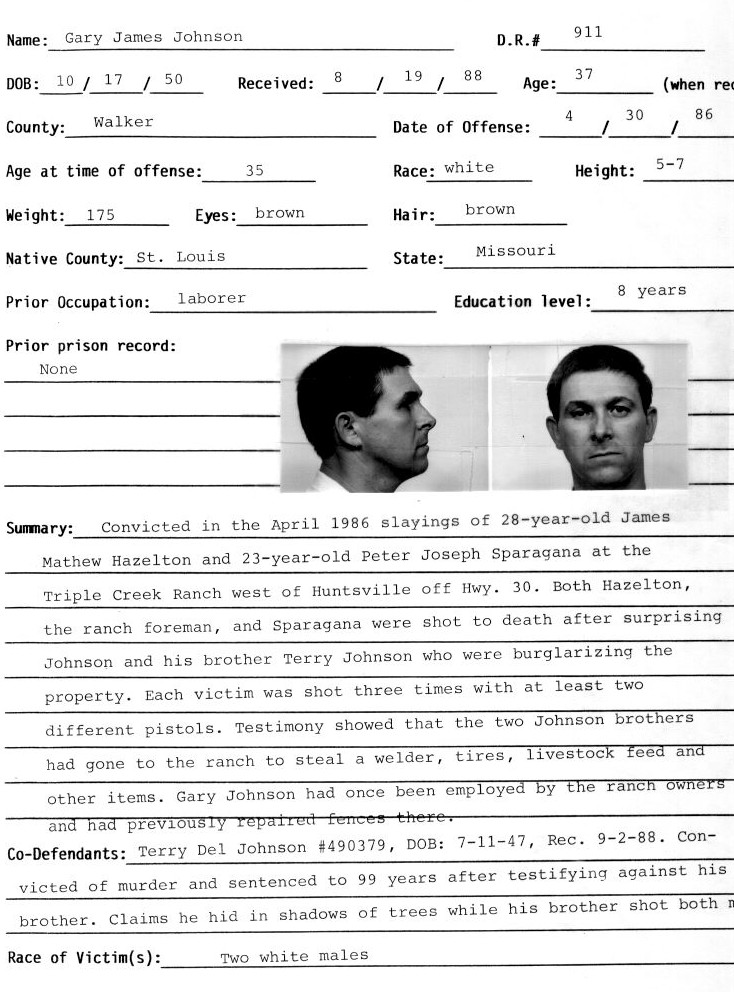
Johnson, Gary James
Date of Birth: 10/17/50
DR#: 911
Date Received: 8/19/88
Education: 8 years
Occupation: Laborer
Date of Offense: 4/30/86
County of Offense: Walker
Native County: St. Louis, Mo.
Race: White
Gender: Male
Hair Color: Brown
Eye Color: Brown
Height: 5' 7"
Weight: 175
Convicted in the May 1986 slayings of 28 year old
James Matthew Hazelton and 23 year old Peter Joseph Sparanga at the
Triple Creek Ranch west of Huntsville off Hwy. #30. Both Hazelton, the
ranch foreman, and Sparanga were shot to death after surprising
Johnson and his brother Terry Johnson who were burglarizing the
property. Each victim was shot at least three times with two different
pistols. Testimony showed that the two Johnson brothers had gone to
the ranch to stealk a welder, tires, liuvestock feed and other items.
Gary Johgnson had once been employed by the ranch owners and had
previously repaired fences there.
Terry Del Johnson was convicted of murder and was
sentenced to 99 years after testifying against his brother.Claims he
hid in shadows of trees while his brother shot both men.
Texas Attorney General
Wednesday, January 6, 2010
Media Advisory: Gary Johnson scheduled for
execution
AUSTIN – Texas Attorney General Greg Abbott offers
the following information about Gary James Johnson, who is scheduled
to be executed after 6 p.m. on Tuesday, January 12, 2010. A Walker
County jury sentenced Johnson to death in August 1989 for the murders
of James Hazelton, a ranch manager, and Peter Sparagana, Hazelton’s
brother-in-law, at a ranch near Huntsville.
FACTS OF THE CRIME
On the evening of April 30th, 1986, Bill and
Shannon Ferguson were in their pasture when they saw a truck pull over
near a gate of the adjacent Triple Creek Ranch. They noticed someone
get out of the truck, heard a chain rattle on the gate, and observed
someone from the truck go through the gate and onto the ranch. The
truck’s headlights had been turned off.
Concerned there was a burglary in progress, Mrs.
Ferguson ran to her house to call the ranch managers, the Hazeltons.
Fifteen minutes later, the Fergusons observed Jim Hazelton’s truck
appear at the same gate on Highway 30. Unable to enter that gate,
Hazelton backed up and entered the ranch from another location.
Eventually, the Fergusons heard a gunshot after Hazelton’s truck
stopped, prompting Mrs. Ferguson to rush to her house to phone police.
While Mrs. Ferguson was calling authorities, Mr.
Ferguson remained in the pasture watching to see if anyone exited the
gate. Several minutes after the first gunshot, Mr. Ferguson heard
several shots fired in rapid succession. After a brief silence, Mr.
Ferguson heard someone plead for his life. The pleas were silenced by
two more shots. When the police arrived, they discovered the bodies of
Jim Hazelton and Peter Sparagana dead from bullet wounds fired at
close range.
At trial, the State presented evidence from three
of Gary Johnson’s brothers—Tracey, Randy, and Ricky. Tracey Johnson
testified that Gary came to Missouri during the fall of 1986, returned
Tracey's .44 caliber pistol and asked him to destroy it because the
pistol had been involved in a double murder in which Gary and their
brother Terry had participated.
During that same visit to Missouri, Ricky Johnson
testified that Gary Johnson was in possession of the .44 caliber
pistol; that Gary admitted killing one man with the gun; and that Gary
and Terry had also killed a second man. A state firearms examiner
later identified a bullet fragment retrieved from Hazelton’s body as
being fired from the same .44 caliber pistol Gary returned to Tracey.
Randy Johnson testified that Gary told him of the
events that transpired at the Triple Creek Ranch. Gary told Randy that
he (Gary) and Terry were out at the Triple Creek to steal something
when two men “got the drop on them.” While Terry distracted them, Gary
shot one of the men. Gary and Terry caught the other man, brought him
back to the barn, made him kneel, and tied his hands behind his back.
While the second man pleaded for mercy, Gary shoved the gun in his
mouth. The medical examiner later testified that the second man died
from a contact bullet wound to the mouth.
Gary Johnson explained the reason for killing the
two men to his brother Randy: “Dead men don’t talk.” Terry Johnson was
sentenced to 99 years in state prison after being convicted of murder
in the case.
EVIDENCE OF FUTURE DANGEROUSNESS
At the penalty phase of the trial, the State
presented evidence that Gary Johnson shot and killed a neighbor’s dog
from a distance of 75 to 100 yards while the dog was standing a few
feet from the neighbor. The State also presented evidence that Johnson
was carrying a loaded handgun when he was arrested for the murders of
Hazelton and Sparagana. A psychiatrist, testified for the State. Based
on a hypothetical question that summarized the testimony about Johnson,
the psychiatrist concluded that Johnson would be a future danger to
society.
PROCEDURAL HISTORY
04/30/86 - Johnson killed James Hazelton and Peter
Sparagana.
06/23/88 - A Walker County grand jury indicted Johnson for capital
murder.
08/19/88 - A Walker County jury convicted Johnson of capital murder.
08/19/88 - A Walker County district judge officially sentenced Johnson
to death.
12/16/92 - The Texas Court of Criminal Appeals affirmed Johnson’s
conviction and sentence.
10/04/93 - The United States Supreme Court denied Johnson’s petition
for a writ of certiorari.
08/30/96 - Johnson filed an original application for a state writ of
habeas corpus.
10/20/04 -The Texas Court of Criminal Appeals denied state habeas
relief.
10/19/05 - Johnson filed a petition for a federal writ of habeas
corpus.
09/28/07 - A Houston U.S. district court denied habeas relief and
issued.
09/09/08 - The United States Court of Appeals for the Fifth Circuit
granted a certificate of appealability on two issues.
01/07/09 - The federal appeals court affirmed the federal district
court’s denial of habeas relief.
10/05/09 - The United States Supreme Court denied Johnson’s petition
for certiorari review.
09/30/09 - The trial court scheduled Johnson’s execution for Tuesday,
January 12, 2010.
01/05/10 -- Johnson filed a petition for a writ of certiorari, and an
application for stay of execution.
Man executed for ranch murders
By Mary Rainwater - The Huntsville Item
January 12, 2010
After more than 20 years on death row, convicted
murderer Gary Johnson was executed Tuesday for the shooting deaths of
two men at a Huntsville area ranch in 1986. Johnson, 59, the second to
die by lethal injection in Texas this year, was pronounced dead by
Texas Depart-ment of Criminal Justice officials at 6:26 p.m., just 11
minutes after the lethal dose began at 6:15 p.m.
A Walker County jury sentenced Johnson to death in
August 1988 for the murders of Peter Sparagana, 23, and James Hazelton,
28, at the Triple Creek Ranch, located about 10 miles west of
Huntsville off state Highway 30. Hazelton’s brother, George, was the
only family member to observe Johnson’s execution, standing just a few
feet away and watching through a glass window in silence.
At first declining offers to make a last statement,
Johnson directed his comments to family members and friends in the
personal witness room, including his daughter, a brother and sister-in-law
and friends. “Tell my family goodbye,” he said. “... you tell the rest
of them what they did was wrong for letting me fall for what they did.
I never done anything in my life to anybody.”
Hazelton, the ranch manager, and Sparagana,
Hazelton’s brother-in-law, were called to the Triple Creek Ranch on
the evening of April 30, 1986, by neighbors Bill and Shannon Ferguson,
who observed Johnson and his brother, Terry, burglarizing the ranch.
Hazelton and Sparagana discovered Terry Johnson but didn’t see his
brother, who opened fire with a .44-caliber Magnum pistol and shot
Sparagana, according to evidence and statements from Terry Johnson.
Hazelton tried to run but was caught by Gary
Johnson, who once worked for him. “He put the gun in Hazelton’s mouth,”
Frank Blazek of Huntsville, the prosecutor at Johnson’s trial, told
the Associated Press. “Hazelton begged for his life and people across
the way, in the nearby pasture, couldn’t see all this but could hear a
man begging for his life.”
Shannon Ferguson, told the AP last week that she’s
always “felt kind of responsible” for the two men being murdered
because they wouldn’t have investigated if she hadn’t called. But
Ferguson also believes if she ignored the Johnson brothers’ suspicious
activity, “I think they probably would have gone on and murdered more
people.”
At the trial, Gary Johnson’s brother, Randy,
testified that Gary Johnson told him of the events that transpired at
the Triple Creek Ranch — that the pair were at the ranch to steal
something when two men “got the drop on them.” Johnson explained the
reason for killing the two men to his brother, Randy, stating that
“dead men don’t talk.”
Earlier Tuesday, Gary Johnson’s lawyers asked the
U.S. Supreme Court to stay his execution, saying he was nearly blind,
in poor health and posed no danger to society if he was spared from
the death chamber. The court rejected their plea. Terry Johnson, now
62, took a plea deal with a 99-year prison term.
Former worker who shot 2 at Texas ranch executed
By Michael Graczyk - The Houston Chronicle
AP Jan. 12, 2010
HUNTSVILLE — Convicted killer Gary Johnson was
executed Tuesday for fatally shooting a ranch foreman and another man
who interrupted his burglary of a southeast Texas ranch nearly 24
years ago. Johnson, 59, was the second inmate to receive lethal
injection this year in the state that executes the most prisoners. At
least six others have execution dates scheduled for the coming months.
He was condemned for the April 1986 slayings of
James Hazelton, 28, and Hazelton’s brother-in-law, Peter Sparagana,
23. The two were gunned down while investigating a call from a
neighbor who reported intruders had driven through a chained gate at
the Triple Creek Ranch about 10 miles west of Huntsville.
Hazelton’s brother, George, was among who watched
Johnson die. He stood just a few feet away and watched through a glass
window. He declined to meet with reporters following the execution.
One of Johnson’s brothers, Dell, and a daughter were among witnesses
in an adjacent room.
Johnson declined the warden’s offer to make a final
statement. “Just tell my family good bye,” he said. But then, his
voice choking with emotion, he urged relatives to tell other family
members “what they did was wrong for letting me take the fall for what
they did.” “I never done anything in my life to anybody,” he said.
Eleven minutes later, at 6:26 p.m. CST, he was pronounced dead.
It took about two years for investigators to
assemble their case against Johnson, who once worked at the ranch, and
his brother, Terry. The brothers became suspects after the neighbor
who saw men drive into the ranch described distinctive brake lights on
their truck.
Terry Johnson, 62, took a plea deal with a 99-year
prison term. Gary Johnson went to trial on capital murder charges, was
convicted and sentenced to death. “This was not their first nighttime
burglary,” recalled Frank Blazek, the prosecutor at Johnson’s trial.
“They knew the various pastures and that was part of a pattern they
had.”
Hazelton and Sparagana discovered Terry Johnson but
didn’t see his brother, who opened fire with a .44-caliber Magnum
pistol and shot Sparagana, according to evidence and statements from
Terry Johnson. Hazelton tried to run but was caught by Gary Johnson,
who once worked for him. “He put the gun in Hazelton’s mouth,” Blazek
said. “Hazelton begged for his life and people across the way, in the
nearby pasture, couldn’t see all this but could hear a man begging for
his life.”
Shannon Ferguson, the neighbor who called Hazelton
about the suspicious truck entering the ranch, and her husband were in
a pasture tending to a horse about to give birth. She said last week
she’s always “felt kind of responsible” for the two men being murdered
because they wouldn’t have investigated if she hadn’t called. But
Ferguson also believes if she ignored the Johnson brothers’ suspicious
activity, “I think they probably would have gone on and murdered more
people.” The murder weapon was recovered at the home of another
Johnson brother in Union, Mo.
Johnson declined to speak with reporters in the
weeks preceding his scheduled execution. Before arriving on death row,
he had no previous prison record. Trial testimony showed that in 1972,
in his native Missouri, he paid $150 in restitution to a man whose dog
he shot and killed. The dog’s owner was a few feet away at the time.
Blazek said investigators found the same slogan etched in concrete
outside Johnson’s home and on a T-shirt he was wearing in a photograph:
“Kill them all and let God sort them out.” “It indicated a callousness
about human life,” he said.
Earlier in the day, Johnson’s lawyers asked the U.S.
Supreme Court to stay his execution, saying he was nearly blind, in
poor health and posed no danger to society if he was spared from the
death chamber. The court rejected their plea.
Former worker who shot 2 at Texas ranch executed
Kvia.com
Associated Press - January 13, 2010
HUNTSVILLE, Texas (AP) - Convicted killer Gary
Johnson talked about "taking the fall" before he was executed over a
1986 double slaying at a ranch near Huntsville. He was condemned for
the shooting deaths of James Hazelton and Hazelton's brother-in-law
Peter Sparagana during an apparent burglary attempt. Johnson formerly
worked at the ranch.
Johnson last night at first declined the warden's
offer to make a final statement. He said: "Just tell my family good
bye." But then, his voice choking with emotion, Johnson urged
relatives to tell other family members "what they did was wrong for
letting me take the fall for what they did." He also said: "I never
done anything in my life to anybody."
The inmate's older brother, Terry Johnson, took a
plea deal with a 99-year prison term over the killings during a
burglary attempt.
Former worker who shot 2 at Texas ranch executed
By Michael Graczyk - APNews
Jan 12, 2010
HUNTSVILLE, Texas (AP) - Convicted killer Gary
Johnson was executed Tuesday for fatally shooting a ranch foreman and
another man who interrupted his burglary of a southeast Texas ranch
nearly 24 years ago. Johnson, 59, was the second inmate to receive
lethal injection this year in the state that executes the most
prisoners. At least six others have execution dates scheduled for the
coming months.
He was condemned for the April 1986 slayings of
James Hazelton, 28, and Hazelton's brother-in-law, Peter Sparagana,
23. The two were gunned down while investigating a call from a
neighbor who reported intruders had driven through a chained gate at
the Triple Creek Ranch about 10 miles west of Huntsville.
Hazelton's brother, George, was among who watched
Johnson die. He stood just a few feet away and watched through a glass
window. He declined to meet with reporters following the execution.
One of Johnson's brothers, Dell, and a daughter were among witnesses
in an adjacent room.
Johnson declined the warden's offer to make a final
statement. "Just tell my family good bye," he said. But then, his
voice choking with emotion, he urged relatives to tell other family
members "what they did was wrong for letting me take the fall for what
they did." "I never done anything in my life to anybody," he said.
Eleven minutes later, at 6:26 p.m. CST, he was pronounced dead.
It took about two years for investigators to
assemble their case against Johnson, who once worked at the ranch, and
his brother, Terry. The brothers became suspects after the neighbor
who saw men drive into the ranch described distinctive brake lights on
their truck.
Terry Johnson, 62, took a plea deal with a 99-year
prison term. Gary Johnson went to trial on capital murder charges, was
convicted and sentenced to death.
"This was not their first nighttime burglary,"
recalled Frank Blazek, the prosecutor at Johnson's trial. "They knew
the various pastures and that was part of a pattern they had."
Hazelton and Sparagana discovered Terry Johnson but didn't see his
brother, who opened fire with a .44-caliber Magnum pistol and shot
Sparagana, according to evidence and statements from Terry Johnson.
Hazelton tried to run but was caught by Gary Johnson, who once worked
for him. "He put the gun in Hazelton's mouth," Blazek said. "Hazelton
begged for his life and people across the way, in the nearby pasture,
couldn't see all this but could hear a man begging for his life."
Shannon Ferguson, the neighbor who called Hazelton
about the suspicious truck entering the ranch, and her husband were in
a pasture tending to a horse about to give birth. She said last week
she's always "felt kind of responsible" for the two men being murdered
because they wouldn't have investigated if she hadn't called. But
Ferguson also believes if she ignored the Johnson brothers' suspicious
activity, "I think they probably would have gone on and murdered more
people."
The murder weapon was recovered at the home of
another Johnson brother in Union, Mo.
Johnson declined to speak with reporters in the
weeks preceding his scheduled execution. Before arriving on death row,
he had no previous prison record. Trial testimony showed that in 1972,
in his native Missouri, he paid $150 in restitution to a man whose dog
he shot and killed. The dog's owner was a few feet away at the time.
Blazek said investigators found the same slogan
etched in concrete outside Johnson's home and on a T-shirt he was
wearing in a photograph: "Kill them all and let God sort them out." "It
indicated a callousness about human life," he said.
Earlier in the day, Johnson's lawyers asked the U.S.
Supreme Court to stay his execution, saying he was nearly blind, in
poor health and posed no danger to society if he was spared from the
death chamber. The court rejected their plea.
Gary Johnson
ProDeathPenalty.com
Bill and Shannon Ferguson were in their pasture on
the evening of April 30, 1986, waiting for a mare to foal. Sometime
before 10:00 p.m., they saw a truck pull over near a gate to the
adjacent Triple Creek Ranch. They saw someone get out of the truck,
heard a chain rattle on the gate, and saw the truck go through the
gate and onto the ranch. Other evidence showed that the original chain
had been cut and a new lock had been placed on the gate. The truck’s
headlights were off, but Mrs. Ferguson noticed an unusual brake light
pattern on the truck (four large round lights, two on each side, one
above the other). Mrs. Ferguson went to the barn and called the Triple
Creek Ranch. She spoke to the wife of Jim Hazelton, the ranch manager,
and told her that a burglary might be taking place because a truck had
entered the ranch with its lights off. Mrs. Hazelton told Mrs.
Ferguson that her husband would be right out.
Fifteen minutes later, the Fergusons saw Triple
Creek Ranch manager Jim Hazelton’s truck appear at the same gate.
Hazelton was unable to enter the ranch through that gate, so he backed
up and entered the ranch from another location. Eventually the
Fergusons heard Hazelton’s truck stop. When they heard a gunshot, Mrs.
Ferguson went back to the barn to call the Walker County Sheriff’s
Department and Mrs. Hazelton. While Mrs. Ferguson was gone, Mr.
Ferguson remained in the pasture.
Several minutes after the first gunshot, Mr.
Ferguson heard several shots fired in rapid succession. After a brief
silence, Mr. Ferguson heard someone plead for his life. The pleas were
silenced by two more shots. When the law enforcement officials arrived,
they discovered the bodies of Jim Hazelton and his brother-in-law,
Peter Sparagana. Mrs. Hazelton was Peter's sister. Walker County
Deputy Sheriff Allen McCandles saw a truck matching Shannon Ferguson’s
description of the truck driven by the intruders in Gary James
Johnson’s pasture after the shootings, and he saw Johnson driving the
truck numerous times. Another law enforcement officer testified that
two of the lights on the back of Johnson’s truck were removed in the
two weeks after the murders. Johnson and his brother Terry Del Johnson
were arrested for the murders two years later.
Three of Johnson’s brothers, Tracey, Randy, and
Ricky, testified for the State at trial. Tracey testified that Johnson
came to Missouri during the fall of 1986, returned Tracey’s .44
caliber pistol, and asked Tracey to destroy it because the gun had
been used in a double murder in which Johnson and another brother,
Terry, participated. Ricky testified that, during that same visit to
Missouri, Johnson was in possession of the .44 caliber pistol, he
admitted killing one man with the gun, and he said that he and Terry
also killed a second man. A state firearms examiner later identified a
bullet fragment retrieved from Hazelton’s body as having been fired
from the same .44 caliber pistol that Johnson returned to Tracey.
Randy testified that Johnson told him that Johnson
and Terry were out at the Triple Creek to steal a welder, tires,
livestock feed and other items when two men “got the drop on them”;
while Terry distracted them, Johnson shot one of the men; Johnson and
Terry caught the other man, brought him back to the barn, made him
kneel, and tied his hands behind his back; and while the second man
pleaded for mercy, Johnson shoved the gun in his mouth. The medical
examiner testified that Jim Hazelton died from a contact bullet wound
to the mouth. Randy testified that Johnson told him the two men were
killed because “dead mean don’t talk.”
The defense called Johnson’s brother, Terry, as a
witness. Terry testified that Gary Johnson killed both of the victims.
He testified that his brother Gary’s favorite expression was “kill
them all, let God sort them out.” The defense also presented testimony
from two inmates in the Walker County Jail that Terry Johnson told
them that he (Terry) had killed both of the victims.
At the penalty phase of the trial, the State
presented evidence that Johnson shot and killed a neighbor’s dog from
a distance of 75 to 100 yards, while the dog was standing a few feet
from the neighbor. The State also presented evidence that Johnson was
carrying a loaded handgun when he was arrested for the murders.
Johnson’s uncle testified for the defense at the penalty phase that he
had never seen Johnson act violently. Johnson’s former boss and a co-worker
testified that Johnson was hard-working, respectful, and non-violent.
Johnson’s ex-wife testified that Johnson was never violent toward
their children, and never drank or used drugs. The jury found that
Johnson had acted deliberately and with a reasonable expectation that
death would result, and that it was probable that Johnson would commit
future acts of criminal violence that constitute a continuing threat
to society. The trial court sentenced to Johnson to death. Co-defendant
Terry Del Johnson was convicted of murder and sentenced to 99 years
after testifying against his brother and accepting a plea bargain to
avoid a death sentence.
Gary James Johnson
Txexecutions.org
Gary James Johnson, 49, was executed by lethal
injection on 12 January 2010 in Huntsville, Texas for killing two men
while burglarizing a ranch.
On 30 April 1986, Johnson, then 35, and his brother,
Terry, 38 went to the Triple Creek Ranch west of Huntsville to
burglarize it. Gary Johnson had once been employed there as a
ranchhand. While the brothers were looking for items to steal, ranch
foreman James Hazelton, 28, and his brother-in-law, Peter Sparagana,
23, arrived. They confronted Terry, but did not see Gary. While Terry
distracted them, Gary surprised them and opened fire on Sparagana.
Hazelton tried to run, but Gary caught him. The assailants then
brought Hazelton back to the barn, made him kneel, and tied his hands
behind his back. While Hazelton pleaded for mercy, Gary shoved the gun
in his mouth and fired. Both victims died from wounds from a .44-caliber
pistol at close range.
At Johnson's trial, Bill and Shannon Ferguson
testified that they were in their pasture on the evening of the murder
when they saw a truck pull over near a gate of the Triple Creek Ranch,
which was adjacent to their property. They noticed someone get out of
the truck, heard a chain rattle on the gate, and observed someone from
the truck go through the gate and onto the property. The truck's
headlights had been turned off. Concerned that there was a burglary in
progress, Mrs. Ferguson ran to her house to call the ranch managers,
the Hazeltons.
Fifteen minutes later, the Fergusons observed Jim
Hazelton's truck appear at the same gate. Unable to enter through that
gate, Hazelton entered the rance from another location. The Ferguson's
subsequently heard a gunshot, prompting Mrs. Ferguson to rush to her
house and phone the police.
Mr. Ferguson remained in the pasture, watching to
see if anyone exited the gate. Several minutes after the first gunshot,
several more shots were fired in rapid succession. After a brief
silence, Mr. Ferguson heard someone plead for his life. The pleas were
silenced by two more shots.
Johnson's brothers - Tracey, Randy, and Ricky - all
testified that in the fall of 1986, Gary visted them in Missouri. Each
of them testified that Gary confessed to the murder and described it
to them. In addition, Tracey testified that Gary gave him the .44-caliber
pistol used in the double murder and asked him to destroy it. Johnson
had no prior criminal convictions.
A jury convicted Johnson of capital murder and
sentenced him to death. The Texas Court of Criminal Appeals affirmed
the conviction and sentence in December 1992. All of his subsequent
appeals in state and federal court were denied. Terry Del Johnson
accepted a conviction of murder and sentence of 99 years in prison in
exchange for his testimony. He remains in custody as of this writing.
In an interview with the Associated Press the week
before Johnson's execution, Shannon Ferguson said she's always "felt
kind of responsible" for the two victim's deaths, since they wouldn't
have come out to investigate the burglary if she hadn't called. But,
she also said that if she hadn't done anything, "I think they probably
would have gone on and murdered more people."
Johnson's execution was attended by his daughter, a
brother and sister-in-law, and friends. In the other witness chamber,
reserved for family and friends of the victim, was James Hazelton's
brother, George. When the warden asked Johnson if he wanted to make a
final statement, he declined, saying only "Just tell my family goodbye."
He then continued speaking, however, urging his relatives, "you tell
the rest of them what they did was wrong for letting me take the fall
for what they did. I never done anything in my life to anybody." The
lethal injection was then started. He was pronounced dead at 6:26 p.m.
Jury assesses death penalty; Huntsville Panel
deliberates half an hour
By Kathy Fair - The Houston Chronicle
August 20, 1988
HUNTSVILLE - A 37-year-old ranch hand who a Dallas
psychiatrist said would "most certainly" commit future acts of
violence was sentenced to death Friday for the 1986 slayings of two
men.
A jury of seven men and five women - which also
heard a Bryan psychologist say such predictions were irresponsible -
deliberated about 35 minutes before assessing the penalty to Gary
Johnson, convicted of murdering James M. Hazelton, 28, and Peter J.
Sparagana, 23, on April 30, 1986, during a burglary at the Triple
Creek Ranch.
Hazelton was the ranch manager, and he and
Sparagana, his brother-in-law, had gone to the ranch after being
notified of a possible burglary in progress.
Johnson covered his face with his hands and cried
softly after the verdict was read. "Most certainly an individual with
that type of history and behavior would continue to commit acts of
violence," Dallas psychiatrist James Grigson testified Friday.
However, Grigson, nicknamed "Dr. Death," admitted
that he had never examined Johnson or his criminal history. His
opinion about Johnson's future danger was based, he said, on Walker
County District Attorney Frank Blazek's description of Johnson's one
prior arrest and the Triple Creek slayings.
Johnson had been arrested 17 years ago for shooting
a neighbor's dog and later paid $150 restitution to the man, according
to court testimony. Testimony that Johnson had bragged to his brothers
that he had killed Hazelton and Sparagana indicates that he "doesn't
have any regard for human life," said Grigson, who has testified in
186 capital murder cases.
But Wendell L. Dickerson, a Bryan psychologist
called by the defense to testify during the sentencing phase of the
trial, labeled such "blind predictions" as professionally
irresponsible and highly subject to error. Studies have indicated that
the error rate for criminals predicted not to be a future danger is
seven in every 100,000 cases, Dickerson said. But the error rate in
predictions that someone will be a future danger to society is two out
of three, Dickerson added.
Another defense witness, James Marquart, a
professor of criminology at Sam Houston State University, said his
research indicates that Grigson has said virtually the same thing
about the future dangerousness of defendants in every capital cases in
which he has testified.
Blazek had told jurors he thought the death penalty
was the appropriate punishment for the "brutality, the cold
bloodedness, the viciousness of the killings."
Ridley told jurors the death sentence would not be
fair because Johnson's co-defendant in the slayings, his 41-year-old
brother, Terry, had been offered a plea bargain by authorities in
exchange for testifying against his brother.
Terry Johnson's trial is pending. The plea bargain
called for him to testify in exchange for a reduction of the charge to
murder and a sentence of 40-75 years. "I find that very interesting
when the state has given an agreement to a man whom they now believe
is the trigger man," Ridley said.
Legal history of case: Attorney Jim Skelton's
legal analysis of Johnson's journey through court
ExecutionWatch.org
DOB: October 17, 1950. Age 59 Walker County
Co-Defendant: Terry Johnson, Gary Johnson's brother.
Terry was convicted of murder and was assessed 99 years in prison.
FACTS: On the evening of April 30th, 1986, Bill and
Shannon Ferguson were in their pasture when they saw a truck pull over
near a gate of the adjacent Triple Creek Ranch. They noticed someone
get out of the truck, heard a chain rattle on the gate, and observed
someone from the truck go through the gate and onto the ranch. The
truck's headlights had been turned off. Concerned there was a burglary
in progress, Mrs. Ferguson ran to her house to call the ranch managers,
the Hazeltons.
Fifteen minutes later, the Fergusons saw Jim
Hazelton's truck at the same gate on Highway 30. Unable to enter that
gate, Hazelton backed up and entered the ranch from another location.
Eventually, the Fergusons heard a gunshot after Hazelton's truck
stopped, prompting Mrs. Ferguson to rush to her house to phone police.
While Mrs. Ferguson was calling authorities, Mr. Ferguson remained in
the pasture watching to see if anyone tried to leave. Several minutes
after the first gunshot, Mr. Ferguson heard several shots fired in
rapid succession. After a brief silence, Mr. Ferguson heard someone
plead for his life. The pleas were silenced by two more shots.
When the police arrived, they discovered the bodies
of 28-year-old Jim Hazelton and his 23-year-old brother-in-law, Peter
Sparagana. dead from bullet wounds fired at close range. Each man was
shot three times from at least two different guns. Gary Johnson was a
former employee at the ranch.
Procedural History
April 30, 1986: Gary Johnson shot and killed James
Hazelton and Peter Sparagana.
June 23, 1988: A Walker County grand jury indicted Johnson for capital
murder.
August 19, 1988: A Walker County jury convicted Johnson for capital
murder.
August 19, 1988: Gary Walker was tried and convicted of capital murder.
Gary Johnson three brothers, Tracey, Randy, and Ricky, testified for
the State.
Tracey Johnson testified that Gary came to Missouri
during the fall of 1986, several months after the two Texas murders,
and asked him to destroy his .44 caliber pistol because it had been
involved in a double murder in which Gary and their brother Terry had
participated. During that same visit, Ricky testified that Gary
Johnson showed a .44 caliber pistol and admitted killing one man with
the gun; and that He and Terry had also killed a second man. A state
firearms examiner later identified a bullet fragment retrieved from
Hazelton's body as being fired from the .44 caliber pistol.
Randy Johnson said Gary told him that he and Terry
were at the Triple Creek to steal something when two men “got the drop
on them.” While Terry distracted them, Gary shot one of the men. Gary
and Terry caught the other man, brought him back to the barn, made him
kneel, and tied his hands behind his back. While the second man
pleaded for mercy, Gary shoved the gun in his mouth. The medical
examiner later testified that the second man died from a contact
bullet wound to the mouth. Gary Johnson explained the reason for
killing the two men: “Dead men don't talk.”
Terry Johnson was convicted of murder and was
sentenced to 99 years in prison after being convicted of murder. Gary
Johnson was convicted of capital murder and was assessed the death
penalty. At the penalty phase of the trial, the State presented
evidence that Gary Johnson shot and killed a neighbor's dog from a
distance of 75 to 100 yards while the dog was standing a few feet from
the neighbor. The State also presented evidence that Johnson was
carrying a loaded handgun when he was arrested for the murders of
Hazelton and Sparagana. A psychiatrist, testified for the State. Based
on a hypothetical question that summarized the testimony about Johnson,
the psychiatrist concluded that Johnson would be a future danger to
society.
December 16, 1992: The Court of Criminal Appeals
affirmed Johnson's conviction and sentence. On October 4, 1993, the
United States Supreme Court denied Johnson's petition for a writ of
certiorari.
August 30, 1996: Johnson filed a state application
for a writ of habeas corpus. Relief was denied on October 20, 2004.
October 19, 2005: Johnson filed a federal petition for habeas corpus.
Relief was denied by a Houston United States District Court on
September 28, 2007 - A Houston U.S. district court denied habeas
relief. On September 9, 2008, the Fifth Circuit granted a certificate
of appealability on two issues and thereafter affirmed the federal
district court's denial of habeas relief on January 7, 2009. On
October 5, 2009, the United States Supreme Court denied Johnson's
petition for certiorari review.
Johnson v. State, 853 S.W.2d 527 (Tex.Cr.App.
1992). (Direct Appeal)
Defendant was convicted of capital murder and was
sentenced to death by the 12th Judicial District Court, Walker County,
Jerry A. Sandel, J., and he appealed. The Court of Criminal Appeals,
Benavides, J., held that: (1) defendant was not entitled to accomplice-witness
instruction where defendant called the accomplice himself; (2)
evidence was sufficient for jury to return affirmative finding on
question of future dangerousness; (3) law of parties was applicable in
determining whether two persons were murdered in the same transaction,
but defendant could not be put to death for being party to murder
absent finding of deliberateness; (4) there was no egregious error in
instruction on the special issue concerning deliberateness; and (5)
defendant's mitigating evidence was sufficiently taken into account in
connection with the future dangerousness issue. Affirmed.
Baird and Maloney, JJ., concurred in the result.
Clinton, J., filed a dissenting opinion.
BENAVIDES, Judge.
Appellant was convicted of Capital Murder for
intentionally killing James Hazelton and Peter Sparagana during the
same criminal transaction. Tex.Penal Code Ann. § 19.03(a)(6)(A) (West
1990). After the jury returned an affirmative answer to both special
issues submitted under Tex.Crim.Proc.Code Ann. Art. 37.071(b) (West
1988), the judge assessed a sentence of death. The judgement of the
trial court is affirmed.FN1
FN1. By per curiam order we withdrew our original
opinion of December 19, 1990. The cause was resubmitted on original
briefs on May 23, 1991.
I.
On the evening of April 30th, 1986, Bill and
Shannon Ferguson were in their pasture waiting on a mare to foal.
Sometime before 10:00 p.m. they observed a truck heading in an
eastward direction pull over near a gate of the adjacent Triple Creek
Ranch. They noticed someone get out of the truck, heard a chain rattle
on the gate, and observed someone from the truck go through the gate
and onto the ranch. The truck's headlights had been turned off, but
Mrs. Ferguson noticed that when the driver of the truck applied the
brakes, an unusual brake light pattern appeared. Concerned there was a
burglary in progress, Mrs. Ferguson ran to her house to call the ranch
managers, the Hazeltons. Other evidence showed that the original chain
had been cut and a new lock had been placed on the gate.
Fifteen minutes later, the Fergusons observed Jim
Hazelton's truck appear at the same gate on Highway 30. Unable to
enter that gate, Hazelton backed up and entered the Ranch from another
location. Eventually, the Fergusons heard Hazelton's truck stop. Upon
hearing a gunshot, Mrs. Ferguson rushed to her house to phone Mrs.
Hazelton and the police.
While Mrs. Ferguson was calling the police, Mr.
Ferguson remained in the pasture watching to see if anyone exited the
gate. Several minutes after the first gunshot, Mr. Ferguson heard
several shots fired in rapid succession. After a brief silence, Mr.
Ferguson heard someone plead for his life. The pleas were silenced by
two more shots. When the police arrived, they discovered the bodies of
Jim Hazelton and Peter Sparagana, Hazelton's brother-in-law, dead from
bullet wounds fired at close range.
At trial the State presented damaging evidence from
three of appellant's brothers-Tracey, Randy, and Ricky. Tracey Johnson
testified that appellant came to Missouri during the fall of 1986,
returned Tracey's .44 caliber pistol and asked him to destroy it
because the pistol had been involved in a double murder in which
appellant and their brother Terry had participated.
During that same visit to Missouri, Ricky Johnson
testified that appellant was in possession of the .44 caliber pistol;
that appellant admitted killing one man with the gun; and that
appellant and Terry had also killed a second man. A state firearms
examiner later identified a bullet fragment retrieved from Hazelton's
body as being fired from the same .44 caliber pistol appellant
returned to Tracey.
Randy Johnson also testified that appellant told
him of the events that transpired at the Triple Creek Ranch. Appellant
told Randy that he and Terry were out at the Triple Creek to steal
something when two men “got the drop on them.” While Terry distracted
them, appellant was able to shoot one of the men. Appellant and Terry
caught the other man, brought him back to the barn, made him kneel,
and tied his hands behind his back. While the second man plead for
mercy, appellant shoved the gun in his mouth. The medical examiner
later testified that the second man died from a contact bullet wound
to the mouth. Appellant explained the reason for killing the two men
to his brother Randy: “Dead men don't talk.”
II.
In the first point of error, appellant contends
that he was entitled to an accomplice-witness instruction under
Tex.Code Crim.Proc.Ann. Art. 38.14 (West 1979): A conviction cannot be
had upon the testimony of an accomplice unless corroborated by other
evidence tending to connect the defendant with the offense committed;
and the corroboration is not sufficient if it merely shows the
commission of the offense.
Appellant requested the instruction because of the
testimony of Terry Johnson, appellant's brother, who was indicted for
the same offense. As part of a plea agreement with the state, Terry
Johnson had agreed to testify against his brother. The state, however,
decided their evidence was complete without Terry's testimony and
chose not to call Terry to the witness stand. During defense's
case-in-chief, appellant attempted to inculpate Terry by calling him
to testify. On direct examination by defense counsel Terry testified
as to his participation in the robbery and inculpated appellant in the
killing of Hazelton and Sparagana.
Appellant recognizes prior case law which indicated
that when an accomplice is called by the defense to testify on behalf
of the defense, no accomplice-witness instruction is required. But
appellant argues the rationale for such a rule was based on the old
“voucher” rule which is no longer in effect, and thus appellant was
entitled to the instruction. See Russeau v. State, 785 S.W.2d 387 (Tex.Crim.App.1990).
However, in Selman v. State, this Court reaffirmed the “established
principal in this State that testimony elicited from a witness called
by the accused and offered by the accused is not accomplice-witness
testimony which must be corroborated as contemplated under Article
38.14.” 807 S.W.2d 310, 311 (Tex.Crim.App.1991); see also Brown v.
State, 576 S.W.2d 36, 42 (Tex.Crim.App.1979); Cranfil v. State, 525
S.W.2d 518, 520 (Tex.Crim.App.1975); Aston v. State, 656 S.W.2d 453,
456 (Tex.Crim.App.1983) (trial court erred in giving accomplice-witness
instruction where witness was called by defense). The very language of
the rule illustrates its inapplicability to appellant's cause. The
statute begins, “A conviction cannot be had upon the testimony of an
accomplice ...” supra. But the State did not rely on the accomplice's
testimony but closed its case-in-chief without calling him. It did not
seek a conviction based upon the testimony of Terry Johnson. The
statute provides for situations where a conviction is based in some
part on the testimony of an accomplice. In this case, the witness was
called by the defense, and his testimony as to the events of the crime
was elicited by the defense. While the State did cross-examine the
witness concerning his testimony, the witness had already testified as
to the events of the crime. See Selman, supra (Miller, J. concurring
opinion). As we opined in Selman, “accomplice-witness testimony must
be corroborated and the jury so instructed only when the State calls
the witness and seeks to rely on such witness's testimony.” 807 S.W.2d
at 311. This is not the type of evidence which must be corroborated
under the statute. No accomplice-witness instruction was required.
Point of error three is related to point of error
one. Appellant complains that because the trial court failed to give
an accomplice-witness instruction during the guilt-innocence phase,
the evidence is insufficient to support the jury's affirmative finding
to special issue number one during the punishment phase. Appellant
contends, among other things, that if the testimony of Terry Johnson
was excluded the remaining evidence is circumstantial as to the issue
of deliberateness and the jury was left in the position of guessing
how the actual deaths occurred. But since all of his arguments are
predicated on the contention that the trial court improperly failed to
instruct the jury on the accomplice-witness rule during the guilt-innocence
phase, we reject appellant's arguments.
We find there is sufficient evidence to find
appellant acted deliberately. The facts at the guilt stage of the
trial alone can often be sufficient to support the affirmative finding
of the jury to the special issues at the penalty stage of the trial.
Williams v. State, 773 S.W.2d 525, 538 (Tex.Crim.App.1988), cert.
denied, 493 U.S. 900, 110 S.Ct. 257, 107 L.Ed.2d 207 (1989). “A jury
must find ‘a moment of deliberation and the determination on the part
of the actor to kill’ before it is justified in answering ‘yes' to
special issue number one.” Kinnamon v. State, 791 S.W.2d 84, 95-96 (Tex.Crim.App.1990).
The determination of deliberateness must be found from the totality of
the circumstances. Williams, 773 S.W.2d at 539; Cannon v. State, 691
S.W.2d 664, 677 (Tex.Crim.App.1985), cert. denied, 474 U.S. 1110, 106
S.Ct. 897, 88 L.Ed.2d 931 (1986). In determining the sufficiency of
the evidence, the evidence must be viewed in the light most favorable
to the verdict. Dunn v. State, 819 S.W.2d 510, 513 (Tex.Crim.App.1991);
Jackson v. Virginia, 443 U.S. 307, 319, 99 S.Ct. 2781, 2789, 61 L.Ed.2d
560 (1979).
Hazelton died as a result of gunshot wounds to the
head, a contact type gunshot wound to the face into the neck, and a
graze wound to the right shoulder. The medical and firearms examiner
identified the fragments retrieved from the neck of Hazelton as being
fired from the .44 caliber pistol retrieved from appellant's brother
Tracey. There were also .38 caliber fragments retrieved from the
gunshot wound to the head. The medical examiner's testimony and the
evidence of the position of the body was consistent with someone being
shot at point blank range in the face, and then when Hazelton was
lying on the ground he was again shot in the head by someone standing
over the body. The contact wound to the face could illustrate
deliberateness.
But in addition to the wounds, Terry Johnson
testified during defense's direct that he told appellant someone was
coming up in a truck through the woods. Appellant's reply was that
they would have to shoot it out because he was not going to get caught.
While Terry went to look for a means of escape, appellant hid in
waiting. The evidence reflects much more than an intentional killing
of Hazelton. Appellant recognized and determined that by killing
Hazelton and Sparagana, he could not be implicated because, as he told
Randy: “Dead men don't talk.” Viewed in the light most favorable to
the verdict, the evidence is sufficient to allow a rationale juror to
have found beyond a reasonable doubt that appellant deliberately
killed Hazelton. Appellant's first and third points of error are
overruled.
III.
In appellant's second point of error, he contends
that the evidence was insufficient for the jury to return affirmative
finding to the question of future dangerousness. Again, in determining
the sufficiency of the evidence, the evidence must be viewed in the
light most favorable to the verdict. Dunn v. State, 819 S.W.2d 510,
513 (Tex.Crim.App.1991); Jackson v. Virginia, 443 U.S. 307, 319, 99
S.Ct. 2781, 2789, 61 L.Ed.2d 560 (1979).
The jury can consider numerous factors in
determining whether the defendant poses a continuing threat to society
including, but not limited to, the following: 1. The circumstances of
the capital offense, including the defendant's state of mind and
whether he or she was working alone or with other parties; 2. The
calculated nature of the defendant's acts; 3. The forethought and
deliberateness exhibited by the crime's execution; 4. The existence of
a prior criminal record, and the severity of the prior crimes; 5. The
defendant's age and personal circumstances at the time of the offense;
6. Whether the defendant was acting under duress or the domination of
another at the time of the commission of the offense; 7. Psychiatric
evidence; and 8. Character evidence. Keeton v. State, 724 S.W.2d 58,
61 (Tex.Crim.App.1987).
Specifically, appellant claims that “the mere fact
of two persons being murdered in the same transaction should not be
considered a special factor” on the issue of future dangerousness in
the second special issue. See Tex.Code Crim.Proc.Ann. Art.
37.071(b)(2) (West 1988). But it is not the mere fact of two persons
being murdered that is a special factor. No killing exists in a vacuum.
The circumstances of the offense, and the events surrounding it may
provide greater probative value than any other evidence regarding the
probability of future acts of violence. Alexander v. State, 740 S.W.2d
749, 761 (Tex.Crim.App.1987); see also Vuong v. State, 830 S.W.2d 929,
935 (Tex.Crim.App.1992); Sosa v. State, 769 S.W.2d 909, 912 (Tex.Crim.App.1989);
Moreno v. State, 721 S.W.2d 295 (Tex.Crim.App.1986). We are unwilling
to abandon this view and to disregard the circumstances of the offense
in making our sufficiency review.
During the punishment hearing, a state's expert
testified that the defendant represented a future threat to society.
There was also testimony from a neighbor that appellant shot and
killed his dog. Appellant fired a semi-automatic rifle at a range of
75 to 100 feet killing the dog which was approximately 3 to 5 feet
from appellant's neighbor. When the jury considered the second issue,
the circumstances surrounding the criminal act itself were certainly
more damaging than the testimony at punishment. Evidence at trial also
indicated appellant had previously worked on the ranch. This work
presented appellant ample opportunity for him to prepare a plan for
the burglary. Appellant and his brother entered the Triple Creek Ranch
late at night. They cut the gate's lock and replaced the lock with one
of their own to prevent detection and entered the ranch heavily armed
with an intention of stealing a specific welder that appellant had
observed at the ranch.
When appellant and his brother heard the
approaching truck, instead of fleeing the scene, appellant hid in
waiting. As Hazelton and Sparagana approached, appellant's brother
distracted Hazelton providing appellant an opportunity to shoot
Hazelton and capture Sparagana. Appellant then had Sparagana get on
his knees, and while Sparagana plead for mercy, appellant shoved the
pistol barrel in Sparagana's mouth and fired. The purpose for both
murders was that “dead men don't talk.” The circumstances of the
offense are such that the jury could rationally find beyond a
reasonable doubt that appellant presented a future threat to society.
See Vuong, 830 S.W.2d at 935. Accordingly, appellant's second point of
error is overruled.
IV.
In points of error four, five, and six, appellant
attacks the court's charge during the guilt-innocence phase of the
trial on numerous grounds including the constitutionality of Tex.Penal
Code Ann. § 19.03(a)(6)(A).FN2. Section 19.03 of the Penal Code
provides, in pertinent part, that:(a) A person commits an offense if
he commits murder as defined under Section 19.02(a)(1) of this code
and: ...(6) the person murders more than one person:(A) during the
same criminal transaction; or(B) during different criminal
transactions but the murders are committed pursuant to the same scheme
or course of conduct. In point of error four, appellant contends §
19.03(a)(6)(A) is unconstitutional in its application, violating the
Eighth and Fourteenth Amendments to the United States Constitution and
Article I, Section 13, of the Texas Constitution, and that the statute
is unconstitutionally vague and indefinite under numerous provisions
of the Texas and U.S. constitutions. We disagree.
While appellant complains that § 19.03(a)(6)
violates the Texas Constitution, appellant proffers no argument or
authority as to the protection offered by the Texas Constitution or
how that protection differs from the protection guaranteed by the U.S.
Constitution. We decline to pursue appellant's Texas Constitutional
arguments for him. Narvaiz v. State, 840 S.W.2d 415 (Tex.Crim.App.1992);
Morehead v. State, 807 S.W.2d 577, 579 n. 1 (Tex.Crim.App.1991);
McCambridge v. State, 712 S.W.2d 499, 501-502 n. 9 (Tex.Crim.App.1986);
Tex.R.App.Proc. 74 and 210.
With regard to the claims under the U.S.
Constitution, we note that prior to the enactment of § 19.03(a)(6) the
Supreme Court upheld the constitutionality of the Texas capital
punishment scheme in Jurek v. Texas, 428 U.S. 262, 96 S.Ct. 2950, 49
L.Ed.2d 929 (1976) (plurality opinion). When analyzing whether a
state's capital murder scheme is violative of the Eighth Amendment,
the Supreme Court has continually considered whether the scheme
sufficiently narrows or limits the class of death-eligible defendants
and whether the scheme allows a jury to sufficiently consider the
mitigating evidence. Jurek v. Texas, 428 U.S. at 273-274, 96 S.Ct. at
2957; Blystone v. Pennsylvania, 494 U.S. 299, 305, 110 S.Ct. 1078,
1083, 108 L.Ed.2d 255 (1990).
Initially we must decide whether the Texas capital
murder scheme, with the enactment of § 19.03(a)(6), complies with the
Eighth Amendment by sufficiently narrowing the class of death-eligible
defendants. In Blystone v. Pennsylvania, the Supreme Court noted
“[the] presence of aggravating circumstances serves the purpose of
limiting the class of death-eligible defendants, and the Eighth
Amendment does not require that these aggravating circumstances be
further refined or weighed by the jury.” 494 U.S. at 306-07, 110 S.Ct.
at 1083. While we note that with the addition of Tex.Penal Code §
19.03(a)(6) the Texas capital murder scheme is broader than it existed
when Jurek was decided, the addition of a second “murder” to the list
of aggravating circumstances, such as rape, burglary, kidnapping,
etc., does not make the Texas statute overbroad so as to violate the
Eighth Amendment. The addition of this aggravating circumstance to the
Texas capital murder scheme adequately channels the jury's discretion
in the assessment of punishment, thus satisfying the Eighth Amendment.
Narvaiz v. State, supra; Blystone v. Pennsylvania, 494 U.S. 299, 305,
110 S.Ct. 1078, 1083 (1990). We reject appellant's facial attack to
the statute in his fourth point of error.
In the same point of error, appellant additionally
argues that the statute is void for vagueness because the statute
fails to define the terms “criminal transaction” and “same scheme or
course of conduct.” Initially, appellant must show that the statute is
unconstitutional as applied to him. Vuong, 830 S.W.2d 929, 941 (Tex.Crim.App.1992);
Parent v. State, 621 S.W.2d 796, 797 (Tex.Crim.App.1981). Because the
phrase “same scheme or course of conduct” relates to § 19.03(a)(6)(B)
which was inapplicable to his conviction, the constitutionality of
that portion of the statute may not be challenged. See Vuong, 830 S.W.2d
at 941; Parent, 621 S.W.2d at 797.
We also find that the term “criminal transaction”
is not vague as applied to the facts of this case. There is no dispute
on appeal that appellant and his brother entered the property with the
intent to steal certain specified items from the Ranch. While
appellant and his brother were in the course of this transaction, two
men discovered their presence. While one of the men was distracted
appellant shot him. The other man was caught and shot execution style.
Appellant's brief only suggests that appellant, himself, did not
murder both men, but that instead his brother actually pulled the
trigger. While these issues may present a defense to the capital
murder charge, we cannot see how this even raises the issue of whether
the murders were committed within the same “criminal transaction.” As
we stated in Vuong, “[e]ven the most narrow construction of the term
‘same criminal transaction’ would include the type of actions the jury
determined were committed by appellant.” 830 S.W.2d at 941.
Appellant's constitutional challenge to the statute on the basis that
it is void for vagueness is also rejected in appellant's fourth point
of error.
In both points of error four and five, appellant
recognizes the general rule that the law of parties applies to the
capital murder statute. Nevertheless he contends the legislature did
not intend for the law of parties to apply to the newly enacted §
19.03(a)(6)(A). We refuse to read such an exception in the statute.
This Court has continually held that the law of parties announced in
§§ 7.01 and 7.02 is applicable to capital murder cases. Crank v. State,
761 S.W.2d 328, 351 (Tex.Crim.App.1988), cert. denied, 493 U.S. 874,
110 S.Ct. 209, 107 L.Ed.2d 162 (1989); English v. State, 592 S.W.2d
949, 955 (Tex.Crim.App.), cert. denied, 449 U.S. 891, 101 S.Ct. 254,
66 L.Ed.2d 120 (1980); Ruiz v. State, 579 S.W.2d 206, 209 (Tex.Crim.App.
[panel op.] 1979); Pitts v. State, 569 S.W.2d 898 (Tex.Crim.App.1978)
(en banc). It would be an anomaly for this court to say the law of
parties under §§ 7.01 and 7.02 applies to capital murder cases except
under § 19.03(a)(6), where there is no language in the statute
indicating such an exception. See Boykin v. State, 818 S.W.2d 782 (Tex.Crim.App.1991);
Garcia v. State, 829 S.W.2d 796, 799 (Tex.Crim.App.1992) (plurality
opinion) (“As jurists, we are obliged to implement the expressed will
of our legislature, not the will it keeps to itself.”)
Appellant's final arguments, intertwined within
points of error four, five and six, are based on the assumption that
the law of parties does not apply to § 19.03(a)(6)(A). At trial during
the guilt-innocence stage, the jury was instructed on the law of
parties under Tex.Penal Code §§ 7.01 and 7.02.FN3 (West 1990).
Appellant's argument is both a constitutional argument and a challenge
to the interpretation of the statute. FN3. The jury was instructed on
the law of parties under § 7.01(a), which states:A person is
criminally responsible as a party to an offense if the offense is
committed by his own conduct, by the conduct of another for which he
is criminally responsible, or both.
The trial court also instructed the jury under §
7.02(a)(2) and (b):(a) A person is criminally responsible for an
offense committed by the conduct of another if: . . . . (2) acting
with intent to promote or assist the commission of the offense, he
solicits, encourages, directs, aids or attempts to aid the other
person to commit the offense ...(b) If, in the attempt to carry out a
conspiracy to commit one felony, another felony is committed by one of
the conspirators, all conspirators are guilty of the felony actually
committed, though having no intent to commit it, if the offense was
committed in furtherance of the unlawful purpose and was one that
should have been anticipated as a result of the carrying out of the
conspiracy.
Appellant contends a capital murder conviction
based on the law of parties under § 7.02(b) is unconstitutional under
Enmund v. Florida, 458 U.S. 782, 788, 102 S.Ct. 3368, 3371, 73 L.Ed.2d
1140 (1982) and Tison v. Arizona, 481 U.S. 137, 107 S.Ct. 1676, 95
L.Ed.2d 127 (1987). Appellant's reliance on Enmund and Tison are
misplaced.
The Texas capital murder scheme does not allow an
individual to be put to death for merely being a party to a murder. As
this court said in Cuevas v. State: To be convicted of a capital
felony in Texas, a defendant must intentionally or knowingly cause the
death of an individual in certain enumerated circumstances. See
V.T.C.A., Penal Code Sec. 19.03. Of course, application of the law of
parties at the guilt phase means it is possible for a non-triggerman,
such as appellant, to be convicted of a capital offense. However, a
capital defendant will be assessed the death penalty only if the jury
answers the special issues of Art. 37.071(b) in the affirmative.
Special issue number one requires the jury to determine “whether the
conduct of the defendant that caused the death of the deceased was
committed deliberately and with reasonable expectation that the death
of the deceased would result.” Because the law of parties may not be
applied in answering this issue, an affirmative verdict is possible
only when the jury finds that the defendant's own conduct satisfies
both parts of special issue number one. Therefore, the first special
issue of Art. 37.071(b) includes the Enmund and Tison findings. 742
S.W.2d 331, 343 (Tex.Crim.App.1987), cert. denied 485 U.S. 1015, 108
S.Ct. 1488, 99 L.Ed.2d 716 (1988). The Texas special issue contained
in Art. 37.071(b) sufficiently limits the imposition of death so as to
meet constitutional challenges under Enmund or Tison. Having found
that an individual may be found guilty of capital murder based on the
law of parties and the statute is constitutional as applied to
appellant, his fourth, fifth, and sixth points of error are overruled.
V.
Appellant next complains of certain instructions
given to the jury in the court's punishment charge. The instructions
immediately preceded the first special issue and provided as follows:
In answering Special Issue No. 1 you are instructed that before you
may answer “yes” to Special Issue No. 1, you must find from the
evidence, beyond a reasonable doubt, that the defendant, Gary Johnson,
either solely caused the death of James Hazelton and Peter Sparagana
by shooting them with a handgun, or that the defendant contemplated
that the death of James Hazelton and Peter Sparagana would result
while acting as a party or in furtherance of a conspiracy to commit
the offence [sic] of burglary of a building.
Appellant's seventh, eighth and ninth points of
error essentially complain of error in the use of three specific terms-“contemplated,”
“party,” and “conspiracy,” respectively in the instruction quoted
above. Because appellant failed timely to object to the Court's charge,
appellant must claim any such error was ‘fundamental,’ and “... he
will obtain a reversal only if the error is so egregious and created
such harm that he ‘has not had a fair and impartial trial’-in short
‘egregious harm.’ ” Almanza v. State, 686 S.W.2d 157 at 171 (Tex.Cr.App.1984).
In point of error seven, appellant contends that
the trial court's insertion of the word “contemplated” rises to the
level of egregious harm because of its vague and indefinite nature and
thus, since the court did not give a concomitant definition of the
term, appellant was denied due course of law under Article I, Sections
10, 13 and 19 of the Texas Constitution. Because the court failed to
define “contemplated” in the charge, appellant argues the jury did not
examine appellant's conduct but rather what appellant may have
contemplated. We do not believe that the term “contemplated” has
become so technical that it is a legal term of art requiring the trial
court to define the term. As opined in Russell v. State:
Where terms used are words simple in themselves and
are used in their ordinary meaning, jurors are supposed to know such
common meaning and terms, and under such circumstances such common
words are not necessarily to be defined in the charge to the jury. [Citations
omitted.] 665 S.W.2d 771, 780 (Tex.Crim.App.1983), cert. denied, 465
U.S. 1073, 104 S.Ct. 1428, 79 L.Ed.2d 752, rehearing denied, 466 U.S.
932, 104 S.Ct. 1720, 80 L.Ed.2d 192 (1984). The jury was entitled to
give the term the common and ordinary meaning of the word. We are not
persuaded that the trial court erred in failing to instruct the jury
on the definition of “contemplated.”
Appellant also argues that the preparatory
instruction for special issue one is fundamentally defective because
it allows the jury to answer in the affirmative without any regard to
the specific conduct of the defendant. While the preparatory
instruction, by itself, may not focus the jury's attention on the
conduct of appellant, special issue one clearly does: Was the conduct
of [appellant] that caused the death of the deceased, James Hazelton
and Peter Sparagana, committed deliberately and with the reasonable
expectation that the death of the deceased or another would result. [Emphasis
added.] Because the first special issue correctly focuses the jury's
attention on the conduct of appellant, and no egregious harm is shown,
his seventh point of error is overruled.
Appellant further complains that the term “party”
in the preparatory instruction constitutes an instruction on the law
of parties, such that, appellant can be sentenced to death for being
merely a party to the offense. Appellant correctly notes that the law
of parties cannot be applied to the punishment phase of a capital
murder trial. Green v. State, 682 S.W.2d 271 (Tex.Crim.App.1984), cert.
denied, 470 U.S. 1034, 105 S.Ct. 1407, 84 L.Ed.2d 794 (1985). When the
law of parties is presented to the jury in the guilt phase of a trial,
a trial court should give an “anti-parties” charge at punishment when
requested. Belyeu v. State, 791 S.W.2d 66, 73 (Tex.Crim.App.1989),
cert. denied, 499 U.S. 931, 111 S.Ct. 1337, 113 L.Ed.2d 269 (1991);
Webb v. State, 760 S.W.2d 263, 268 (Tex.Crim.App.1988); Cuevas v.
State, supra.
Appellant argues that failure to give such an
instruction is harmful whether or not an objection is made, thus
requiring a reversal under Tex.R.App.P. 81(b)(2). We disagree. Absent
an objection or request, an “anti-parties” charge is not required by
statute or by the constitution. Belyeu v. State, 791 S.W.2d at 73;
Green v. State, 682 S.W.2d 271 (Tex.Crim.App.1984), cert. denied, 470
U.S. 1034, 105 S.Ct. 1407, 84 L.Ed.2d 794 (1985). Because no objection
is made, appellant's eighth point of error is rejected.
Appellant specifically complains in point of error
nine that the preparatory instruction was fundamentally defective
because it lessened the prosecutor's burden. Appellant believes the
jury was authorized to answer affirmatively to special issue number
one, if appellant was shown to be “in furtherance of a conspiracy to
commit the offense of burglary of a building.” Essentially, appellant
argues, if the jury found appellant participated in a conspiracy they
were authorized to answer the special issue in the affirmative. The
charge merely instructed the jury that if, at the guilt phase of the
trial, their guilty verdict was predicated upon § 7.02(b), criminal
responsibility involving conspiratorial liability, then at the
punishment phase, in order to warrant the affirmative finding, it was
mandated that the jury find from the evidence beyond a reasonable
doubt that appellant “contemplated” that the death of the victims
would result. Coupled with the instruction focusing on appellant's own
conduct causing the death of the victims which was committed by him
deliberately with the reasonable expectation that death would result,
we fail to see any egregious harm which could have resulted from the
trial court's instruction. Point of error nine is overruled.
VI.
Appellant's tenth point of error alleges that the
trial court erred in failing to instruct the jury on the requested
definition of “deliberately.” This Court has previously addressed the
issue of defining “deliberately” and held no definition is required.
We decline to reconsider the issue here. Lewis v. State, 815 S.W.2d
560, 563 (Tex.Crim.App.), cert. denied, 503 U.S. 920, 112 S.Ct. 1296,
117 L.Ed.2d 519 (1991), and cases cited therein.
VII.
In the eleventh, twelfth, and thirteenth points of
error, appellant contends that the Texas capital murder statute is
unconstitutional on its face and as applied. He claims a violation of
the Eighth Amendment of the U.S. Constitution based upon the trial
court's failure to submit an additional instruction that takes into
account appellant's mitigating evidence.
This Court addressed appellant's facial challenge
to the Texas statutory sentencing scheme recently in Lewis v. State.
We opined: It is plain from a reading of Franklin v. Lynaugh, 487 U.S.
164, 108 S.Ct. 2320, 101 L.Ed.2d 155 (1988) and Penry v. Lynaugh, 492
U.S. 302, 109 S.Ct. 2934, 106 L.Ed.2d 256 (1989) that the statutory
method of assessing the death penalty in Texas can be administered in
a manner consistent with the Eighth Amendment of the United States
Constitution. Whether it is so administered in fact depends upon the
circumstances of individual cases. But, in any event, the capital
sentencing procedure is not itself unconstitutional for its failure to
provide for jury consideration of mitigating evidence. 815 S.W.2d at
567. The central question in analyzing the constitutionality of the
Texas statutory scheme is the application of the capital sentencing
procedure, and whether the special issues sufficiently allow for the
jury to consider any mitigating evidence.
Appellant directs this Court's attention to the
following mitigating evidence in support of his constitutional
challenge: 1) evidence of lack of violent behavior towards other
persons, 2) evidence that he was a hard worker at his last place of
employment, 3) testimony by his ex-wife that he was non-violent, 4)
and testimony from an expert witness specifically challenging the
state expert's ability to predict future dangerousness.
The evidence of appellant's non-violent behavior
and the evidence that he is a hard working individual are mitigating
in nature. However, the mitigating effect of such evidence can be
considered within the second special issue. See Mooney v. State, 817
S.W.2d 693, 705-6 (Tex.Crim.App.1991); Boyd v. State, 811 S.W.2d 105,
111 (Tex.Crim.App.), cert. denied, 502 U.S. 971, 112 S.Ct. 448, 116
L.Ed.2d 466 (1991); Ex Parte Baldree, 810 S.W.2d 213 (Tex.Crim.App.1991);
Ex Parte Ellis, 810 S.W.2d 208, 211 (Tex.Crim.App.1991). On the other
hand, the evidence from appellant's expert witness is not in itself
mitigating evidence, but rather a challenge to the credibility or the
weight of the State's expert witness. The jury could consider any
mitigating effect of the testimony in assessing the weight or
credibility of the State's expert in the consideration of the special
issue. Accordingly appellant's points of error are overruled.
VIII.
In the fourteenth point of error, appellant
contends the trial court committed fundamental error by failing to
charge the jury on the issue of provocation as required by
Tex.Crim.Proc.Code Ann. Art. 37.071(b) (West 1988), which states: On
conclusion of the presentation of the evidence, the court shall submit
the following three issues to the jury: ... (3) If raised by the
evidence, whether the conduct of the defendant in killing the deceased
was reasonable in response to the provocation, if any, by the deceased.
The third special issue must be given if raised by
the evidence. Robinson v. State, 851 S.W.2d 216 (Tex.Crim.App.1991),
reh'g granted on other grounds, (July 3, 1991). In support of his
argument that it was raised by the evidence, appellant points to the
testimony of Mr. Ferguson who testified he heard five to seven shots
fired. Because appellant's .44 magnum revolver only held six shots,
appellant asks us to infer that one of the victims fired first, and in
such a manner that it provoked appellant to shot him. Such is more in
the nature of speculation than a permissible inference, especially
since all the evidence indicates quite to the contrary that in fact
appellant initiated the violence. Appellant additionally points to the
testimony of Terry Johnson in support of his contention that a gun
fight ensued. However a more careful reading of Terry's testimony
supports the contrary. Terry testified during the defense's direct
examination that appellant told him that “as soon as he hit [Hazelton]
he fired a shot at him, Hazelton boy fired a shot at him as he was
going down.” Additionally, Terry testified that when they heard the
approaching truck, Terry told appellant that they were going to get
caught. Appellant replied, “the only thing we can do is shoot it out
with them.” None of the evidence presented raises an inference that
appellant was provoked into shooting Hazelton. No error was committed
by the trial court's failure to sua sponte charge the jury on the
third special issue. Appellant's fourteenth and final point of error
is overruled. The judgement of the trial court is affirmed.
BAIRD and MALONEY, JJ, concur in the result.
CLINTON, Judge, dissenting.
Appellant presented evidence that he is not a man
of violent character, that he neither drinks nor takes drugs, and that
he was a diligent employee respectful of his coworkers. These
character traits do not fall squarely within the ambit of Penry v.
Lynaugh, supra, and they obviously carry little weight as mitigating
evidence with the majority today. Nevertheless, it is not plain to me
that jurors would find these facets of appellant's character
insignificant in making the normative evaluation whether he deserves
to live in spite of his crime. The Supreme Court has not expressly
limited its view of “relevant” mitigating evidence to those
circumstances necessarily bearing on personal culpability for the
particular offense committed or those aspects of the defendant's
background or makeup to which his crime may be, at least in part,
attributable. See Skipper v. South Carolina, 476 U.S. 1, at 4-5, 106
S.Ct. 1669, 1671, 90 L.Ed.2d 1, 7 (1986). To the contrary, there is
every indication a majority of the Supreme Court believes “[e]vidence
of voluntary service, kindness to others, or of religious devotion” to
be relevant inasmuch as it “might demonstrate positive character
traits that might mitigate against the death penalty.” Franklin v.
Lynaugh, 487 U.S. 164, at 186, 108 S.Ct. 2320, at 2333, 101 L.Ed.2d
155, at 173 (1988) (O'Connor, J., concurring). Appellant's proffered
evidence was of the same ilk. Because jurors in this cause were
precluded from effectuating that evidence beyond the scope of special
issues under Article 37.071, § (b), V.A.C.C.P., appellant has been
sentenced to death in contravention of the Eighth Amendment. His
conviction should be reversed and remanded for new trial. Article
44.29(c), V.A.C.C.P.
I also disagree with the majority's treatment of
appellant's first point of error. Article 38.14, V.A.C.C.P., reads
substantially as it has read since originally promulgated as Art. 653
of the Old Code, viz: “A conviction cannot be had upon the testimony
of an accomplice unless corroborated by other evidence tending to
connect the defendant with the offense committed; and the
corroboration is not sufficient if it merely shows the commission of
the offense.”
The majority concludes that a defense witness may
not be considered an accomplice for purposes of this statute, and thus
concludes the trial court did not err in failing to submit appellant's
requested instruction at the conclusion of the guilt phase of trial.
In this I believe the majority errs.
It is true that in relatively recent years the
Court has said that, e.g., “Article 38.14, supra, is not construed to
require corroboration of a witness called by the accused. Brown v.
State, 476 S.W.2d 699 (Tex.Cr.App.1972); Davis [sic] v. State, 162
Tex.Cr.R. 280, 284 S.W.2d 713 (1955).” Jenkins v. State, 484 S.W.2d
900, at 902 (Tex.Cr.App.1972). Reasoning from this proposition, the
Court later concluded that any testimony offered by an accused “is not
that of an accomplice witness.” Cranfil v. State, 525 S.W.2d 518, 520
(Tex.Cr.App.1975); Aston v. State, 656 S.W.2d 453, 455 (Tex.Cr.App.1983).
All of these holdings seem to me to derive from a misunderstanding of
earliest holdings construing predecessors to Article 38.14, supra.
In Joseph v. State, 34 Tex.Cr.R. 446, 30 S.W. 1067
(1895), the decomposed body of a newborn was found in a cistern, and
Joseph was charged with infanticide. Marie Nicholas, a woman with whom
Joseph was “engaged in the business of peddling,” testified that: “she
gave birth to the child; that she did so in a privy on the premises;
that, after its birth, it uttered a cry, and she took it up, and it
immediately died; and that by herself, without any knowledge on the
part of any person, she disposed of it in the cistern.” Id., 30 S.W.
at 1068. The trial court gave an accomplice witness instruction
pursuant to then Article 741 of the 1879 Code of Criminal Procedure.
After quoting the statute, this Court observed: “If there was a crime
committed in this case, certainly Marie Nicholas was an accomplice.
She was not introduced by the state as a witness, and all her
testimony was in favor of the defendant; and yet the jury were told
that, if the state relied for a conviction in any measure upon her
testimony, they were to discredit it to the extent of requiring its
corroboration before they would be authorized to convict. While this
might be true as an abstract proposition, yet, without a pertinent
charge telling the jury in this connection that the same rule did not
apply to said witness where her testimony was in favor of the
defendant, it was liable to mislead and confuse the jury, and to
discredit said witness when they should come to consider her testimony.
Under such a charge they were liable to regard the same rule
applicable to the state as equally applicable to the defendant, and to
require that she be corroborated before they would be authorized to
acquit the defendant upon the testimony of said witness alone. We
believe that the charge was erroneous as to said witness.” Id., 30 S.W.
at 1068-69.
A year later, in Williams v. State, 37 S.W. 325 (Tex.Cr.App.1896),
the accused appealed his conviction for incest. “The appellant
proposed to prove by his said daughter, in substance, that at no time
had he ever had carnal intercourse with her.” He sought a continuance
to obtain her presence, and in the process of holding it should have
been granted, the Court opined: “The law does not require the
testimony of an accomplice to be corroborated, when given for the
accused. The statute forbids conviction upon the testimony of an
accomplice, unless corroborated, but does not require such testimony
to be corroborated when given for the accused.” Id. Thus, the Court
indicated that when an accomplice witness testifies purely to facts
favorable to an accused, an instruction pursuant to the statute,
without qualification, would be error inasmuch as it might lead the
jury to believe, contrary to the law, that an accomplice witness's
testimony must be corroborated not only before it may support a
conviction, but also before it may support an acquittal.FN1 That is to
say, a jury must not be misled to believe that testimony from an
accomplice that exculpates an accused need also be corroborated under
the statute.
FN1. Prior to this Court's decision in Daviss v.
State, 162 Tex.Cr.R. 280, 284 S.W.2d 713 (1955), see text post, the
rule was stated in the second edition of Branch's as follows:“When an
accomplice testifies for the defendant it is error to charge that if
the State relies for a conviction in any measure upon his testimony it
must be corroborated, if the charge omits to also inform the jury that
the same rule does not apply to his testimony given in favor of the
defendant.” (Emphasis added.)2 Branch's Annotated Penal Code, § 744
(2d ed. 1956).
Two points must be noted. First, the Court did not
hold in these cases that a witness called by the defendant to give
exculpatory testimony cannot be considered an accomplice. Quite the
contrary, both Joseph and Williams identify the defense witness as an
accomplice, “[i]f there was a crime committed” at all. Second, by
“given for the accused,” the Court did not mean simply that the
testimony was proffered during the defendant's presentation of
evidence, but that the testimony was exculpatory, admitted solely in
an effort to persuade the jury to acquit, not to convict, as would be
impermissible sans corroboration under the statute. These cases do not
address the question whether the statute requires corroboration of an
accomplice who is called by the defendant, but gives testimony upon
which the jury could rationally rely to convict. Facially, the statute
would appear to require corroboration in the premises, for it contains
no express or implicit qualification based upon which party sponsors
the accomplice witness.
Nevertheless, on opinion on appellant's motion for
rehearing in Daviss v. State, 162 Tex.Cr.R. 280, 284 S.W.2d 713, at
714 (1955), the Court held that inculpatory testimony from an
accomplice witness, when the witness is proffered by the accused, need
not be corroborated under the statute. Without further elaboration,
the Court simply cited Joseph and Williams, both supra, and concluded
that no corroboration was required because the testimony at issue had
been “given for the accused.” The holding of Daviss was uncritically
accepted and expanded in Jenkins, Cranfil, and Aston, all supra, to
the point that we now say that no witness called by an accused can be
an accomplice at all. It seems to me these cases thwart the very
purpose of Article 38.14, supra.
Frequently the State must offer an accomplice
immunity or leniency in order to induce him to forego constitutional
privileges against self-incrimination and testify. There is reason to
mistrust testimony of an accomplice under those circumstances, for he
has every incentive to fabricate, or to downplay his own involvement
in the offense to the detriment of the accused. He wants to appease
the State and “to save his own skin.” But suppose an accused can prove
some exculpatory fact through no means other than the testimony of an
accomplice who otherwise has an abundance of inculpatory testimony to
give. If the State declines to call that witness, must the accused
suffer loss of the benefit of Article 38.14, supra, simply because he
must rely on that witness for partial exculpation? An accomplice
witness willing to relinquish his testimonial privilege without
benefit of a deal with the State, willing to establish some small
point in favor of the accused because it does not concomitantly
incriminate him, may nevertheless harbor strong incentive to inculpate
an accused in other aspects to deemphasize his own involvement in the
crime. As to those inculpatory aspects of his testimony, the same
reasons exists to mistrust his testimony as had the State itself
called the accomplice. Moreover, in this cause Terry Johnson had
worked out a plea agreement with the State in exchange for testimony
at appellant's trial. That the State then declined to call him in its
case-in-chief does not relieve the pressure he was under to testify in
such a way as to appease the State. Under such circumstances “the aura
of distrust” does not lift simply because appellant himself called the
witness to the stand.
I cannot imagine a rationale for holding that an
accomplice witness called by an accused who gives inculpatory
testimony is not subject to the statutory corroboration requirement,
unless it is a remnant of the “voucher” notion-that a party is bound
to the testimony of the witnesses he presents, and any grounds for
mistrust must fall away. This “voucher” requirement has been largely
discredited on the sensible ground that a party must take his
witnesses as he finds them. See 3A Wigmore, Evidence, Chadbourn rev.
1970, § 898; McCormick, Evidence, Cleary ed. 1984, § 38. Accordingly,
Rule 607 of the Federal Rules of Evidence has abandoned the former
common law prohibition against a party impeaching its own witness, at
least on its face.FN2 Except for the gender-neutral terminology in the
current federal rule, our Tex.R.Cr.Evid., Rule 607 is identical to its
federal counterpart. Having abandoned “voucher” in the context of
impeachment, I can see no compelling reason that we should cling to it
in the context of construing the corroboration requirement of Article
38.14, supra. I would therefore hold the trial court erred in failing
to give the requested instruction.FN3
FN2. Caselaw requirements of “surprise” and
“damage” as prerequisites to impeaching one's own witness are
conspicuously absent from Federal Rule 607. These requirements were
designed to protect against a party calling a witness he knows will
testify adversely to his cause solely so that he might introduce as
“impeachment” a prior inconsistent statement of that witness, hoping
the jury will consider the statement for its substantive content, the
hearsay rule notwithstanding. The drafters of Federal Rule 607
dispensed with this problem by “proposing a definition of hearsay
which excluded prior inconsistent statements, thereby making such
evidence admissible for all purposes.” 27 Wright & Gold, Federal
Practice and Procedure: Evidence § 6091 (1990), at 483. Because by
this scheme prior inconsistent statements were to be admitted for any
purpose, there would no longer exist an incentive to present a witness
solely to “impeach” him with one, and the necessity for showing
surprise and damage as a prerequisite to impeachment of one's own
witness would disappear. “Unfortunately, ... Congress would reject
Rule 801 as proposed and greatly limit the class of prior inconsistent
statements that may be considered ‘not hearsay.’ Congress made no
effort to revise Rule 607 in light of the changes made to Rule
801(d)(1)(A).” Id. Commentators and federal courts have struggled with
the question of whether, and if so how, to read “surprise” and
“damage” requirements back into Rule 607, in view of the fact that
prior inconsistent statements are still considered inadmissible
hearsay. Id., § 6093, at 496-515. Because Tex.R.Cr.Evid., Rule
801(e)(1)(A) echoes Federal Rule 801(d)(1)(A), presumably this Court
will eventually confront a similar problem.
FN3. One of appellant's other brothers testified
during the State's case-in-chief that appellant had admitted to him
facts that were substantially the same as those Terry Johnson later
testified to, insofar as they inculpated appellant. Under these
circumstances the Court has held under earlier incarnations of Article
36.19, V.A.C.C.P., that failure to give an accomplice instruction “was
not calculated to injure the rights of the defendant....” Saucier v.
State, 156 Tex.Cr.R. 301, 235 S.W.2d 903, at 909-910 (1951), and cases
cited therein. Because I believe that it was reversible error not to
give appellant's requested mitigation instruction, I need not address
the question of harm. Although the majority correctly disposes of
appellant's remaining points of error, a few bear further comment. In
his seventh, eighth, and ninth points of error appellant alleges the
trial court erred in instructing the jury at the punishment phase of
trial that it must find appellant either “solely caused the death” of
the two victims, or else “contemplated” that they would be killed. In
my view this instruction was not only not erroneous, it was probably
necessary if a sentence of death was to pass Eighth Amendment muster
in this cause.
In Cuevas v. State, 742 S.W.2d 331, 343 (Tex.Cr.App.1987),
the Court held that the first special issue alone is sufficient to
meet the demands of Enmund v. Florida, 458 U.S. 782, 102 S.Ct. 3368,
73 L.Ed.2d 1140 (1982), and Tison v. Arizona, 481 U.S. 137, 107 S.Ct.
1676, 95 L.Ed.2d 127 (1987). I do not believe that invariably to be
the case, however.
We have held that when a jury convicts a capital
accused as a party under the provisions of V.T.C.A. Penal Code, §
7.02(a)(2), the verdict of guilty entails a sufficient finding under
Enmund and Tison, both supra. See Webb v. State, 760 S.W.2d 263, at
268-69 (Tex.Cr.App.1988); Tucker v. State, 771 S.W.2d 523, at 530 (Tex.Cr.App.1988).
This is so because: “before the accused may be found criminally
responsible for the conduct of another who ‘intentionally commits the
murder,’ under the provisions of V.T.C.A. Penal Code, § 7.02(a)(2), it
must be shown the accused harbored a specific ‘intent to promote or
assist the commission of’ the intentional murder the other committed.
Meanes v. State, [668 S.W.2d 366,] at 375-76 [ (Tex.Cr.App.1983) ];
Rector v. State, 738 S.W.2d 235, 244 (Tex.Cr.App.1986); See also
Martinez v. State, 763 S.W.2d 413, 420 n. 5 (Tex.Cr.App.1988). One
could hardly indulge an intent to promote or assist in the commission
of an intentional murder without, at a minimum, intending or
contemplating that lethal force would be used. In short, that the jury
may not have believed [a capital accused] pulled the trigger of the
actual murder weapon is of no moment. Because it was required to find
an intent to promote or assist commission of an intentional murder
before the jury could convict [him] as a party to the offense in the
first instance, we cannot say its later punishment verdict was
‘fatally defective’ under Enmund.” FN4. Emphasis in the original. Webb
v. State, supra. The same cannot be said where the jury may have
reached a verdict of guilty relying upon a conspiracy theory of
parties under V.T.C.A. Penal Code, § 7.02(b). That provision reads:
“(b) If, in the attempt to carry out a conspiracy to commit one felony,
another felony is committed by one of the conspirators, all
conspirators are guilty of the felony actually committed, though
having no intent to commit it, if the offense was committed in
furtherance of the unlawful purpose and was one that should have been
anticipated as a result of the carrying out of the conspiracy.”
Under § 7.02(b), supra, a jury could convict a
capital accused upon no more than a finding that the killing “should
have been anticipated as a result of the carrying out of the
conspiracy.” That a result “should have been anticipated” does not
necessarily mean a capital accused did in fact intend or contemplate
it, or even that he harbored “the reckless indifference to human life
implicit in knowingly engaging in criminal activities known to carry a
grave risk of death.” Tison v. Arizona, 481 U.S. at 157, 107 S.Ct. at
1688, 95 L.Ed.2d at 144. A guilty verdict premised upon § 7.02(b),
supra, will not meet the dictates of Enmund and Tison.
Furthermore, the first special issue will also
prove insufficient to ensure that Enmund and Tison have been met where
a capital accused has been convicted under a conspiracy theory of
parties. The jury is to focus on “the conduct of the defendant that
caused the death of the deceased” under Article 37.071(b)(1),
V.A.C.C.P. When a capital defendant has been found guilty as a party
under § 7.02(a)(2), supra, we have construed Article 37.071(b)(1),
supra, to require that what must be scrutinized for deliberateness is
not the conduct of the primary actor which directly caused the death,
but the conduct of the defendant by which he solicited, aided,
encouraged or directed that killing. Meanes v. State, supra, at
375-76; Martinez v. State, supra, at 420, n. 5. Analogously, unless we
are to hold that the law of parties does apply at the punishment phase
of a capital case-something we expressly declined to do in Green v.
State, 682 S.W.2d 271 (Tex.Cr.App.1984)-then what must be shown to
have been deliberate on the part of a capital accused found guilty
under § 7.02(b), supra, is his conduct as a conspirator. But again,
because that is conduct which may have been committed without actual
anticipation that death would result, application of the first special
issue in this context may not satisfy Enmund and Tison after all.
Thus, the instruction given in this cause, that if
the jury finds appellant himself was not the triggerman it must find
at least that he “contemplated” that death would result, may very well
have been necessary to render any sentence of death imposed as a
consequence of the jury's answers to special issues valid under the
Eighth Amendment. Appellant contends the instruction operated to
lessen the State's burden of proof on the issue of his deliberateness,
in violation of due process and due course of law. But the only
finding of deliberateness required by Article 37.071(b)(1), supra,
focuses on appellant's conduct as a conspirator in the underlying
felony. Requiring a finding for purposes of the Eighth Amendment that
appellant at least “contemplated” that death would result as a
consequence of carrying out the conspiracy only serves to increase the
State's burden beyond that which the statute alone imposes, not to
decrease it.FN5
FN5. Whether the instruction given here is
authorized or even permitted under Article 37.071, supra, is quite
another question, cf. State v. Wagner, 309 Or. 5, 786 P.2d 93 (1990),
but one which appellant does not now raise. For this reason I also
agree with the majority's ultimate disposition of appellant's seventh,
eighth, and ninth points of error. Nevertheless, because in my view
the trial court erred in failing to give the requested Penry
instruction, I respectfully dissent.
Johnson v. Quarterman, 306 Fed.Appx. 116
(5th Cir. 2009). (Habeas)
Background: Following affirmance on direct appeal
of petitioner's state court capital murder conviction and death
sentence, 853 S.W.2d 527, he filed petition for writ of habeas corpus.
The United States District Court for the Southern District of Texas,
John D. Rainey, J., 2007 WL 2891978, denied petition. Certificate of
appealability (COA) was granted.
Holdings: The Court of Appeals held that: (1)
state's suppression of evidence of the hypnosis of one witness and the
attempted hypnosis of another witness did not violate Brady; (2)
defendant was not deprived of effective assistance of counsel; and (3)
exclusion of expert witness affidavits was warranted. Affirmed.
Before JOLLY, DENNIS, and PRADO, Circuit Judges.
PER CURIAM
Gary Johnson was convicted of capital murder and
sentenced to death for the 1986 murders of James Hazelton and Peter
Sparagana during the same criminal transaction. We granted a
certificate of appealability (“COA”) authorizing Johnson to appeal the
district court's denial of habeas relief for Johnson's due process and
ineffective assistance of counsel claims. We AFFIRM.
I.
The recitation of the facts that follows is drawn
from the opinions of the Texas Court of Criminal Appeals and the
district court. Bill and Shannon Ferguson were in their pasture on the
evening of April 30, 1986, waiting for a mare to foal. Sometime before
10:00 p.m., they saw a truck pull over near a gate to the adjacent
Triple Creek Ranch. They saw someone get out of the truck, heard a
chain rattle on the gate, and saw the truck go through the gate and
onto the ranch.FN1 The truck's headlights were off, but Mrs. Ferguson
noticed an unusual brake light pattern on the truck (four large round
lights, two on each side, one above the other). Mrs. Ferguson went to
the barn and called the Triple Creek Ranch. She spoke to the wife of
Jim Hazelton, the ranch manager, and told her that a burglary might be
taking place because a truck had entered the ranch with its lights off.
Mrs. Hazelton told Mrs. Ferguson that her husband would be right out.
FN1. Other evidence showed that the original chain
had been cut and a new lock had been placed on the gate.
Fifteen minutes later, the Fergusons saw Triple
Creek Ranch manager Jim Hazelton's truck appear at the same gate.
Hazelton was unable to enter the ranch through that gate, so he backed
up and entered the ranch from another location. Eventually the
Fergusons heard Hazelton's truck stop. When they heard a gunshot, Mrs.
Ferguson went back to the barn to call the Walker County Sheriff's
Department and Mrs. Hazelton.
While Mrs. Ferguson was gone, Mr. Ferguson remained
in the pasture. Several minutes after the first gunshot, Mr. Ferguson
heard several shots fired in rapid succession. After a brief silence,
Mr. Ferguson heard someone plead for his life. The pleas were silenced
by two more shots. When the law enforcement officials arrived, they
discovered the bodies of Jim Hazelton and his brother-in-law, Peter
Sparagana.FN2. Mrs. Hazelton is Peter Sparagana's sister.
Walker County Deputy Sheriff Allen McCandles saw a
truck matching Shannon Ferguson's description of the truck driven by
the intruders in Johnson's pasture after the shootings, and he saw
Johnson driving the truck numerous times. Another law enforcement
officer testified that two of the lights on the back of Johnson's
truck were removed in the two weeks after the murders.
Three of Johnson's brothers-Tracey, Randy, and
Ricky-testified for the State at trial. Tracey testified that Johnson
came to Missouri during the fall of 1986, returned Tracey's .44
caliber pistol, and asked Tracey to destroy it because the gun had
been used in a double murder in which Johnson and their brother, Terry,
participated.
Ricky testified that, during that same visit to
Missouri, Johnson was in possession of the .44 caliber pistol, he
admitted killing one man with the gun, and he said that he and Terry
also killed a second man. A state firearms examiner later identified a
bullet fragment retrieved from Hazelton's body as having been fired
from the same .44 caliber pistol that Johnson returned to Tracey.
Randy testified that Johnson told him that Johnson
and Terry were out at the Triple Creek to steal something when two men
“got the drop on them”; while Terry distracted them, Johnson shot one
of the men; Johnson and Terry caught the other man, brought him back
to the barn, made him kneel, and tied his hands behind his back; and
while the second man pleaded for mercy, Johnson shoved the gun in his
mouth. The medical examiner testified that the second man (Hazelton)
died from a contact bullet wound to the mouth. Randy testified that
Johnson told him the two men were killed because “dead mean don't talk.”
The defense called Johnson's brother, Terry, as a
witness. (Defense counsel's decision to do so is the basis for
Johnson's ineffective assistance of counsel claim.) Terry testified
that Johnson killed both of the victims. The defense also presented
testimony from two inmates in the Walker County Jail that Terry
Johnson told them that he (Terry) had killed both of the victims.
At the penalty phase of the trial, the State
presented evidence that Johnson shot and killed a neighbor's dog from
a distance of 75 to 100 yards, while the dog was standing a few feet
from the neighbor. The State also presented evidence that Johnson was
carrying a loaded handgun when he was arrested for the murders. Dr.
James P. Grigson, a psychiatrist, testified for the State. Based on a
hypothetical question that summarized the testimony about Johnson, Dr.
Grigson concluded that Johnson would be a future danger to society.
Johnson's uncle testified for the defense at the
penalty phase that he had never seen Johnson act violently. Johnson's
former boss and a co-worker testified that Johnson was hard-working,
respectful, and non-violent. Johnson's ex-wife testified that Johnson
was never violent toward their children, and never drank or used drugs.
Dr. James Marquart, a sociologist, testified for the defense. He had
studied the post-conviction criminality of sixty-nine convicted
murderers whose sentences were subsequently reduced or commuted, and
none of them had ever killed again. He pointed out that the American
Psychiatric Association takes the position that it is impossible to
make a future dangerousness assessment with 100 percent certainty. He
testified that his study of cases in which a prosecution expert
predicted future dangerousness showed that the expert was wrong two-thirds
of the time. Dr. Wendell Lee Dickerson, a psychologist, testified that
the American Psychiatric Association holds that psychiatrists who,
like Dr. Grigson, purport to predict future dangerousness with a high
degree of certainty, “are engaging in practice little short of
quackery.”
The jury found that Johnson had acted deliberately
and with a reasonable expectation that death would result, and that it
was probable that Johnson would commit future acts of criminal
violence that constitute a continuing threat to society. The trial
court sentenced to Johnson to death.
Johnson's conviction and sentence were affirmed on
direct appeal. Johnson v. State, 853 S.W.2d 527 (Tex.Crim.App.1992).
The Supreme Court denied certiorari. Johnson v. Texas, 510 U.S. 852,
114 S.Ct. 154, 126 L.Ed.2d 115 (1993). The Texas Court of Criminal
Appeals denied Johnson's application for state habeas relief. Ex parte
Johnson, No. 55,377-01 (Tex.Crim.App. Oct. 20, 2004). The district
court denied Johnson's petition for federal habeas relief and denied a
COA. Johnson v. Quarterman, No. H-05-3581, 2007 WL 2891978 (S.D.Tex.
Sept. 28, 2007).
Johnson requested a COA from this court to appeal
the denial of relief as to three claims. Based on our “threshold
inquiry,” consisting of “an overview of the claims in the habeas
petition and a general assessment of their merits,” Miller-El v.
Cockrell, 537 U.S. 322, 327, 336, 123 S.Ct. 1029, 154 L.Ed.2d 931
(2003), this court granted a COA for Johnson's claims that (1) his due
process rights under Brady v. Maryland, 373 U.S. 83, 83 S.Ct. 1194, 10
L.Ed.2d 215 (1963), were violated by the State's suppression of
evidence that the Fergusons, who testified for the State at trial, had
been hypnotized; and (2) his trial counsel rendered ineffective
assistance by calling Johnson's brother, Terry, as a witness at the
guilt phase of trial. Johnson v. Quarterman, 2008 WL 4155471 (5th Cir.
Sept.9, 2008). We denied a COA for Johnson's claim that the district
court erred by refusing to consider the affidavits of attorneys on the
issue of whether Johnson's trial counsel rendered constitutionally
ineffective assistance, on the ground that it was unnecessary. Id.
The parties submitted supplemental briefs on the
merits of the claims for which a COA was granted. Having considered
the briefs and based on our review of the record of the state court
trial, and the state and federal habeas proceedings, we conclude that
the state court's decision to deny relief on these claims is not based
on an unreasonable determination of the facts in the light of the
evidence presented, and is neither contrary to, nor an unreasonable
application of, clearly established federal law. We therefore AFFIRM
the district court's denial of federal habeas relief, for the reasons
that follow.
II.
Johnson is not entitled to federal habeas relief on
his claims unless the state court's adjudication of the claims (1)
resulted in a decision that was contrary to, or involved an
unreasonable application of, clearly established Federal law, as
determined by the Supreme Court of the United States; or (2) resulted
in a decision that was based on an unreasonable determination of the
facts in light of the evidence presented in the State court proceeding.
28 U.S.C. § 2254(d). The state court's factual determinations “shall
be presumed to be correct,” and the petitioner “shall have the burden
of rebutting the presumption of correctness by clear and convincing
evidence.” 28 U.S.C. § 2254(e)(1). “In reviewing the district court's
application of § 2254(d) to the state court decision, we review the
district court's findings of fact for clear error and its conclusions
of law de novo.” Blanton v. Quarterman, 543 F.3d 230, 235 (5th
Cir.2008). We address Johnson's Brady claim first, and then turn to
his claim of ineffective assistance of counsel.
A.
Johnson argues that the prosecution violated his
right to due process by suppressing evidence that the Fergusons, who
testified for the State at the guilt-innocence phase of the trial,
were hypnotized. The law governing claims that prosecutors improperly
withheld evidence from a defendant is clearly established. See Brady
v. Maryland, 373 U.S. 83, 83 S.Ct. 1194, 10 L.Ed.2d 215 (1963). “The
Due Process Clause of the Fourteenth Amendment requires prosecutors to
disclose to a defendant, on request, any evidence which is favorable
and material to the issue of guilt or punishment.” Titsworth v. Dretke,
401 F.3d 301, 306 (5th Cir.2005). “This disclosure requirement imposes
a duty to learn of any favorable evidence known to the others acting
on the government's behalf in the case, including the police.” Id. (internal
quotation marks and citation omitted). To establish his Brady claim,
Johnson must demonstrate that: “(1) the prosecutor suppressed evidence,
(2) favorable to the defense, and (3) material to guilt or punishment.”
Pippin v. Dretke, 434 F.3d 782, 789 (5th Cir.2005) (citing Brady, 373
U.S. at 87, 83 S.Ct. 1194). “The suppressed evidence is material if
there is ‘a reasonable probability that, had the evidence been
disclosed to the defense, the result of the proceeding would have been
different.’ ” Id. (quoting United States v. Bagley, 473 U.S. 667, 682,
105 S.Ct. 3375, 87 L.Ed.2d 481 (1985)).
In 1997, Johnson's state habeas counsel discovered
evidence indicating that Mrs. Ferguson had been hypnotized by agents
of the Walker County Sheriff's Office on June 10, 1986 (nearly six
weeks after the murders on April 30, 1986). An attempt to hypnotize Mr.
Ferguson was unsuccessful. Johnson filed a supplemental state habeas
application in which he contended that the suppression of this
evidence violated his due process rights under Brady and state law,
citing Zani v. State, 758 S.W.2d 233 (Tex.Crim.App.1988). FN3 FN3.
Zani deals with the admissibility of hypnotically enhanced testimony
under Texas evidence law.
The state habeas court conducted an evidentiary
hearing on the claim and made the following findings and conclusions:
According to the presentation by Petitioner's counsel, the State
suppressed from the defense information that two [of the] State's
witnesses, Mr. and Mrs. Ferguson, had been hypnotized by agents of the
State during the investigation, and that said information was not
divulged to the defense prior to trial, and that said hypnotized
evidence presented by the State during trial was therefore tainted
under the Court of Criminal Appeals decision in Zani v. State, 758 S.W.2d
233.
This court finds:
(a) In the evidence presented during the habeas
corpus hearing, by the ex-District Attorney in charge of this
prosecution, and his law enforcement agents, and the trial counsel Hal
Ridley, that it was undisputed that Mr. and Mrs. Ferguson did undergo
a hypnosis session in June, 1987, and that said witnesses did testify
for the State, and that defense counsel Ridley was never told about
the existence of this hypnosis enhanced testimony.
(b) This court finds, therefore, that as a matter
of law, relevant and material evidence was, in fact, suppressed from
the defense prior to trial, by the State's failure to notify Ridley
that hypnosis sessions had been performed upon these State witnesses.
See Zani v. State, supra, which requires the State to notify the
defense where hypnosis sessions are conducted as part of the State's
investigation.
(c) During the hearing in this case, the State
presented evidence from the sheriff's deputy who performed the
hypnosis sessions on both Mr. and Mrs. Ferguson, and other witnesses
who were involved in this investigation. It appears that the sheriff
deputy who performed this hypnosis session, Mr. Rick Berger, performed
this session at the instruction of Chief Deputy Sheriff Ted Pierce, of
the Walker County Sheriff's office, who was in charge of this
investigation, and that Mr. Berger did not follow the guidelines
recommended by the Court of Criminal Appeals in the Zani decision.
(d) Mr. Berger was not shown to have the necessary
qualifications to perform such hypnosis sessions. No preliminary
statement was taken from the witnesses by Berger to determine what the
witnesses recalled. The session was apparently tape recorded, but the
tape recordings are now missing. There is no showing that the
witnesses received any psychological counseling prior to the session,
and absent any recorded evidence of said session, this court finds
that the hypnosis session was not properly conducted pursuant to the
guidelines as set out in Zani v. State, supra, since none of the
witnesses had any present recollection of the procedures used during
said session.
(e) Therefore, evidence was suppressed from the
defense, and that such evidence was not shown by the State, as
required by the law, to be admissible in any Texas trial court
proceeding.
(f) However, the State introduced evidence during
the hearing that Mr. Ferguson was not hypnotized, but Mrs. Ferguson
was, and that prior to the hypnosis session, Mrs. Ferguson gave a full
and complete written statement to other law enforcement agents, which
comported in general with her trial testimony. The state has taken the
position that since none of Mrs. Ferguson's testimony was apparently
altered by the hypnosis session to the detriment of Petitioner, that
the admission of this hypnosis evidence should be considered to be
harmless error.
(g) As to the State's argument that such evidence
was not harmful to Petitioner, this court would defer to the Court of
Criminal Appeals for further ruling on the issue of “harmless error,”
since such determination is a question of law, which must ultimately
be determined by the Court of Criminal Appeals on review of this
habeas corpus action.
Therefore, this court finds that error was
committed in that evidence was suppressed from the defense, and that
such evidence was not shown to be admissible under the law available
at that time, or even now. The trial court will defer any final
decisions to the Court of Criminal Appeals as to whether or not the
admission of this hypnotically enhanced testimony constitutes
reversible error or not, under the harmless error standards applicable
to this proceeding.
The Court of Criminal Appeals noted that the trial
judge had deferred to it for a determination on a question of law
presented in Johnson's supplemental state habeas application. The
Court of Criminal Appeals adopted the trial judges findings and
conclusions and, based on those findings and conclusions and its own
review, found all of Johnson's claims to be without merit and denied
relief. Ex parte Johnson, No. 55,377-01 (Tex.Crim.App. Oct. 20, 2004).
The district court observed that the question of
whether any error was harmless is legally inapplicable to a Brady
claim, because claims of Brady error are not subject to harmless error
analysis. Kyles v. Whitley, 514 U.S. 419, 434-35, 115 S.Ct. 1555, 131
L.Ed.2d 490 (1995). Furthermore, the state habeas court did not cite
Brady or any other federal law; the only case it cited was Zani. As a
result, the district court found that the state habeas court
apparently had analyzed the claim under state law. Accordingly, the
district court concluded that it owed no deference under the Anti-Terrorism
and Effective Death Penalty Act (“AEDPA”) to the state court's finding
of materiality.
In any event, the district court held that, even if
the state habeas court had found that the evidence of hypnosis was
material under Brady, such a finding was an unreasonable application
of Supreme Court precedent and was not entitled to any deference. The
district court stated that Supreme Court precedent clearly established
that evidence is material under Brady “if there is a reasonable
probability that, had the evidence been disclosed to the defense, the
result of the proceeding would have been different.” United States v.
Bagley, 473 U.S. 667, 682, 105 S.Ct. 3375, 87 L.Ed.2d 481 (1985). The
district court reasoned that, even assuming that the disclosure of the
evidence of hypnosis would have completely destroyed the credibility
of the Fergusons' testimony, there was not a reasonable probability
that the result of Johnson's trial would have been different.
The district court characterized the Fergusons'
testimony as merely providing context for the murders. It stated that,
even if they had never testified, the jury still would have heard
testimony that two dead bodies were found on the ranch; that both men
died from gunshot wounds; and that Johnson returned a .44 caliber
handgun to his brother and admitted participating in a double murder.
The only significant detail that the jury might not have heard if the
Fergusons had not testified was Mrs. Ferguson's observation of the
unusual brake light pattern on the truck. The district court concluded
that, although this detail, and Johnson's possession of a truck with
similar brake lights, strengthened the State's case, it was not a
dispositive fact in the light of Johnson's admissions to his brothers
and his possession of the murder weapon. The district court concluded
that the evidence was, therefore, not material under Brady.
Johnson argues, first, that the district court
erred by failing to defer to the state habeas court's determination
that the suppressed evidence is material. This contention is without
merit. The state habeas court did not cite Brady or federal law in its
findings and conclusions, and it deferred to the Court of Criminal
Appeals on the question of whether the suppression of the hypnosis
evidence was harmless. As the district court correctly observed,
harmless error analysis does not apply to Brady claims. Accordingly,
we agree with the district court's determination that the state habeas
court's finding of materiality was based on state evidence law, and
not Brady. The district court therefore did not err by failing to
defer to the state habeas court's finding of materiality.
Johnson contends further that the district court
applied an incorrect standard of materiality. According to Johnson,
the correct inquiry is whether there is a reasonable likelihood that
the testimony could have affected the judgment of the trier of fact.
He argues that the evidence of hypnosis is material under that
standard because, if defense counsel had known that the Fergusons had
been hypnotized, he could have persuaded the trial court exclude their
testimony. In his supplemental brief, Johnson cites cases holding that,
when the defense is informed of the use of hypnosis, there are no due
process violations. He argues that it is, therefore, logical to assume
that if the evidence of hypnosis is suppressed, thus denying the
defense the opportunity to challenge it, there are due process
problems.FN4 In his supplemental reply brief, Johnson argues that the
standard for materiality can differ from state to state, depending on
state law. He contends that, in a state such as Texas, where the state
courts have determined that the prosecution must reveal to the defense
even a mere attempt to hypnotize a prospective witness, the failure to
do so must be material. Johnson contends that the lack of disclosure
deprived him of his right, under state law, to a pretrial hearing on
the issue; that he was deprived of the opportunity to make appropriate
inquiries of prospective jurors as to their knowledge and predilection
as to hypnosis evidence, in order to challenge their fairness to
consider such evidence; that he was deprived of the opportunity to
secure expert witnesses to challenge the hypnotically enhanced
testimony presented, and to confront and cross-examine the State's
witnesses before the jury on the reliability of their recollections
under hypnosis; and that he was deprived of an opportunity to
challenge the hypnotically enhanced testimony on direct appeal.
FN4. Johnson's argument refers to Confrontation
Clause violations resulting from the failure to disclose evidence of
hypnosis. He did not present a claim for violation of his rights under
the Confrontation Clause and did not request or obtain a COA
authorizing him to appeal as to any such claim.
Contrary to Johnson's assertion, the district court
applied the correct standard of materiality: whether “there is a
reasonable probability that, had the evidence been disclosed to the
defense, the result of the proceeding would have been different.”
Bagley, 473 U.S. at 682, 105 S.Ct. 3375. Under that standard, the
evidence of the hypnosis of Shannon Ferguson and the attempted
hypnosis of Bill Ferguson is not material because there is not a
reasonable probability that the result of Johnson's trial would have
been different had the evidence of hypnosis been disclosed. That is so
because the evidence is clear that the hypnosis had no effect on the
testimony of Bill and Shannon Ferguson, and thus no “hypnotically
enhanced” testimony was presented at trial. The evidence is undisputed
that the attempt to hypnotize Mr. Ferguson was not successful. Mrs.
Ferguson had described the unusual configuration of the brake lights
on the truck to law enforcement officers on the night of the murders,
nearly six weeks before she was hypnotized. Her description of the
brake lights after hypnosis was the same as before hypnosis.
Accordingly, her trial testimony was not enhanced or affected by the
hypnosis. Furthermore, as the district court correctly concluded, even
if the Fergusons' testimony had been excluded, there is no reasonable
probability that Johnson would have been acquitted.
Deputy Ted Pierce testified at the guilt-innocence
phase of the trial that he found out about the distinctive taillight
pattern on the night of the murders, when he talked to Bill and
Shannon Ferguson. He said that they gave him a description of the
truck with the four taillights, and that he put out a “be on the
lookout” alert for it. Deputy Pierce testified that late that night or
early the following morning, a constable told him that Gary Johnson
drove a truck like the one described by Mrs. Ferguson. Allan McCandles,
a Walker County deputy sheriff, testified at trial that he heard over
the radio on the night of the murders a witness's description of the
vehicle involved in the murders as having four large taillights, two
on each side, one above the other, and a Koenig-type bed.
At the state habeas evidentiary hearing, the State
introduced into evidence a transcript of Ranger Wesley Stiles's
interview of Shannon Ferguson on May 4, 1986 (over a month prior to
the hypnosis session). In that interview, Mrs. Ferguson described the
brake lights on the truck in the same manner that she described them
in her testimony at trial. She also stated in the interview,
consistent with her testimony at trial, that the day after the murders,
she saw a vehicle, like the one she had seen the night before, at Gary
Johnson's home.
At the state habeas evidentiary hearing, the State
also introduced into evidence a copy of the Walker County Sheriff's
Department offense report. It states that Shannon Ferguson described
the taillights to Officer Pierce on the night of the murders: The
vehicle appeared to be a utility truck, similar to a Gulf States truck
or a Koenig truck with tool boxes. There were two brake lights in the
regular place and there were two more that appeared to be on the tool
boxes. All four brake lights were round in shape.
The offense report states further that Johnson was
a possible suspect as of May 6, 1986 (before the hypnosis in June),
because he drove a truck with lights like those described by Mrs.
Ferguson. Mr. Ferguson testified at the state habeas evidentiary
hearing that he and his wife were up most of the night after the
murders and that all she talked about was the taillights on the truck
and that the truck had to be a utility-type vehicle. He testified
further that they saw such a vehicle the very next day, and she was
convinced it was the same one.
Mrs. Ferguson also testified at the state habeas
evidentiary hearing. She stated that she described the configuration
of the taillights on the vehicle on the night of the murders; that she
saw a vehicle with the same light configuration parked at a trailer
house the following day; and that she gave the same information to
Ranger Stiles when he interviewed her on May 4, 1986. Mrs. Ferguson
testified that she did not remember anything under hypnosis that she
had not remembered before, and that she provided no new information to
the interviewer; and, therefore, the hypnosis had no effect whatsoever
on her trial testimony.
Ridley, Johnson's trial counsel, testified at the
state habeas evidentiary hearing that, if he had known that the
Fergusons had been hypnotized, he would have tried to find out what
they were saying prior to the hypnosis to see if it was consistent
with what they said afterward. He said he possibly would have moved
for a hearing and would, at least, have interviewed the person who
hypnotized them. Ridley testified that the major point of Shannon
Ferguson's testimony was the configuration of the lights on the back
of the truck. He acknowledged that she had talked about those lights
in her statement to the police before she was hypnotized, and that she
had said she observed a vehicle with the same type of taillights at
Gary Johnson's trailer the day after the murders.
Rick Berger, who performed the hypnosis, testified
that Mr. Ferguson was not susceptible to hypnotism and that when he
checked “yes” on the form to indicate that new information was
obtained as a result of hypnosis of Shannon Ferguson, he meant that it
was new information to him, not that it had not already been provided
to law enforcement.
Thus, the evidence-both at trial and at the state
habeas evidentiary hearing-is clear that the hypnosis had no enhancing
effect on the Fergusons' testimony at trial. Accordingly, the
suppressed evidence of the hypnosis was not material and Johnson was
not prejudiced by the State's failure to disclose it. Even if we
assume that the Fergusons' testimony would have been excluded by the
state court had the evidence of hypnosis been disclosed to the defense,
it would not have affected the outcome of the trial in the light of
the substantial other evidence of Johnson's guilt. Indeed, the
Fergusons' testimony centered altogether on establishing by
circumstantial evidence that Johnson was present when the murders
occurred, a fact that was hardly disputed at trial; the focus of the
defense was who did the actual killing.
Because the evidence of hypnosis was not material,
within the meaning of Brady, the decision of the Texas Court of
Criminal Appeals denying relief on Johnson's Brady claim, was not
contrary to, or an unreasonable application of, clearly established
federal law.
We now turn to consider Johnson's ineffective
assistance of counsel claim.
B.
Johnson argues that he was denied the effective
assistance of counsel in violation of the Sixth and Fourteenth
Amendments when his trial counsel called Johnson's brother, Terry, as
a witness, knowing that Terry would testify that Johnson had shot both
of the victims. To establish a Sixth Amendment violation, Johnson must
prove that his counsel rendered deficient performance and that the
deficient performance prejudiced his defense. Strickland v.
Washington, 466 U.S. 668, 687, 104 S.Ct. 2052, 80 L.Ed.2d 674 (1984).
To receive federal habeas relief on his ineffective assistance claim,
Johnson must establish that the decision of the Texas Court of
Criminal Appeals is either contrary to, or an unreasonable application
of, Strickland. See Blanton, 543 F.3d at 235.
Terry was charged with capital murder along with
Johnson. Terry was arrested on May 20, 1988. That same day, he gave a
written statement to law enforcement authorities implicating his
brother, Gary Johnson, in the shooting of both victims. On June 23,
1988, Terry spoke to Johnson's trial counsel, Ridley. During that
interview, Terry told Ridley that he had made a deal with the
prosecutors and that Gary Johnson had killed both of the victims. On
July 18, 1988, Terry entered into an agreement with the State,
pursuant to which the State waived the death penalty and Terry agreed
to plead guilty to murder, for which he would be sentenced to a term
of years to be decided after full review of the case.
In his opening statement for the defense, made
after the State had rested its case-in-chief without calling Terry as
a witness, Ridley asserted that Terry, acting alone, had murdered both
of the victims, and that Ricky, Randy, and Tracey testified as that
did out of fear of what Terry would do to them or their families.
Ridley called Terry as one of the witnesses for the defense. Terry
denied firing any shots, and testified that Gary shot both of the
victims. In his lengthy testimony, Terry also admitted that he gave a
statement to police, implicating his brother Gary, within twenty to
thirty minutes after he was arrested, in order to spare himself from
the death penalty. On cross-examination, he testified that Gary's
favorite expression was “kill them all, let God sort them out.”
At the state habeas evidentiary hearing, Ridley
testified that he was fully aware that Terry had maintained from the
beginning that Gary Johnson did all of the shooting. Ridley testified
that he had anticipated that Terry would testify for the prosecution
in its case-in-chief. When the State rested without having called
Terry, Ridley testified that he “was concerned because I already felt
there was sufficient evidence to implicate Gary in both killings, and
what I was trying to do was pin the blame, quite frankly, on Terry
Johnson.” Ridley explained that he was surprised by Randy Johnson's
trial testimony, because in statements made to Ridley prior to trial,
Randy had exculpated Gary Johnson and stated that Terry had killed
both of the victims. Ridley believed that Randy's testimony was the
most harmful evidence presented by the State. He wanted to show the
jury that Terry had made a deal with the State, and he wanted the
details of the deal before the jury. He also wanted to show that Terry
was not a credible witness, and that he had sold out his own brother
to save his neck. Ridley testified that he wanted the jury to see
Terry because he thought that was Gary Johnson's best chance for
acquittal. He explained that, as a trial lawyer, sometimes you have to
get into some things that hurt you in order to get some things that
also help you, and that he really thought there was a chance of
defeating the capital murder charge against Gary Johnson by showing
that he was an accomplice of Terry in the murders. Ridley pointed out
that Louie John Brown and Bruce Edward Davis testified that Terry had
told them that he had committed both of the murders. Ridley stated
that, even if he had not called Terry and had only called Brown and
Davis, the State might have called Terry in rebuttal as its “smoking
gun” witness. He explained that he did not “want Terry Johnson, of all
people, to be the last person they heard from in the case.”
The state habeas court found that Ridley called
Terry as a witness for three purposes: (1) to impeach Terry as to his
credibility and show him to be the perpetrator who made a deal for a
life sentence; (2) to get this information before the jury for use as
mitigation against a death sentence; and (3) to try to get an
accomplice witness instruction. The state habeas court ruled:
The court finds that Terry Johnson testified that
Petitioner killed both individuals. The court also finds that by
putting Terry Johnson on the stand, Petitioner was able to inform the
jury that Terry Johnson had made a deal for life imprisonment with the
State and impeach Terry Johnson by two witnesses who stated Terry
Johnson told them he had committed both killings.... The court also
finds the combination of Terry Johnson's testimony and the impeachment
by two witnesses who testified Terry Johnson admitted the killings is
a reasonable trial strategy.
Therefore, the court finds that the decision to put
Terry Johnson on the witness stand for the purpose of impeaching him
and showing his relatively lighter sentence of life, was a decision of
strategy that does not fall below the level of competence of trial
counsel.
The state habeas court also observed that Johnson's
guilt was established through Randy's testimony that Johnson admitted
shooting one victim and putting a gun in the mouth of the other, and
the testimony of the medical examiner that the second victim had died
from a gunshot wound inflicted by a gun near the victim's mouth. The
state habeas court also held that the decision to put Terry on the
stand did not harm Johnson. Instead, it stated that the fact that
Terry made a deal for life was a strike against the death penalty for
Johnson.
The district court pointed out that Johnson himself,
in his pleadings and briefs, had acknowledged that the testimony of
his brothers Randy and Ricky, and the testimony of the medical
examiner, created a strong inference that Johnson shot both of the
victims. The district court stated that Johnson's counsel was left
with the options of trying to discredit the testimony about Gary's
admissions to his brothers or of arguing that, while Johnson put the
gun in the second victim's mouth, someone else pulled the trigger.
Instead, counsel chose to offer the jury the alternative theory that
Terry shot the victims and sold out his brother to avoid a death
sentence. In order to accomplish this goal, counsel called Terry as a
witness to try to discredit him. The district court concluded that the
fact that, in hindsight, the strategy was unsuccessful does not change
the fact that it was a legitimate strategic choice by counsel.
Johnson acknowledges that Ridley's decision to call
Terry as a witness was a strategic decision, but he argues that the
strategy was so unsound that it is unconstitutional. He acknowledges
that the testimony of his brothers, Randy and Ricky, could be taken as
establishing that he (Johnson) admitted having committed both murders,
but he asserts that their testimony was not clear. He argues that
calling Terry to impeach Terry's credibility and show Terry to be the
perpetrator who made a deal for a life sentence could not have
benefited him at the guilt-innocence phase because, even if Ridley had
been successful in impeaching Terry, the testimony still would have
resulted in demonstrating that he (Johnson) was guilty as a party. He
contends that putting Terry on the stand for the purpose of getting an
accomplice witness instruction was not a reasonable strategy, because
even if he had been successful, the State could easily point to the
testimony of Randy and Ricky as corroborating Terry's testimony.
Finally, he argues that calling Terry as a defense witness to present
mitigating evidence was of no benefit to him at the guilt phase of
trial. Johnson argues that confidence in the outcome is undermined
because Terry's testimony turned the case from a weak punishment case
to a strong one. He notes that he had one fifteen-year-old misdemeanor
conviction, no felony convictions, and no history of violent behavior.
Furthermore, there was no psychiatric testimony that he had any
psychotic tendencies. He therefore contends that it is extremely
doubtful that the jury would have found him to be a future danger to
society without Terry's testimony.
In support of his ineffective assistance claim,
Johnson attached to his federal habeas petition the affidavits of five
attorneys experienced in Texas capital law. All five attorneys stated
in their affidavits that no reasonable trial counsel would have used
the strategy that Johnson's trial counsel used in this case.FN5 The
district court refused to consider the affidavits, because the
proffered expert testimony did not assist the court within the meaning
of Rule 702 of the Federal Rules of Evidence. The district court
explained:
FN5. One of the “expert” affidavits was signed by
Roy Greenwood, who was appointed as co-counsel for Johnson on direct
appeal, along with Ridley (Johnson's trial counsel). Greenwood signed
Johnson's brief on direct appeal. In that brief, in connection with
his argument that the trial court erred in failing to give an
accomplice witness instruction, he argued that calling Terry as a
witness was crucial to the defense, especially because the State
refused to call Terry. He stated in that brief that he “simply had to
have the jury view Terry Johnson, and review his story, and then be
able to impeach brother Terry with other admissions, threats,
misstatements, etc., in order to allow the jury to arrive at the truth
as to the culpability for these murders.”
This court is intimately acquainted with the legal
standards governing ineffective assistance of counsel claims. Expert
testimony purporting to tell the court how those legal standards apply
to the facts of a particular case invade the court's province as trier
of the law, and are not helpful to the court in determining the facts
of the case. Because the proposed expert testimony both moves beyond
the appropriate boundaries of expert testimony and is unhelpful to the
court in its role as trier of fact, the affidavits will not be
considered.
We conclude that, for the reasons given by the
district court, the district court did not abuse its discretion in
refusing to consider the attorney affidavits. We agree with the
reasoning of the Eleventh Circuit in Provenzano v. Singletary, 148
F.3d 1327, 1332 (11th Cir.1998): [I]t would not matter if a petitioner
could assemble affidavits from a dozen attorneys swearing that the
strategy used at his trial was unreasonable. The question is not one
to be decided by plebiscite, by affidavits, by deposition, or by live
testimony. It is a question of law to be decided by the state courts,
by the district court, and by this Court, each in its own turn.
With respect to the merits of Johnson's ineffective
assistance claim, we agree with the district court's assessment that
the state court did not unreasonably apply Strickland in denying
relief. Although counsel's decision to call Terry as a witness
ultimately was not a successful strategy, the state court did not
unreasonably apply Strickland in determining that it was not deficient
performance. Even assuming that it was deficient performance, the
state court's determination that Johnson was not prejudiced is neither
contrary to, nor an unreasonable application of, Strickland. Terry's
testimony did not add significantly to the substantial other evidence
of Johnson's guilt that was already before the jury. As the state
habeas court found, Randy had already testified that Johnson told him
that he (Johnson) shot “the one with the gun” and that they caught
“the other man” and that he (Johnson) stuck the gun in his mouth.
Because the state courts did not unreasonably apply Strickland, the
district court did not err in denying federal habeas relief on
Johnson's ineffective assistance of counsel claim.
III.
For the foregoing reasons, we AFFIRM the judgment
of the district court denying Johnson's petition for federal habeas
relief.