Murderpedia has thousands of hours of work behind it. To keep creating
new content, we kindly appreciate any donation you can give to help
the Murderpedia project stay alive. We have many
plans and enthusiasm
to keep expanding and making Murderpedia a better site, but we really
need your help for this. Thank you very much in advance.
Alvin
Andrew KELLY
Classification: Murderer
Characteristics: Robbery
- Revenge
Number of victims: 4
Date of murders:
April 30,
1984 / 1990
Date of arrest: 1990
Date of birth:
March 14,
1951
Victims profile: Jerry Morgan, 30, his wife,
Brenda, 25, and their 22-month-old son, Devin /
John Ford
Method of murder:
Shooting (.22-caliber pistol)
Location: Gregg
County, Texas, USA
Status: Executed
by lethal injection in Texas on October 14,
2008
United States Court of
Appeals For the Fifth Circuit
Summary:
On the morning of 1 May 1984, the bodies of Jerry Morgan, 30, his wife,
Brenda, 25, and their 22-month-old son, Devin, were found in their
Gregg County home by family members. Each victim had died from gunshot
wounds. Their car had been stolen, along with several items from
inside the home, including a television, videocassette recorder, and
several guns. The murders remained unsolved for six years.
In 1990, Chris Vickery called the
Gregg County Sheriff's Office and told them that his former wife,
Cynthia Kelly, had information for them. After authorities contacted
Cynthia in Michigan, they obtained an indictment charging her ex-husband,
Alvin, in the 1984 triple homicide.
At trial, Cynthia testified she was
with Kelly at the scene of the murders. Kelly's brother Steven and a
friend of Kelly also testified that Kelly had bragged about the
murders. Steven, testified that he and Alvin were in the business of
selling drugs, and the motive for the murders was that they were
suspected of coopertating with police.
In the six years between the triple homicide and
his trial, Kelly had several felony convictions which resulted in
prison time, including Burglary and Delivery of a controlled substance.
In 1990, Kelly pleaded guilty to the murder of his roommate, John Ford,
and was sentenced to 30 years in prison. He was serving that sentence
when he was charged with capital murder for the Morgan killings. His
accomplice in the killings, Ronnie Lee Wilson, was convicted of murder
and sentenced to 66 years in prison.
Citations:
Kelly v. Cockrell, 72 Fed.Appx. 67 (5th Cir. 2003) (Habeas).
Final/Special Meal:
"I'm getting communion. I don't want no worldly food. I filled out the
paperwork, and I'm going to have the Lord's Supper for my last meal.
I'm fasting from Sunday to Tuesday, so when I go, I'll be purified."
Final Words:
"I offer my sorrow, and my heart goes out to y'all," Kelly said in his
last statement to the members of the Morgan family who attended his
execution. "I know you believe that you're going to have closure
tonight. As I stand before God today, the true Judge, I had nothing to
do with the death of your family." Kelly then asked for forgiveness
for Ford's murder "because I do stand guilty for my involvement for
that." Kelly also thanked his family, his friends, and God. As the
lethal injection was administered, he sang, "Thank You, Lord Jesus,
for coming into my life. You walked with me through prison. Thank You,
Lord Jesus, because You died for me. Thank You, Lord Jesus, for
remembering me."
ClarkProsecutor.org
Texas Department of Criminal
Justice
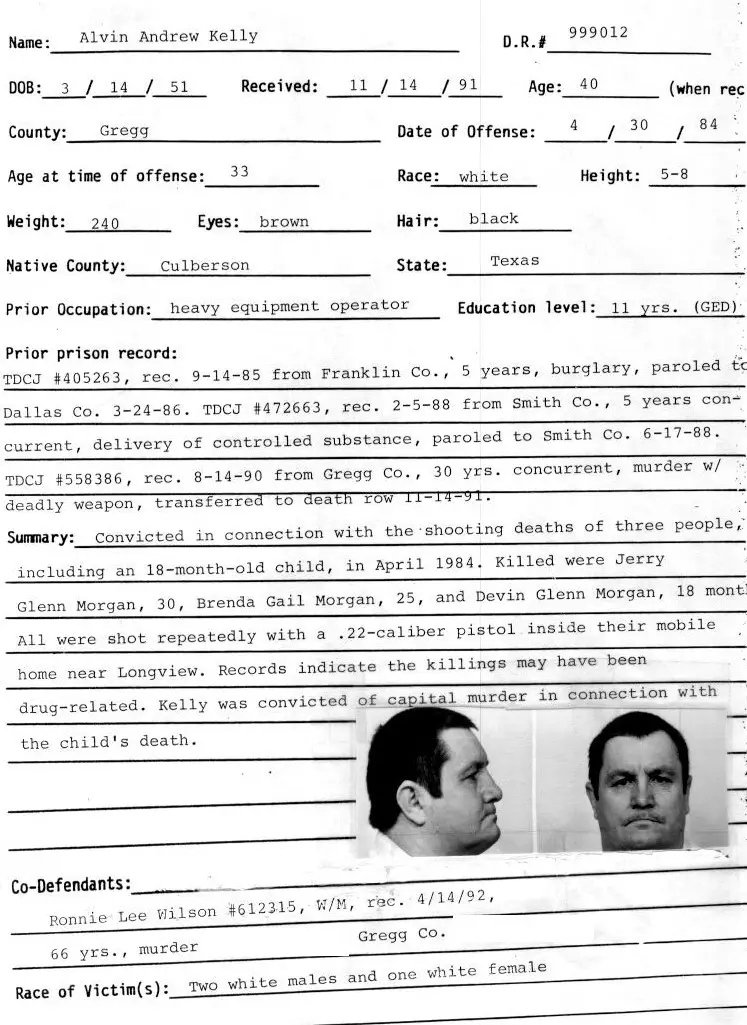
Inmate: Kelly, Alvin Andrew
Date of Birth: 03/14/51
DR#: 999012
Date Received: 11/14/91
Education: 11 years
Occupation: Heavy Equipment Operator
Date of Offense: 04/30/84
County of Offense: Gregg
Native County: Culbertson
Race: White
Gender: Male
Hair Color: Black
Eye Color: Brown
Height: 05' 08"
Weight: 240 lb
Prior Prison Record: TDCJ-ID #405263, five-year
sentence from Franklin County for Burglary, paroled 03/24/86; TDCJ
#472663, five years concurrent for Delivery of a Controlled Substance,
paroled 06/17/88; TDCJ #558386, 30 years concurrent for Murder with a
Deadly Weapon.
Co-Defendants: Ronnie Lee Wilson.
Texas Execution Information
Center by David Carson
Txexecutions.org
Alvin Andrew Kelly, 57, was executed by lethal
injection on 14 October 2008 in Huntsville, Texas for the murder and
robbery of a couple and their baby in their home.
On the morning of 1 May 1984, the bodies of Jerry
Morgan, 30, his wife, Brenda, 25, and their 22-month-old son, Devin,
were found in their Gregg County home by family members. Each victim
had died from gunshot wounds. Jerry Morgan was shot in the chest
several times. Brenda Morgan was shot once in the back. Devin was shot
once in the face. In addition, their car had been stolen, along with
several items from inside the home, including a television,
videocassette recorder, and several guns.
The murders remained unsolved for six years. In
1990, Chris Vickery called the Gregg County Sheriff's Office and told
them that his former wife, Cynthia Kelly, had information for them.
After authorities contacted Cynthia in Michigan, they obtained an
indictment charging her ex-husband, Alvin, in the 1984 triple homicide.
At Kelly's trial, his younger brother, Steven,
testified that he and Alvin were in the business of selling drugs.
Their source of drugs was a man named Walter Shannon. Several days
before the murders, Alvin, then 33, and Steven Kelly drove together
with Ron Wilson, 27, another drug dealer, to the victims' home.
Steven testified that when they arrived, Alvin
ordered him to stay in the vehicle. Disregarding that instruction,
Steven walked around to the back of the house because he heard an
argument. He observed Alvin pointing a gun at a man and threatening to
kill him. Alvin then noticed Steven watching and angrily ordered him
back to the vehicle. As Steven returned to the vehicle, he heard
Wilson arguing with a woman inside the home. Alvin and Wilson then
returned to the vehicle. As the three men drove away, Wilson said to
Alvin, "I told you not to bring him [Steven] because ... we're
supposed to take care of some business and ... we didn't take care of
it." Alvin responded, "We can always come back later and take care of
it ... there's no problem there."
Steven Kelly further testified that on the night of
30 April, Alvin, Cynthia, and Wilson arrived at his house. Appearing
nervous and hurried, Alvin said he was in serious trouble and needed
some money. Alvin said he had killed the family Steven had seen him
threaten, and the child was "involved". Alvin then handed Steven a
pistol and asked him for "five hundred dollars to get out of town."
Steven gave Alvin the $500, and Alvin left with Cynthia and Wilson.
Cynthia Kelly testified that on the evening of 30
April, Alvin, Wilson, and she drove to the victims' home. She
testified that she frequently accompanied Alvin on his drug deals,
knew that he carried a gun, and that she also carried a gun to "watch
his back", but she was unaware of both the destination and the purpose
of this trip. Upon their arrival, Alvin ordered her to remain in the
vehicle. While waiting for the men, Cynthia heard gunfire and a baby
crying. She then entered the home and saw that Alvin had a woman
pinned up against the wall and that a baby was crying. Cynthia picked
up the child and shielded him from the sign of his mother struggling
with Alvin. Alvin then shot the woman in the back of the neck and
dragged her to a bedroom. Cynthia put the baby in a chair and followed
Alvin into the bedroom. Alvin placed the woman next to her husband,
who had already been shot. The woman begged her for help. She
responded by placing a towel under her head. She then returned to the
living room and picked up the baby to comfort him. Alvin took the
crying infant from her and shot him in the head. He then aimed his gun
at Cynthia and ordered her to return to the vehicle. As she exited the
home, she heard another gunshot. Cynthia testified that Alvin shot the
mother and the infant with the same .22-caliber pistol.
Continuing her testimony, Cynthia said that Alvin
and Wilson exited the home with several items including guns, a coffee
maker, and some decorative brass butterflies. The two men drove away
in the victims' car, while she followed in their vehicle. After wiping
the victims' car for fingerprints, they abandoned it in a parking lot
in Tyler. Later, while driving, Alvin and Wilson discussed needing
money, and the three ended up at Steven Kelly's home.
The state introduced physical evidence
corroborating Cynthia's testimony, including the location and position
of the bodies in the home, the location of Brenda and Devin Morgan's
gunshot wounds, the caliber of the murder weapon, the towel under
Brenda's head, and the location of the victims' abandoned car. The
state also introduced evidence that Jerry and Brenda Morgan were city
marshal reserve officers. The prosecution argued that Alvin's motive
for killing the Morgans was that they were providing information to
law enforcement.
Cynthia's sister, Violet Brownfield, testified that
Alvin Kelly had bragged about killing a family, including a child.
Danny Moore, an acquaintance of Kelly's, testified
that Kelly told him he collected debts for a Walter Shannon. He
described a job he had done by telling him, "that man, his old lady,
and the kid ... they're not coming back." Moore testified that Kelly
also said, "There's going to be a lot more people end up like this if
they don't pay up."
In his defense, Kelly's lawyers claimed that the
victims were killed by an unidentified black assailant. This theory
was based on the evidence that two black males were apprehended for
stealing a pick-up truck from a parking lot near the victims'
abandoned car, and that a necklace recovered from that truck was
initially identified as belonging to Brenda Morgan. Additionally,
hairs with Negroid characteristics were found in vacuum sweepings from
the Morgans' home. The defense claimed that Cynthia Kelly had a
relationship with the actual assailant and fabricated her testimony to
protect him and/or to spite Alvin.
The state responded to Kelly's defense by
introducing an expert in trace evidence, who testified that the hairs
with Negroid characteristics found in the Morgan house did not match
either of the two black men who were apprehended for stealing the
truck, and furthermore that those hairs could have come from a
Caucasian person.
At the time of the triple homicide, Kelly had an
arrest record for unlawfully carrying a weapon. In the six years
between the triple homicide and his trial, he had several felony
convictions which resulted in prison time. In September 1985, he was
sentenced to 5 years for burglary. He was paroled in March 1986. In
February 1988, he was again sentenced to 5 years, this time for
delivery of a controlled substance. He was paroled 4 months later, in
June. (At the time, early release was common in Texas due to strict
prison population caps imposed by U.S. District Judge William Wayne
Justice.) In August 1990, Kelly pleaded guilty to the murder of his
roommate, John Ford, and was sentenced to 30 years in prison. He was
serving that sentence when he was charged with capital murder for the
Morgan killings.
A jury convicted Kelly of the capital murder of
Devin Morgan in October 1991 and sentenced him to death. The Texas
Court of Criminal Appeals affirmed the conviction and sentence in June
1996.
Ronnie Lee Wilson was convicted of murder and
sentenced to 66 years in prison. He remains in custody as of this
writing.
Kelly maintained his innocence throughout his
appeals. At an evidentiary hearing in U.S. district court in February
2007, Kelly testified that he did not kill the Morgans, and had never
met them. He admitted that he had been a drug dealer, but claimed that
on the night the Morgans were killed, he was changing the engine in a
truck with a man named Johnny Waller. He claimed that Cynthia and
Steven Kelly and others gave false testimony at his trial.
In that same hearing, Kelly's sister, Nancy Brown,
testified that she and her husband, Conley, visited Cynthia in Georgia
for several hours, and that in that meeting, Cynthia recanted her
trial testimony, telling her that "between you, me, and God," Alvin
Kelly did not kill Devin Morgan. Conley Brown testified that Cynthia
told him and his wife together that Kelly did not murder Devin.
Cynthia testified that she did meet with the Browns in Georgia, but
made no such statement.
Cynthia's sister, Beverly Frank, testified by
deposition that Cynthia had once stated that she killed Jerry Morgan.
Frank testified that she initially believed Cynthia's claim, but later
decided Cynthia was only trying to scare her because she was trying to
stop Cynthia's drug use. Frank testified that Cynthia was incapable of
killing anyone.
The district court found that Cynthia's testimony
was more credible and better supported by the entire record than the
Browns, and noted that even the Browns disagreed as to who was present
when Cynthia allegedly recanted her trial testimony. The court ruled
that Cynthia did not recant her testimony, and denied Alvin Kelly's
appeal. The U.S. Fifth Circuit Court of Appeals affirmed the district
court's ruling in April 2008. All of Kelly's subsequent appeals in
state and federal court were denied.
"I'm tired of being here," Kelly told a reporter in
an interview from death row in Livingston the week before his
execution. "This is not life." Even though he still denied murdering
the Morgans, Kelly said that he was looking forward to his execution
date. "I don't want a stay ... It's time for me to go home. I'm ready.
I embrace it." Kelly said that he would not cause any problems with
prison officials taking him to the death chamber in Huntsville "unless
they're going to bring me back".
"This is not an execution. This is a graduation day,"
Kelly said in another interview, which was videotaped and posted on
the internet. "To live is for Christ; to die is gain," he continued,
quoting from the New Testament book of Philippians. "I'm going home
with peace, and joy, and a song on my lips, you know what I'm saying?
I'm so ready to go."
Kelly described the murder of John Ford in a 2002
interview. "Actually, it wasn't supposed to be a murder," he explained.
Kelly said Ford owed him some drugs and money. He intended to drive
Ford out to the country and rob him of his money, drugs, and car, and
leave him on the side of the road. "That way, he would have plenty of
time to think about what he owed me and everything. I'm not proud of
that - it's stupid, but that was the plan." He said that the plan went
wrong when a gun Cynthia was holding on Ford went off - whether
accidentally or deliberately, he did not know. Kelly said, "I took the
gun away from her, and I'm gonna be honest with you, I was scared at
the time. I was trying to act cool, but I took the gun because I
thought she was going to shoot me too. We are all strung out on drugs,
and so, I took the gun, and I emptied the gun in John T. Ford. I shot
him about five times, emptying the gun so it wouldn't have anymore
bullets in it."
Kelly said that he collected and destroyed the
evidence at the scene, including setting Ford's vehicle on fire.
Because of this, Gregg County investigators did not have the evidence
to convict him. However, in 1987 while in jail on an unrelated charge,
he became a Christian after a visit from a minister. "I wanted to
clear my conscience and everything in my life," Kelly said, "so in
1990, I pled guilty to murdering John T. Ford."
Kelly explained that this guilty plea resulted in
him being charged for killing the Morgans also. He said he had
originally been cleared of suspicion in that case by the lead
investigator, Henry Mize, and the case was eventually put away
unsolved. When Mize died of a stroke, however, the cold case was
reopened. Kelly said that when he pleaded guilty to Ford's murder,
prosecutors were going to bring murder charges against his wife as
well, but she struck a deal with them: testify that Kelly was at the
scene of the Morgan killings in exchange for immunity from prosecution
for Ford's murder.
Kelly said he turned down several plea offers for a
life sentence in the Morgan case because accepting the offers would
have forced him to lie. "If I was guilty, I would plead guilty," he
said. "But I can't stand before God on a lie."
"I offer my sorrow, and my heart goes out to y'all,"
Kelly said in his last statement to the members of the Morgan family
who attended his execution. "I know you believe that you're going to
have closure tonight. As I stand before God today, the true Judge, I
had nothing to do with the death of your family." Kelly then asked for
forgiveness for Ford's murder "because I do stand guilty for my
involvement for that." Kelly also thanked his family, his friends, and
God. As the lethal injection was administered, he sang, "Thank You,
Lord Jesus, for coming into my life. You walked with me through prison.
Thank You, Lord Jesus, because You died for me. Thank You, Lord Jesus,
for remembering me." He then lost consciousness. He was pronounced
dead at 6:30 p.m.
Jerry Morgan's niece, Lori Kubecka, witnessed the
execution. Afterward, she told a reporter that she and the other
family members knew "without a shadow of a doubt" that Kelly was
guilty of the murders. She said Kelly's last words "made me ill." "None
of us came for closure," Kubecka said. "We were there to speak and
give voices to our family who did not have voices anymore."
East Texas man executed in
child's death
Dallas Morning News
Associated Press - Tuesday, October
14, 2008
HUNTSVILLE, Texas – A former East Texas truck
repair shop owner was executed Tuesday evening for fatally shooting a
22-month-old boy in a spree that also killed the child's parents.
Alvin Kelly thanked God, expressed love to friends
and relatives and denied committing the murder that led to his
execution. "I pray this gives you some peace," Kelly said from the
death chamber gurney, looking at four relatives of the slain family.
"I know you believe that you're going to have closure tonight. As I
stand before God today, the true judge, I had nothing to do with the
death of your family."
Alvin Kelly Kelly, 57, said he would ask God to not
hold that against them. At the same time, he acknowledged killing
another man for whom he was serving time when he was charged in the
death of the 22-month-old, who died in 1984 in Gregg County, about 100
miles east of Dallas.
As the drugs were administered, he began singing a
hymn praising God for coming into his life. "I thank you Lord Jesus
for remembering me ... ," he sang as the drugs took effect and he
slipped into unconsciousness. Twelve minutes later, at 6:30 p.m. CDT
he was pronounced dead.
Kelly was the 10th Texas prisoner executed this
year in the nation's busiest capital punishment state. He's among a
dozen condemned inmates scheduled to die over the next six weeks.
Another lethal injection is set for Thursday.
The U.S. Supreme Court last week refused to review
his appeal. His lawyer returned to the high court with another appeal,
asking for a reprieve while the justices examine a Tennessee case
about whether poor death row inmates seeking clemency from state
officials have a right to taxpayer-paid attorneys. About two hours
before his scheduled execution, the justices turned down the appeal.
Kelly, in an interview last week outside death row, said he didn't
want a reprieve and looked forward to "go home to God." "That's what
this is all about," he said. "I have friends and family who are sad.
But I am happy. I'm not going to die. I have eternal life."
Kelly already was serving a 30-year prison term for
murder when he was convicted of killing Devin Morgan, the 22-month-old
son of Jerry and Brenda Morgan. Relatives discovered the bodies at
their home in Spring Hill, a few miles northwest of Longview. Several
items also had been taken, including a car, at least five guns and
some television and stereo equipment.
The murders went unsolved for six years until a man
in Michigan told authorities that his former wife, who also had been
married to Kelly, had information about the case. Prosecutors said his
ex-wife never felt she could come forward because she feared Kelly,
who turned to drug dealing and manufacturing after his truck repair
business cratered because of his drug addiction. By then, Kelly said
he had found religion in the Gregg County Jail, where he was being
held on a drug charge and then was implicated in the aggravated sexual
assault of two fellow inmates. He turned down several plea deals to
confess to the three slayings, saying that accepting the offers would
force him to lie. "If I was guilty, I would plead guilty," he said
from death row. "But I can't stand before God on a lie."
He also denied the possibility he was so strung out
on methamphetamines at the time of the shootings that he couldn't
recall them. "If I did it, I'd remember," he said. "If I did it, I'd
admit to it." And while acknowledging he once viewed himself as a
gangster, he insisted prosecutors "wanted to make me out to be some
John Dillinger."
Lori Kubecka, who was 10 when her aunt, uncle and
nephew were killed, represented her family witnessing Kelly's
execution. "When it comes to what he did to our family, I think he
deserves it," she told the Longview News-Journal. "But it's been so
long. He has sat behind bars for so long now."
At Kelly's trial, prosecutors presented evidence
that showed Jerry and Brenda Morgan had been city marshal reserve
officers, and Kelly's motive was that they were providing information
about him to authorities. He said with his previous murder conviction,
plus convictions for burglary, weapons possession, controlled
substance delivery and possession and aggravated sexual assault, "I
didn't stand a chance."
"I still love Texas," he said. "I love bluebonnets.
Texas didn't put me here. I put me here, by my lifestyle. I'm not
pious. I'm not holy. I'm an old sinner."
Convicted E. Texas child killer
executed
Former repairman maintains his innocence
By Michael Graczyk - Houston Chronicle
Oct. 14, 2008
HUNTSVILLE, Texas — A former East Texas truck
repair shop owner was executed Tuesday evening for fatally shooting a
22-month-old boy in a spree that also killed the child's parents.
Alvin Kelly thanked God, expressed love to friends
and relatives and denied committing the murder that led to his
execution. "I pray this gives you some peace," Kelly said from the
death chamber gurney, looking at four relatives of the slain family.
"I know you believe that you're going to have closure tonight. As I
stand before God today, the true judge, I had nothing to do with the
death of your family."
Kelly, 57, said he would ask God to not hold that
against them. At the same time, he acknowledged killing another man
for whom he was serving time when he was charged in the death of the
22-month-old, who died in 1984 in Gregg County, about 100 miles east
of Dallas.
As the drugs were administered, he began singing a
hymn praising God for coming into his life. "I thank you Lord Jesus
for remembering me," he sang as the drugs took effect and he slipped
into unconsciousness. Twelve minutes later, at 6:30 p.m., he was
pronounced dead.
Kelly was the 10th Texas prisoner executed this
year in the nation's busiest capital punishment state. He's among a
dozen condemned inmates scheduled to die over the next six weeks.
Another lethal injection is set for Thursday.
The U.S. Supreme Court last week refused to review
his appeal. His lawyer returned to the high court with another appeal,
asking for a reprieve while the justices examine a Tennessee case
about whether poor death row inmates seeking clemency from state
officials have a right to taxpayer-paid attorneys. About two hours
before his scheduled execution time, the justices rejected the appeal.
Kelly, in an interview last week outside death row,
said he didn't want a reprieve and looked forward to going "home to
God." Kelly was serving a 30-year prison term for murder when he was
convicted of killing Devin Morgan, the 22-month-old son of Jerry and
Brenda Morgan. Relatives discovered the bodies at their home in Spring
Hill, a few miles northwest of Longview. Several items also had been
taken, including a car, at least five guns and some television and
stereo equipment.
The murders went unsolved for six years until a man
in Michigan told authorities that his former wife, who also had been
married to Kelly, had information about the case. Prosecutors said his
ex-wife never felt she could come forward because she feared Kelly,
who turned to drug dealing and manufacturing after his truck repair
business cratered because of his drug addiction.
By then, Kelly said he had found religion in the
Gregg County Jail, where he was being held on a drug charge and then
was implicated in the aggravated sexual assault of two fellow inmates.
He turned down several plea deals to confess to the three slayings,
saying that accepting the offers would force him to lie. "If I was
guilty, I would plead guilty," he said. "But I can't stand before God
on a lie."
Kelly Kubecka, who was 10 when her aunt, uncle and
nephew were killed, represented her family witnessing Kelly's
execution. "When it comes to what he did to our family, I think he
deserves it," she told the Longview News-Journal. "But it's been so
long. He has sat behind bars for so long now."
Scheduled to die on Thursday is Kevin Watts, 27,
convicted of the execution-style shootings of three people during a
robbery at a San Antonio restaurant in 2002.
ProDeathPenalty.com
On the morning of May 1, 1984, in Gregg County,
Texas, the bodies of Jerry Morgan, his wife Brenda Morgan, and their
twenty-two month old son Devin Morgan were discovered in their home by
other family members. Each victim died of gunshot wounds. Various
items were missing from the victims’ home, including a 1977 Pontiac
Catalina, a .22 caliber revolver, a .380 semi-automatic pistol, a 7-millimeter
rifle, a Remington 870 pump action shotgun, a .38 caliber derringer, a
television set, a video recorder, a stereo, decorative brass
butterflies, and a coffee maker.
These murders went unsolved for six years. In 1990,
a man named Chris Vickery called the Gregg County Sheriff’s Office and
indicated that Cynthia May Kelly Cummings, Alvin Kelly’s former wife,
had information for the authorities. At that time, Cynthia lived in
Michigan, and Kelly was serving a 30-year sentence in Texas for the
murder of John Ford. Kelly pleaded guilty to the unrelated murder of
John Ford which occurred after the Morgan murders. The authorities
contacted Cynthia, and ultimately obtained an indictment charging
Kelly with the capital murder of Devin during the course of the
robbery of Jerry.
At trial, Steven Kelly, Alvin Kelly’s younger
brother, testified that Kelly and he were in the business of selling
drugs. Kelly’s source of drugs was Walter Shannon. Several days prior
to the murders, Steven drove with Kelly and Ron Wilson, a fellow drug
trafficker, to the Morgans’ home. Prior to exiting the vehicle, Kelly
instructed Steven to remain in the vehicle. Disregarding that
instruction, Steven walked around to the back of the house because he
heard an argument. Steven observed Kelly pointing a gun at Jerry and
threatening, “I want you to know that I can kill you at any time.”
Kelly noticed Steven watching and angrily ordered him back to the
vehicle. As Steven returned to the vehicle, he heard Wilson arguing
with a woman inside the home. Kelly and Wilson then returned to the
vehicle. As the three men drove away, Wilson, obviously upset, said to
Kelly, “I told you not to bring him because . . . we’re supposed to
take care of some business, and . . . we didn’t take care of it, . . .
we’re supposed to prove a point, and now, that they’re going to be
upset with us.” Kelly responded, “We can always come back later and
take care of it . . . there’s no problem there.”
Steven further testified that a few days later on
the night of April 30, 1984 (the night of the Morgan murders), Kelly,
Wilson, and Cynthia arrived at his house after he and his wife went to
bed. Appearing very nervous and in a hurry, Kelly said he was in
serious trouble and needed money. Kelly confessed that he had killed
the family Steven had seen him threaten, and the child was “involved.”
Kelly then opened a briefcase, handed Steven a pistol, and asked for
“five hundred dollars to get out of town.” Kelly was wearing a pistol
when he entered Steven’s house but he did not give that gun to Steven.
Steven gave Kelly five hundred dollars and Kelly left with Cynthia and
Wilson.
Cynthia testified that she met Alvin Kelly sometime
in 1982 or 1983, and that they began living together in Tyler, Texas.
Cynthia and Kelly were married in 1985, after the Morgan murders.
Cynthia thereafter became addicted to methamphetamine. She frequently
accompanied Kelly when he sold drugs. Kelly carried a firearm and had
Cynthia carry a pistol to “watch his back.”
On the evening of April 30, 1984, after drinking
beer and injecting methamphetamine, Cynthia, Kelly, and Wilson drove
to the victims’ home. Upon arrival, Kelly ordered Cynthia to remain in
the vehicle. Cynthia had been unaware of both the destination and the
purpose of this trip.
While waiting for the men, Cynthia heard
gunfire and a baby crying. She entered the home and saw that Kelly had
a woman, Brenda Morgan, pinned against the wall and that a baby, Devin
Morgan, was crying. Cynthia picked up the child and shielded him from
the sight of his mother struggling with Kelly. Kelly shot Brenda in
the back of the neck and dragged her to a bedroom. Cynthia put the
baby in a chair and followed Kelly to the bedroom. Brenda’s husband
Jerry had already been shot, and Kelly placed Brenda next to him.
Brenda begged Cynthia for help, and Cynthia responded by retrieving a
towel and placing it under Brenda’s head. Cynthia returned to the
living room and attempted to comfort the crying baby. Kelly grabbed
the crying infant from Cynthia and shot him in the head. Kelly aimed
his gun at Cynthia and ordered her to return to the vehicle. As she
left the house, Cynthia heard Kelly again fire a shot. Cynthia
testified that Kelly used the same gun, a .22 caliber pistol, to shoot
both Brenda and the baby. Kelly and Wilson took several items from the
victims’ home, including guns, decorative brass butterflies, and a
coffee maker.
Kelly, with Wilson as a passenger, drove the
victims’ car and ordered Cynthia to follow him in their vehicle.
Pursuant to Kelly’s instructions, Wilson and Cynthia assisted Kelly in
wiping the victims’ car to destroy any fingerprints evidence. They
abandoned the car in a hospital parking lot in Tyler, Texas.
Subsequently, while driving, Kelly and Wilson discussed needing money,
and the three “ended up at” Steven’s home. Cynthia testified that her
memory became “blurry” after that point. She did remember, however,
that Kelly and Steven retreated to the pool room to have a
conversation. She did not hear the conversation.
The State introduced evidence corroborating several
points of Cynthia’s testimony, including the location of Brenda’s and
Devin’s gunshot wounds, the caliber of the murder weapon, the location
and position of the bodies in the home, the towel that was found under
Brenda’s head, and the location of the victims’ car, devoid of
fingerprints. The State also introduced evidence that Jerry and Brenda
had been City Marshal Reserve Officers. The state argued that Kelly
killed the Morgans because they were providing information to law
enforcement. Additionally, Cynthia’s sister Violet Brownfield
testified that Kelly “bragged” about killing a family, including a
child.
Danny Moore, who met Kelly through Moore’s cousin,
testified that Kelly said that he collected “debts at a forty-sixty
split” for Walter Shannon. Moore further testified that Kelly said he
had “taken care of that job . . . and needed to go see the man about
some money.” Kelly went on to say, “that man, his old lady, and the
kid . . . they’re not coming back.” Kelly became angry and said, “I
warned them, they had a chance. They wouldn’t do nothing.” Kelly
warned, “There’s going to be a lot more people end up like this if
they don’t pay up.”
Kelly’s defense theory was that the victims were
killed by an unidentified black assailant. He relied on the following
evidence: (1) hairs with Negroid characteristics were found in vacuum
sweepings from the Morgans’ home; (2) a pick-up truck was stolen from
a parking lot near the victims’ abandoned car; (3) two black males
were apprehended for the theft of that truck; and (4) a necklace was
recovered from the black males that two of the victims’ family members
initially identified as belonging to Brenda. Kelly’s theory was that
Cynthia had a relationship with a black man and that she fabricated
her story to protect that man or to attempt revenge against Kelly or
both.
In October of 1991, a Gregg County jury found Kelly
guilty of capital murder. At the punishment phase of the trial, the
state introduced evidence that Kelly had a bad reputation for violence
and a record of criminal convictions, including burglary, unlawful
weapon possession, controlled substance delivery and possession,
aggravated sexual assault, and murder. The jury affirmatively answered
the special issues set forth in the Texas Code of Criminal Procedure.
Accordingly, the trial court sentenced Kelly to death.
UPDATE: A former East Texas truck repair
shop owner was executed Tuesday evening for fatally shooting a 22-month-old
boy in a spree that also killed the child's parents. Alvin Kelly
thanked God, expressed love to friends and relatives and denied
committing the murder that led to his execution. "I pray this gives
you some peace," Kelly said from the death chamber gurney, looking at
four relatives of the slain family. "I know you believe that you're
going to have closure tonight. As I stand before God today, the true
judge, I had nothing to do with the death of your family."
Kelly, 57, said he would ask God to not hold that
against them. At the same time, he acknowledged killing another man
for whom he was serving time when he was charged in the death of the
22-month-old, who died in 1984 in Gregg County, about 100 miles east
of Dallas. As the drugs were administered, he began singing a hymn
praising God for coming into his life. "I thank you Lord Jesus for
remembering me ... ," he sang as the drugs took effect and he slipped
into unconsciousness. Twelve minutes later, at 6:30 p.m. CDT he was
pronounced dead. Lori Kubecka, who was 10 when her aunt, uncle and
nephew were killed, represented her family witnessing Kelly's
execution. "When it comes to what he did to our family, I think he
deserves it," she told the Longview News-Journal. "But it's been so
long. He has sat behind bars for so long now."
Man convicted in 1984 shooting
death maintains innocence
By Wes Ferguson - Longview News Journal
Sunday, October 12, 2008
You didn't mess with Big Al in the 1980s. Strung
out on methamphetamine, Alvin Andrew Kelly collected debts for a drug
operation in Kilgore. In 1984, he shot his own roommate, set the man's
truck on fire and dumped the body on a road near Lake Cherokee.
He sold drugs. He stole. He sexually assaulted two
of his fellow inmates in the Gregg County Jail. "I was a bad guy,"
said Kelly, who's scheduled to be executed Tuesday. "I thought I was a
gangster, you know what I'm saying?"
Kelly said he is ready to die for the crimes he
committed, but he swears he did not commit the crime that put him on
death row — the 1984 shooting death of 22-month-old Devin Morgan. The
toddler's body was found along with the bodies of his parents at their
home in the Spring Hill community.
"The travesty of this case is not my death, because
when I die I know where I'm going," said Kelly, who says he became a
Christian in 1987. "The travesty is the victims' family not getting
the truth, because I'm not the person that's responsible for this
family's death. All the fighting I have done in this case is not for
me. I am a child of God. He can do with me whatever he wants to."
Prosecutors and investigators have declined to comment until Kelly has
been executed. His attorney said he intends to ask the governor for a
30-day reprieve.
No physical evidence
On Monday, the U.S. Supreme Court declined to
review the case. The decision has all but ended an appeals process
that began soon after Kelly's conviction in 1991, when a Gregg County
jury reached a guilty verdict based largely on the testimony of
Kelly's ex-wife, Cynthia May Cummings.
Cummings testified she watched her husband and his
friend Ronnie Lee Wilson — who also was convicted — kill the Morgan
family. She described details of the crime scene that prosecutors said
only an eyewitness would know. Kelly's brother also testified. He said
he watched Kelly threaten to kill Jerry Morgan at the Morgans' home a
few days before the murders. He also said Kelly came to his house the
night of the deaths, admitted to the killings and asked for money to
flee town.
However, no physical evidence has been presented
that ties Kelly to the murders. Kelly maintains he first saw the
Morgans when his defense attorney showed him a family portrait shortly
before his trial. "There's no way I could possibly go in this house,
kill three people and drag their bodies to the end of (a bedroom) and
not leave some physical evidence — a hair, skin, blood or something,"
he said. "It's not there because I wasn't there."
After he dies, Kelly said, he believes the truth
will be revealed, but he said officials won't care. "They'll go, 'Oh,
we went on the evidence we had, and so what? He's an ex-drug-dealing
confessed murderer, and we did society a good deal by executing him.'
But that's not right," he said. "I have been offered a life sentence
three times in this case. I can't take a life sentence. I would have
to lie to myself, and I couldn't do that."
Kelly said he only is responsible for the death of
his roommate, John T. Ford, in a dispute over money and drugs 35 days
after the Morgan murders. In a recent interview on death row, he
claimed Cummings shot Ford first, and he merely emptied rounds into
Ford's dead body.
He also speculated that Ford and Cummings might
have killed the Morgans. Cummings has never been charged or indicted
on those accusations, and attempts to find her and her relatives were
unsuccessful.
17 years of appeals
Kelly's attorneys have argued that Cummings and
Kelly's brother agreed to testify in exchange for immunity in other
crimes, tarnishing their credibility. There is no documentation about
a formal agreement, though, and prosecutors have said there was no
deal. Appeals attorneys also have said a heart-shaped necklace casts
the state's entire case in doubt.
A few days after their deaths, police found the
Morgans' car on a street near a Tyler hospital. A few blocks away, a
pickup had been stolen the night of the killings. The pickup was found
in Grand Prairie, and the two men in the vehicle were arrested,
according to appeals attorneys' briefs. Inside the truck, officers
found a heart-shaped necklace.
Investigators presented the necklace to three of
Brenda Morgans' family members, who "immediately" recognized it as
hers, according to a brief filed by Kelly's attorney, T. Scott Smith
of Sherman. "Years later, a few weeks before trial — when it became
apparent that the man who stood accused might go free if the necklace
found in the truck with the two black males was in fact Brenda's —
these witnesses changed their mind and decided that this necklace did
not belong to Brenda Morgan," he wrote. "For unknown reasons, the
police excluded the two black males as suspects in the Morgan murders."
Contacted Friday, Brenda Morgan's mother, Betty
McGrede, said her daughter owned a heart-shaped necklace, but she
could not remember whether investigators showed it to her. Another
attorney, Mark Breding of Quitman, also says he found holes in the
state's case against Kelly.
Representing Kelly during his state appeals,
Breding took statements from Cummings' two sisters that cast doubt on
Cummings' testimony. Shortly thereafter, investigators questioned the
women, and they recanted their statements or said they were taking
medication and delusional when they spoke to Breding. Breding said he
does not buy that. "For them to completely gut their affidavits, it
just floored me. Both of them," he said. "I'm just curious what was
said to those ladies that made them completely change their story."
Kelly said he forgives the people who testified
against him, as well as the state of Texas, Gregg County and the
jurors who found him guilty. Days away from his scheduled death, Kelly
said he is ready, and he has asked for a special meal before he dies.
"I'm getting communion," he said. "I don't want no
worldly food. I filled out the paperwork, and I'm going to have the
Lord's Supper for my last meal. "I'm fasting from Sunday to Tuesday,
so when I go, I'll be purified."
*****
Niece keeps promise to watch
execution
Jim Morgan didn't live to see the execution of the
man who, on a spring night in 1984, craddled Morgan's toddler grandson
in one hand, held him at arm's length and shot the child in the face.
Morgan died a year and a half ago. Before his death, his granddaughter,
Lori Kubecka, made a promise to him that she intends to keep Tuesday.
"He said if he couldn't be there, he sure hoped I would step in," she
said. Kubecka said she is the only member of her family who plans to
witness the scheduled Tuesday execution of Alvin Andrew Kelly.
After 17 years of appeals, Kelly is set to die for
the murder of 22-month-old Devin Morgan, whose body was found along
with the bodies of his parents, Jerry and Brenda Morgan, at their home
in the Spring Hill area of Gregg County. Kelly's ex-wife and his
brother testified he killed the family, but Kelly says he didn't know
the Morgans and maintains he did not kill them. "I pray to God I can
go through with it," Kubecka said of witnessing Kelly's lethal
injection. "I hope I can actually go in, but I don't know if I can.
I'm going to be there, and I'm going to try."
The Morgans' remaining family members have mixed
emotions about the execution, Kubecka said. She said she could not
convince her mother, Brenda Morgan's sister, to join her Tuesday. "I
just have this huge knot in my stomach," Kubecka said. "I don't know
if it's right or wrong. I don't think it's right to take another
person's life. Even though this happened to us, I'm not really for the
death penalty.
"But I think it depends on the act, and for this
particular act, when it comes to a baby, he shot Devin in the face.
When it comes to what he did to our family, I think he deserves it.
But it's been so long. He has sat behind bars for so long now, I can't
really say. I don't know. "I feel for his family. They're going to see
now what we've gone through in the past 24 years."
Kubecka, who lives in Corpus Christi, was 10 at the
time of the killings. She lived a few streets away from the Morgans'
home on Greggtex Road and said she saw them almost every day. She
often helped her mother, Jerry Morgan's sister, baby-sit Devin. "For
years, we didn't know who did it. I was terrified. To this day, I
still cannot stay by myself overnight," she said. "Even though he's
behind bars, you still have this thought in the back of your mind that
if this man could do it, anyone could come into my home and kill my
family. It definitely traumatized me. It was such a brutal, brutal
murder."
A niece remembers the Morgan family
Jerry Morgan, 30: "Jerry was the kindest man. I
call him a clown, because he cut up with everybody. ... He was just a
fun-loving, very kindhearted person. He loved his family more than
anything in this world. He loved his son."
Brenda Morgan, 25: "Brenda was my role model. They
were so happy together. She loved her family, and she was a very
devoted mom. She was beautiful, just a beautiful person inside and
out."
Devin Morgan, 22 months: "Devin was an angel. I
remember the butterfly kisses I used to get from him. He'd wrap his
tiny little arms around my hand, and he'd just squeeze as hard as he
could."
— Lori Kubecka, who was 10 years old when the
Morgans were killed
*****
Family is 'never forgotten,' mom
and grandmother says
The "rocky horse" Betty McGrede built for her
grandson still sits on the front porch of her country home near
Hallsville. Devin Morgan was too small to ride it when he was killed
in 1984.
Two days from now, 57-year-old Alvin Andrew Kelly
is scheduled to die for the toddler's death. Devin would have been 26.
"Nothing's ever going to bring my kids back," said McGrede, whose
daughter and son-in-law, Brenda and Jerry Morgan, also were killed, "but
(Kelly has) lived longer than he really deserved to live."
The case went unsolved for about five years, until
Kelly's estranged wife implicated him in the deaths. "The first few
years after they were killed, you lived in fear because you didn't
know who they were, where they were, or why they did it," she said. "Chances
are, we'll live the rest of our lives and never know why."
At Kelly's trial in 1991, witnesses said the
killings might have been drug-related, but prosecutors presented no
physical evidence of that. McGrede said she does not believe the drug
claims. "Brenda would do good if you could get her to take aspirin for
a headache," she said. "There's just no way. I know there were rumors,
but I just don't believe they would have dealt with drugs in any way."
She said Devin had an older brother, Shane, who
died of complications from cerebral palsy two months before the
killings. Jerry and Brenda Morgan were still grieving when they were
killed.
Today, the McGredes often talk about the Morgan
family, especially around the holidays. "They're never forgotten," she
said. "It'll always be there. It changes you forever." After losing
her two grandsons, McGrede now has "a bunch of little girls," she said
– three granddaughters and four great-granddaughters. "None of the
grandkids were even born then," she said. "They just know by pictures."
*****
Alvin Kelly's road to execution
April 30, 1984: A Gregg County family is shot to
death in the Spring Hill community. The next morning, family members
discover the bodies of Jerry, Brenda and 22-month-old Devin Morgan,
arranged on the floor of Devin's bedroom.
June 5, 1984: A burning truck is found north of the
Judson community. The body of the owner, John T. Ford, is located a
few days later on a road near Lake Cherokee.
Sept. 5, 1985: A couple since 1982, Alvin Andrew
Kelly and Cynthia May Cummings marry. By 1987, they have separated,
and Cummings has move from East Texas to Michigan.
July 7, 1987: Kelly, who had been in the Gregg
County Jail on a drug charge, is convicted of the aggravated sexual
assault of two fellow inmates.
Nov. 20, 1989: A man in Michigan calls Gregg County
investigators to say Cummings, his ex-wife, has information about
Ford's and the Morgans' deaths. Cummings implicates her estranged
husband, Alvin Kelly.
July 26, 1990: Kelly pleads guilty to Ford's murder
and is sentenced to 30 years in prison. He denies killing the Morgan
family.
Sept. 23, 1990: In a sworn statement, Cummings says
she witnessed Kelly kill the Morgan family. She describes a towel she
folded under Brenda Morgan's head and provides other details that
prosecutors say only an eyewitness would know. She says another man,
Ronnie Lee Wilson, helped with the killings.
Nov. 28, 1990: Kelly is indicted in the Morgans'
deaths.
Oct. 24, 1991: After a weeklong trial, a Gregg
County jury deliberates 73 minutes before convicting Kelly of the
capital murder of Devin Morgan. A day later, the jury sentences Kelly
to death. Kelly is never tried for the deaths of Jerry or Brenda
Morgan. Kelly maintains he did not kill the family.
April 6, 1992: Wilson is found guilty of capital
murder and is sentenced to 66 years in prison. Wilson has been
eligible for parole since 1998, and is scheduled for release in 2013.
June 26, 1996: The first of almost 20 years of
failed appeals is announced, with the Texas Court of Criminal Appeals
affirming Kelly's sentence.
Aug. 15: Gregg County District Judge Alvin Khoury
sets Kelly's execution date for Oct. 14.
Oct. 6: The U.S. Supreme Court declines to review
the case.
Tuesday: Kelly is scheduled to be executed.
Canadian Coalition Against the
Death Penalty
Alvin Kelly - Texas Death Row
Hymns by Alvin Kelly
Interview with Alvin Kelly - By The Kilgore News Herald
TRIAL BY FIRE
My name is Alvin Kelly, I am presently incarcerated
on Texas Death Row at the Polunsky Unit in Livingston, Texas. We (Death
Row) were moved over here to the then Terrell Unit since named
Polunsky Unit in March 2000 from Ellis One Unit in Huntsville, Texas,
where we had a work program, religious services, in-cell craft program,
group exercise and in and outs each hour on the hour, just as
population does. Of course we were not allowed to mingle with
population inmates, we were kept in a Death Row society separated from
all the others.
Since our move to the new Polunsky Unit we have
been placed in isolation cells and denied all we have grown used to. I
have been on DR now for over 10 years, 8 of those years I spent on the
work program free of handcuffs and allowed all privileges as were
available at that time.
Since coming here to the Polunsky Unit we are
locked in our cells 23 hours a day. We are allowed out for one hour
exercise plus a shower. The rest of the time we are in our cells.
These are isolation cells 11 ft x 7 ft with a stainless steel sink and
toilet, a bunk against the far wall and a small table built into the
wall by the head of the bunk, all made of steel.
We are not allowed any work program at all, no TVs,
no religious services, no craft program, and no group rec. Everything
here is single man cells and single man rec (exercise). We are strip
searched and handcuffed every time we leave our cell for any reason.
Escorted by 2 officers, one holding on to your arm at all times, to
any place we go, shower, rec, medical or visitation. Then placed in
the cage at destination and uncuffed, all except medical. You are
never uncuffed during medical exam at all for any reason.
I explain all of this to give you an idea of what a
day on DR is like and the isolation cells add to the tension and
atmosphere. I am a Christian and consider myself a strong and mature
Christian. As I’ve said, I’ve been on the Row now for over 10 years
and I have never been in any trouble and never had a disciplinary case
of any kind for any reason. At Ellis Unit I was allowed Bible study on
Friday nights and church service on Sunday. So I kept my life filled
with doing God’s business and reading and studying His word. My
perspective on most things is different than most because I align all
I do to God’s law and His word. I try to live at peace with all men,
including the authority over me here.
I learned a lot about myself after coming to the
Polunsky Unit back in March 2000. A lot of it I didn’t like and was
honestly very ugly. My speech changed, my attitude towards others
changed, my temper got shorter and my whole world just seemed to be
out of control. I still read by Bible daily, do a college Bible study
course, and pray 3- times a day. But still I seem to be mad most of
the time.
In December of 2001 the Unit instituted a new
policy of our personal property could not exceed 2 bags. So this
brought on a major shakedown which we were all locked down in our
cells 24/7. During this shakedown I received my very first
disciplinary case which was for having my old craft supplies that I
was once allowed to purchase while at Ellis One. This consisted of my
small stapler, staples, craft scissors, 1 oz glue bottle, craft razor
blade, and some clear tape. All of which I’ve had for over 2 years of
being here. I pleaded guilty to the charge because I was in possession
of the items. However, a 10 year clean disciplinary record did not
mean anything, so I was given 15 days cell restriction, then placed on
Level 2 and moved to F-pod. F-pod is a disciplinary pod totally Level
2 and Level 3. Level 2 is property restriction, i.e. radio, fan
typewriter, all electrical, no commissary except 10 dollars postage
materials (stamps, pen, legal pads, envelopes etc.) every 2 weeks.
Level 2 can also buy hygiene supplies once every 30 days, i.e.
shampoo, toothpaste, deodorant. We are not allowed anything else from
the unit commissary. We’re only allowed rec one hour a day Monday –
Thursday, 4 days a week. On Friday, Saturday and Sunday we are locked
down 24/7. We were not even allowed our thermal underwear this winter
even when it was down to 30 degrees outside. We are only allowed 2
regular visits a month. Level 1 is allowed 1 visit per week each month.
Level 3 is not allowed any hygiene supplies at all,
only postage every 2 weeks. So the atmosphere down here is filled with
animosity. The people back here are denied anything beyond the meager
necessities to survive in any sort of dignity or humanity. It is an
evil and vile place. The atmosphere is filled with cussing, beating
and banging and floods, fires, feces and urine being chunked on people,
gas being sprayed in peoples’ cells or the day room where everyone has
to breathe it in. Visitation being denied some just because they live
on F-pod, and it just goes on and on.
I write this article to reflect what I as a
Christian have learned in my stay back here at F-pod. I do not
begrudge or belittle any man back here his stand or actions against
this unfair and unjust disciplinary system. I myself have to answer to
God first and then to man. I try to live my life, even back here, in
obedience to God’s law and submissive to man’s. I’ve found it hard,
cruel and at times almost unbearable. However, what I have learned is
that God sometimes allows us to be placed in a situation or
circumstances of our own making to allow us to face a deep seated sin
in our lives so we can recognize it and confess it to Him, and grow in
maturity and spirituality. Mine I came to know face to face was my
anger. I am not proud of my actions upon first arriving on F-pod nor
my response to the officials around me, as well as other inmates.
However, as I was faced with all this and came to see the ugly anger
buried deep within me, I began to cry out to God, Help me!
The first day I did this I must have went to God 20
times asking for His help to get past my anger. The next day maybe 15,
then 10, then 5, and so on until even now I still get angry and
believe me in this place its just a matter of time. But now as soon as
I do, no matter what the circumstances, I go straight to God and I’m
over it. I may not still be happy but I’m not out of control either,
therefore I sin not. I take it to God, he calms my soul, forgives me,
I therefore forgive the person I was angry with and God deals with the
problem so its not a problem any more.
I still have a long way to go in my walk and I am
trying every day to study and pray to come closer to Christ so I can
be a witness in this darkness to all those who are lost so they too
can come to know the hope and the joy of salvation by grace through
faith in Jesus Christ.
Feb. 19 2002
Alvin Kelly would appreciate pen pals and mail.
Please forward your mail to him directly at the following address:
Mr. Alvin Kelly , #999012
Polunsky Unit DR.
3872 FM 350 South
Livingston Texas 77351 USA
An Innocent Man on Texas Death
Row
LampOfHope.org
Background:
On April 30, 1984 in Longview Texas, Jerry and
Brenda Morgan and their 18-month-old son, Devin, were murdered in
their home. Jerry is shot 4 times, Brenda is shot once and Devin is
shot twice. The motive for the murders was never determined. Though
police and the DA's office apparently tried to link the killings to
drug activities during the trials, the Morgans were, by all accounts,
law-abiding, decent, hard-working average people with no connections
to criminal activity. Nothing of any value was stolen from the house.
The only missing items appear to be handguns and rifles from a gun
case, some small electronics and housewares and a heart-shaped
necklace of Brenda Morgan's.
The Morgan's car was taken and found the next
morning thirty miles away in Tyler, Texas. No murder weapon was found
and no suspect fingerprints were found at the scene or in the car. The
minimal forensic evidence recovered from the scene consisted of
African-American hairs found on a towel under Brenda Morgan's head,
assorted African-American hairs from vacuumings and some latent
fingerprints (none of which could be connected to the suspects,
including Wilson and Alvin and Cynthia Kelly). Unfortunately, DNA
technology in the 1980's was relatively new and unsophisticated and no
comparative testing or data bank comparison was done on the African
American hairs from the scene. However, with the passage of the new
DNA testing law in Texas, the test could be done now. No motive meant
there were no readily identifiable suspects and the investigation into
the murders quickly went cold.
In the winter of 1985, Roy Bean, a property crimes
detective with the Longview Police Department arrested Cynthia Mae
Kelly and her husband, Alvin Kelly, for outstanding warrants. Since
the investigation into the Morgan murders was still active, all police
personnel were asked to pursue information about the case with all
suspects. Cynthia apparently volunteered information about her
involvement in the murder of the Kellys' roommate, John Ford. During
this interview with Bean, Cynthia also said she had information about
the Morgan murders.
He turned this information over to the two Longview
homicide detectives in charge of the Morgan investigation. Neither
homicide detective talked to or interviewed Cynthia after receiving
the arresting Bean's information. Cynthia continued to contact Bean at
his office while she was in jail for outstanding warrants, asking if
she could get an offer of immunity in the Ford case for information
she claimed to have in the Morgan case. However , Bean did not have
the authority to promise her immunity. These contacts continued and at
no time did she mention Ronnie Lee Wilson. Bean also spoke with the
first assistant district attorney shortly after Cynthia's arrest and
told the ADA about Cynthia's knowledge of the Morgan murders, which
also implicated Alvin. Though Bean said he does not know whether the
ADA made a deal with Cynthia, he notes that shortly after he gave the
information to the ADA, Cynthia was released from jail and went to
stay with relatives in Michigan. Bean continued to receive calls from
Cynthia and her boyfriend about the immunity issue. The conversations
occurred through 1986. All interviews and calls were taped per
Longview Police Department Criminal Investigation Division policy.
Nothing of note occurred in the Morgan murder investigation until six
years later, 1990, when Cynthia suddenly came forward under
questionable circumstances to give a statement about her "knowledge”
of the crime. Subsequently, her husband Alvin and Wilson were charged
with the Morgan murders. Though Bean garnered extensive information
about the case from his conversations with Cynthia, he was never
called to testify in either trial or contacted by the police or DA's
office about the information he had. Worse yet, the prosecution
suppressed this critical information and neither Wilson nor his
defense attorney saw it until 1998.
Sequence of important events and conflicts:
April 30, 1984: Jerry, Brenda and Devin Morgan are
murdered between 6 and 9 p.m. according to the pathologist's report.
This is based on the fact that Jerry and Brenda are in their work
clothes and no dinner is being or has been prepared. The Morgan's
neighbor tells police she saw an African-American male drive away from
the Morgan home in the Morgan's car between 7:30 and 8 p.m. (it was
Daylight Saving time and light out). This lead was never followed up
on. In Tyler, Texas, thirty miles from Longview, a Silverado pickup is
reported stolen from Saunders Street.
May 1, 1984: Morning: the Morgan's car is found
thirty miles away in Tyler, Texas. One block from the recovery site is
the location from which Boswell's Silverado was stolen.
May 7, 1984: The stolen Silverado is recovered in
Grand Prairie, Texas in the possession of two African American males.
May 11, 1984: Evidence taken from the truck
includes: three towels, one hair, one vegetation sample and one
woman's necklace, a gold chain with a flying heart on it.
May 14, 1984: Because of the coincidence of the
Silverado theft just blocks from the Morgan car recovery site, an
investigator shows the necklace from the stolen vehicle to Brenda
Morgan's relatives, possibly believing it might have been Brenda's.
Brenda's sister and father identified the necklace as Brenda's.
Brenda's mother, her other sister and Jerry Morgan's mother could not
positively identify the necklace.
May 15, 1984: Brenda's mother remembers that her
daughter did have a necklace like the one she was shown the day before.
The sister who identified the necklace as Brenda's shows the
investigator a necklace she owned that was identical to the one Brenda
had. The floating heart necklace does not appear in photos taken of
the jewellery Brenda Morgan was wearing at the time of her autopsy
(May 3, 1984). According to an affidavit from Brenda's sister, police
only had possession of Brenda Morgan's rings. Brenda's necklace has
not been found.
May 16, 1984: The evidence is taken to the
Southwestern Institute of Forensic Sciences. The items have not yet
undergone DNA testing for comparison to national data banks of known
offenders, hairs found at the scene, or to Brenda Morgan to verify
whether or not the necklace was hers, though they have been recently
submitted for testing in Kelly's case and are waiting the results now.
Pre-trial background, 1990-92: Cynthia reappears
and divulges the information she allegedly has on the case.
Subsequently, Wilson and Alvin are charged with the murders. Cynthia
is the prosecution's only witness. Her testimony will be the
foundation of the prosecution's case. Supporting testimony (also
suspect) will come from one of Alvin's brothers. There is no
supporting forensic evidence or anything to link Alvin or Wilson to
the crime. Cynthia still has not been charged in any way with the John
Ford murder for which Alvin has received a thirty-year sentence. In
1990, prior to Cynthia's return to Texas, prosecutors visit her in
Michigan to discuss her participation in the trials of Alvin and
Wilson. She is brought back to Texas and gives a second statement,
under close supervision of prosecutors, that includes many obvious
discrepancies and untruths. During the Alvin Kelly trial, Cynthia was
sequestered in a state apartment, with her sister, under close
scrutiny of the state and was taking Demerol for her drug addiction (two
prescriptions are filled in one week). There are serious questions
about the degree to which Cynthia was a "voluntary" (and coherent)
witness in the case.
Cynthia Kelly -Immunity/prosecution issues:
John Ford murder: One of Alvin's brothers signs an
affidavit in 1998 that he overheard Cynthia tell his mother and his
wife, that she killed John Ford. The brother relayed this information
to prosecutors prior to Alvin's trial for the Morgan murders. They "seemed
not to want to hear this information " .
Morgan murders:
In an affidavit, Cynthia's sister relates a
conversation she had with prosecutors about Cynthia's involvement as a
witness in the case. She asked whether or not Cynthia might be
prosecuted or go to jail for her involvement in the crime. Prosecutors
assured her Cynthia would not. In a later conversation with an
investigator for the defense, again the sister says that prosecutors
told her not to worry, because, even though they were not giving
Cynthia immunity, they were not going to prosecute her. Cynthia
confirmed this information in a conversation with her sister after
Cynthia returned from giving her deposition in Texas.
Statement and Trial evidence:
September 1990: Cynthia gives a second statement
about the Morgan murders to prosecutors which conflicts with her 1985
statement. The information in the statement is used at Alvin's trial
and he is convicted of capital murder and sentenced to death in 1991.The
same statement is used in Wilson's trial to implicate him in the crime;
he is sentenced to 66 years on April 14, 1992. This second statement
from Cynthia, and subsequent testimony, is rife with inconsistencies,
irregularities and obvious untruths -the bulk of them concerning
Wilson's involvement. Problems include: Her original statement given
in 1985 did not match her deposition taken in 1990 and her deposition
did not match her trial testimony at Kelly's trial in 1991. When asked
about her statement at Kelly's trial she said she lied, but was
allowed to carry on with testimony.
Lack of solid motive:
The prosecution wove a tenuous story about the
murders being drug related. But, the Morgans were, by all accounts,
law-abiding, decent, hard-working average people with no connections
to drugs or other criminal activity. There is no logical reason to
believe the family was killed as the result of drug activity.
Purported visit to the Morgan home:
In Cynthia Kelly's version of events (deposition
hearing 1991) on the day of the murders, she, Alvin and Wilson stopped
by the Morgan trailer between the hours or 3-4 p.m. Cynthia claims to
have seen three cars in the driveway and people moving around inside
the trailer. Cynthia claims that Wilson went up to the door, knocked
and spoke calmly to a man (who she thought was Jerry Morgan) for a few
moments. It is interesting to note that this placid approach to the
trailer came only days after Steve Kelly claims to have witnessed the
pistol whipping of Jerry Morgan by Alvin Kelly. However, according to
testimony from Jerry Morgan's mother, her son and his wife were at
work during those hours; she was babysitting Devin and Jerry picked
the baby up sometime between 5:30, when he left work, and 5:45. Brenda
got off work at 6 p.m. and stopped by a store before going home. The
work hours of Jerry and Brenda were verified by investigators through
records at the Morgans' employers.
Conflicts in account of post-murder activities:
Cynthia gives two versions of what happened after
the murders. In one version (statement of Sept. 1990), she says that
after the murders, Alvin told her to go to the truck and follow him
and Wilson, who were in the Morgan car. The three drove to a wrecking
yard outside longview and Alvin told Cynthia to go home. She claims
she didn't see either Alvin or Wilson until the following morning (May
1) when the two men pulled into the Kelly yard with the Morgan car on
a wrecker. The statement was used to indict Wilson in 1990 but was
never allowed into court for the trial. In the second version (deposition
hearing 11 months later, 1991), Cynthia is questioned under oath and
now, rather than driving to the wrecking yard, she claims that the
three drove to Tyler, Texas where they abandoned the Morgan car a
block behind Mother Francis Hospital after wiping it clean of
fingerprints. The three then drove to the home of Alvin's brother in
Tyler. Cynthia said while she and Wilson waited in the truck, Alvin
went inside and had a long conversation with his brother. Cynthia,
Alvin and Wilson then supposedly drove to Waco and spent the entire
day there. The second version has obviously been tailored to fit the
evidence since Cynthia's initial version does not account for how the
car got to Tyler. The tailored version also conveniently and smoothly
brings Alvin's brother into the equation, thereby adding credence to
his subsequent testimony about his knowledge of the crime and Alvin's
involvement. Alvin and his brother have had an ongoing war between
them most of their lives.
The mystery wrecker/tow truck:
It is also interesting to note the deletion of the
wrecker/tow truck in Cynthia's second accounting of the post-murder
activities. According to Cynthia, Alvin and, allegedly Wilson, were
dropped at a wrecking yard after the murders and returned to the Kelly
home the next morning (May 1) with the Morgan car on a wrecker. The
tow truck aspect is particularly important because it directly
conflicts with information in Cynthia's second statement and testimony.
Had the prosecution revealed the information during the trial, Kelly's
defense attorney could have tried to verify or disprove the story
about the wrecker. But, this important lead could not be pursued.
Time frame inconsistencies:
Cynthia also testified that Wilson was in her
presence from the morning of April 30 to noon on May 2. There are
several problems with her story: First, Cynthia testifies that she,
Alvin and Wilson arrived at the Morgan home at 9 p.m. But autopsy
reports indicate that the victims had no food in their stomachs which
strongly indicates they were killed before eating dinner that night.
In addition, one of Brenda's sisters called the house sometime between
7 :30 and 8 p.m. and became concerned when she got no answer. There
was also testimony from three witnesses at Wilson's trial that he was
at the Good Shepherd Hospital in Longview between the hours of 2-5
p.m. on April 30 (when he is supposed to be in Rusk, Texas with the
Kellys). They remembered the date well because it was the day their
child had been born and they remembered Wilson visiting with his
mother and his stepfather. There was also testimony from more than one
person that Wilson was at his parents' home the evening and night of
April 30. Yet another critical and indisputable fact thoroughly
impeaches Cynthia Kelly's version of events. Cynthia claims that
Wilson was in her presence from April 30 to May 2. However, on May 2
when Wilson was allegedly in Waco and Rusk with the Kellys, he
received a speeding citation from the Longview Police Dept. at 2:42
p.m. (verified by an NCIC inquiry on Wilson at that time) .
False testimony about Wilson's vehicle:
At the time of the murders, Wilson drove a 1981
black and silver Chevy truck, which is verified by GMAC finance
records. He was in this truck when he received his traffic citation on
May 1 .However, Cynthia testified that the only vehicle she had ever
seen Wilson drive was an "old, little white car" which she claims he
was driving to and from the Kelly house in the April 30-May 2 time
frame. This story about a white car was never pursued and the
information never verified. But, the simple fact that Wilson was
driving his actual vehicle, the truck, when cited for speeding again
disproves Cynthia's story.
Perjury concerning official contact prior to
trial:
During the trial, Cynthia perjured herself again by
denying that she had ever spoken with other law enforcement officials
prior to her contact with the DA's office. In 1998, Cynthia's 1985
interview/statement and numerous conversations with a Longview Police
Dept. detective finally surfaced. The information came directly from
the arresting detective who signed an affidavit about his interviews
with Cynthia. The interviews and conversations were taped and held by
the Longview Police Dept. and should have been readily accessible by
the DA's office at the time of the trials.
Perjured supporting testimony:
During Alvin Kelly's trial, his brother Steve Kelly
testified that the Friday prior to the Morgan murders, he went with
Wilson and Alvin to a brick home in Longview, and that he was told to
stand by the car. Steve said that he heard voices, went to the back
yard and saw his brother kicking and pistol whipping a man he later
identified as Jerry Morgan. This beating went on for seven to ten
minutes. Despite this alleged kicking and pistol whipping, the coroner
confirmed that there were no bruises on Jerry. In addition, when Jerry
attended a Morgan family event at his mother's house the Sunday prior
to the murders, had no injuries. Steve testified that after this
incident, he, Alvin and Wilson returned to Alvin's home in Rusk.
According to Steve, there was a lamp on in the living room, about two
to four days before the killings. However, testimony at Alvin's trial
established that the electricity to the house in Rusk had been
terminated in April 4, 1984 until January of 1985. Steve said, on
April 4, 1984, while on drugs, said he took Alvin's clothes and a
piano and burned them outside the house at Rusk. Two neighbors
testified that, after the fire, it did not appear that anyone lived in
this house. This was the house in which Cynthia claimed she spent the
night after the Morgan murders three and one-half weeks later. Steve
also testified that a few days later, Alvin, Wilson and Cynthia
appeared at his house in the early morning hours. Contrary to the
Cynthia's testimony, Steve said there was no question that all three
came into his house and his (Steve's) wife was present. At Alvin's
trial, Steve admitted untruths in the statement he gave to police.
Following the Alvin Kelly trial, Steve Kelly has subsequently stated
on multiple occasions, "I turned state's evidence against my brother
for a crime he didn't do."
Suppression of prior interviews and tapes:
The critical evidence of the tapes and records of
prior contact with a law enforcement official was suppressed by the
DA's office during the trial. Wilson's defense attorney apparently
found out about the statement and tried to obtain a copy. He was told
it could not be found. The evidence would certainly not help the
prosecution since the inconsistencies cast reasonable doubt on the
veracity of their "star eyewitness". Furthermore, Cynthia's first
statement in 1985 was almost identical to her second with the
exception of those sections obviously changed to more closely fit the
evidence in the case. In view of that fact, Wilson and his attorney
(as well as Alvin's) should have been provided with the tapes and any
other materials dealing with her testimony under the Rules of Evidence.
False assertion that no deal was made with
prosecutor:
Despite her self-confessed involvement in the Ford
murder 17 days after the Morgan murders and her subsequent implication
of herself in the Morgan murders, Cynthia is a free woman who
seemingly need not fear prosecution for her involvement in these
heinous crimes. During the trial, Cynthia said she had not made a deal
with the DA's office in exchange for her testimony. Though it may be
technically true that no formal deal was made, no immunity officially
offered, there is clear evidence that a tacit agreement not to pursue
prosecution for her involvement in the cases existed. Though she
confesses her part in the Ford murder in 1985, and, according to
affidavits about conversations with her about the murder, may well
have been the one who actually pulled the trigger, she is free. She
possesses intimate and critical knowledge about the Morgan murders,
which led to the convictions of her husband and Wilson, yet she has
never been charged for her involvement. This oddity can only be
explained by the fact that there was indeed a deal, tacit as it may
be. In order to solve the crime, prosecutors and law enforcement
officials needed her information and testimony and two other people to
place inside the home to make their version of the events appear
credible.
Prosecutorial pressure and/or coercion:
Since the trial, numerous witnesses have come
forward with sworn evidence that indicates that Cynthia admitted to
them that she lied under oath because she was frightened. Her fear
stemmed from threats by the prosecution to charge her with the Ford
murder if she did not cooperate in the Alvin Kelly and Ronnie Lee
Wilson trials. Alvin's sister and brother-in-law say Cynthia told them
that officials threatened to kill her and her child if she did not
cooperate. During this meeting with Cynthia in 1998, Cynthia also
expressed fear for the her in-Iaw's welfare if they began "asking too
many questions". Cynthia has a history of drug and alcohol abuse and
involvement in crime. At the time, she had implicated herself in the
Ford murder. Threats of prosecution and eventual imprisonment would be
very real to her and effective tools against someone who would
probably have a strong sense of self-preservation. And, with no
statute of limitation on the crime of murder, the lack of an immunity
agreement or formal deal assures initial and continuing cooperation.
One of Alvin's brothers signed an affidavit in 1998 saying that he was
approached by prosecutors who said they would get rid of pending
criminal charges against him if he would give them information leading
to Alvin's conviction. He told them he knew nothing and served his
time. Though he had evidence about Alvin's innocence, prosecutors were
not interested in that. Another brother told people he was coerced
into giving untruthful testimony to convict Alvin.
Witnesses/coercion:
Before Kelly's trial he was contacted by Jonny
Waller who informed Kelly that he knew he did not kill the Morgans'
because he was with him the night this crime took place. They had just
changed out engines in Kellys truck. Kelly tells Waller to go to his
attorney and tell him this and come to trial and testify. At daylight
the next morning Gregg Co. sheriff Dept. raids the Waller home and
finds marijuana and drug paraphernalia. So Waller who is on parole
from TDCJ already is told if he comes to Kelly's trial he will be sent
back to prison. Waller has not been heard from since. Kelly has asked
every court appointed attorney to find and talk to Waller but none
have done so yet. Kelly has a court appointed attorney for his Federal
Habeas and Scott is a good attorney. However he has other cases and is
limited to the time and investigation he can spend on Kelly's case as
bell as having limited money for investigators. Jelly needs help in
finding his alibi witness and talking to other witnesses who were not
allowed to testify at the trial. Kelly is an indigent inmate and
cannot afford to pay investigative fees to hire an investigator. He
needs your help in finding and securing an investigator. To help
contact Kelly at:
Alvin Kelly, #999012
Polunsky Unit
3872 FM350 South
Livingston, Texas 77351 USA
Kelly v. Cockrell,
72 Fed.Appx. 67 (5th Cir. 2003) (Habeas).
Defendant, who was convicted of capital murder in
Texas and sentenced to death, filed petition for federal habeas relief.
The United States District Court for the Eastern District of Texas
denied the petition, and defendant filed application for issuance of a
certificate of appealability (COA). The Court of Appeals, Benavides,
Circuit Judge, held that: (1) affidavits executed seven years after
defendant's trial did not establish the factual basis underlying
defendant's claim that his death sentence constituted cruel and
unusual punishment because it was secured in part through the use of
perjured testimony; (2) even if defendant was denied sufficient funds
to adequately investigate and prepare his defense in violation of Ake,
defendant made no substantial showing of prejudice; and (3) defense
counsel did not render ineffective assistance. Denied.
BENAVIDES, Circuit Judge:
Petitioner Alvin Andrew Kelly (Kelly), convicted of
capital murder in Texas and sentenced to death, appeals the denial of
federal habeas relief. In his “Application for Issuance of a
Certificate of Appealability [COA] on Rejected Requests,” Kelly raises
following claims: (1) his conviction and sentence constitute a denial
of due process of law because he is actually innocent; (2) the
prosecutor violated his due process rights by arguing incorrectly to
the jury that his former wife should not be considered an accomplice;
(3) his death sentence constitutes cruel and unusual punishment
because it was secured in part through the use of perjured testimony;
(4) the denial of sufficient funds to adequately investigate and
prepare his defense constitute a denial of due process of law and
cruel and unusual punishment; (5) the failure to provide sufficient
funds to investigate and prepare his defense rendered counsel's
performance ineffective; (6) the state court's denial of his motion to
recuse itself denied him due process; and (7) counsel rendered
ineffective assistance at trial.FN1 For the reasons stated below, we
DENY a COA with respect to each of the seven claims.
FN1. Also, the district court granted a COA with
respect to four claims that have not yet been briefed and thus are not
before us: (1) Kelly's conviction was obtained through the
prosecution's use of perjured testimony; (2) the prosecution failed to
disclose exculpatory evidence; (3) the prosecution did not disclose
that it had agreed not to prosecute Kelly's former wife or brother-in-law
in exchange for their testimony; and (4) the district court made
impermissible credibility determinations in connection with the grant
of summary judgment.
I. FACTUAL AND PROCEDURAL HISTORY.
On the morning of May 1, 1984, in Gregg County,
Texas, the bodies of Jerry Morgan, his wife Brenda, and their twenty-two
month old son Devin were discovered in their home by other family
members. Each person had died of gunshot wounds. Various items were
missing from the victims' home, including a 1977 Pontiac Catalina, a
.22 caliber revolver, a .380 semi-automatic pistol, a 7-millimeter
rifle, a Remington 870 pump action shotgun, a .38 caliber derringer, a
television set, a video recorder, a stereo, decorative brass
butterflies, and a coffee maker.
These murders remained unsolved for six years. In
1990, a man named Chris Vickery called the Gregg County Sheriff's
Office and indicated that his former wife, Cynthia Kelly (Cynthia),
had information for the authorities. At that time, Cynthia lived in
Michigan, and Kelly was serving a 30-year sentence in Texas for the
murder of John Ford.FN2 The authorities contacted Cynthia, and
ultimately obtained an indictment charging Kelly with the capital
murder of Devin Morgan during the course of the robbery of his father,
Jerry Morgan.
FN2. Kelly had pleaded guilty to the unrelated
murder of John Ford, which occurred after the instant offense.
At trial, Steven Kelly, Kelly's younger brother,
testified that Kelly and he were in the business of selling drugs.
Kelly's source of drugs or “main man” was Walter Shannon.FN3 Several
days prior to the instant offense, Steven drove with Kelly and Ron
Wilson, a fellow drug trafficker, to a home later identified as the
victims' home. Prior to exiting the vehicle, Kelly instructed Steven
to remain in the vehicle. Disregarding that instruction, Steven walked
around to the back of the house because he heard an argument. Steven
observed Kelly pointing a gun at Jerry Morgan and threatening “I want
you to know that I can kill you at any time.” Kelly noticed Steven
watching and angrily ordered him back to the vehicle. As Steven
returned to the vehicle, he heard Wilson arguing with a woman inside
the home. Kelly and Wilson also returned to the vehicle. As the three
men drove away, Wilson, who was obviously upset, said to Kelly “I told
you not to bring him [Steven] because ... we're supposed to take care
of some business, and ... we didn't take care of it, ... we're
supposed to prove a point, and now, that they're going to be upset
with us.” Kelly responded “we can always come back later and take care
of it, ... there's no problem there.”
FN3. Walter Shannon was also known as W.W. Shannon.
Steven further testified that a few days later on
the night of April 30, 1984 (the night of the instant offense), Kelly,
Wilson and Cynthia arrived at his house after he and his wife had gone
to bed. Appearing very nervous and in a hurry, Kelly said he was in
serious trouble and needed money. Kelly confessed that he had killed
the family Steven had seen him threaten, and the child was “involved.”
Kelly then opened a briefcase, handed Steven a pistol, FN4 and asked
for “five hundred dollars to get out of town.” Steven gave Kelly the
five hundred dollars, and Kelly left with Cynthia and Wilson.
FN4. Kelly was wearing a pistol when he entered
Steven's house but he did not give that gun to Steven.
Cynthia testified that she met Kelly sometime in
1982 or 1983 and they began living together in Tyler, Texas.FN5
Cynthia thereafter became addicted to methamphetamine and would
frequently accompany Kelly while he was conducting drug deals. Kelly
carried a firearm and had Cynthia carry a pistol to “watch his back.”
FN6
FN5. Cynthia and Kelly were married after the
instant offense on September 5, 1985.
FN6. Kelly told Cynthia that the police could not
perform a ballistics test on a .22 caliber gun.
On the evening of April 30, 1984, after drinking
beer and injecting methamphetamine, Cynthia, Kelly, and Wilson drove
to the victims' home. Upon arrival, Kelly ordered Cynthia to remain in
the vehicle. Cynthia had been unaware of both the destination and the
purpose of this trip. While waiting for the men, Cynthia heard gunfire
and a baby crying. She entered the home and saw that Kelly had a woman
(Brenda Morgan) pinned against the wall and that a baby (Devin Morgan)
was crying. Cynthia picked up the child and shielded him from the
sight of his mother struggling with Kelly. Kelly shot Brenda in the
back of the neck and dragged her to a bedroom. Cynthia put the baby in
a chair and followed Kelly to the bedroom. Brenda's husband Jerry had
already been shot, and Kelly placed Brenda next to him. Brenda begged
Cynthia for help, and Cynthia responded by retrieving a towel and
placing it under Brenda's head.
Cynthia returned to the living room and attempted
to comfort the crying baby. Kelly grabbed the crying infant from
Cynthia and shot him in the head. Kelly aimed his gun at Cynthia and
ordered her to return to the vehicle. As she exited the home, Cynthia
heard Kelly again shoot the infant. Cynthia testified that Kelly used
the same gun, a .22 caliber pistol, to shoot both Brenda and the baby.
Kelly and Wilson took several items from the
victims' home, including guns, decorative brass butterflies, and a
coffee maker. Kelly, with Wilson as a passenger, drove the victims'
car and ordered Cynthia to follow him in their vehicle. Pursuant to
Kelly's instructions, the three wiped the victims' car to destroy any
fingerprints and abandoned the car in a hospital parking lot in Tyler,
Texas. Subsequently, while driving, Kelly and Wilson discussed needing
money, and the three “ended up at” Steven's home. Cynthia's memory
became “blurry” after that point; however, she did remember Kelly and
Steven retreating to the pool room to have a conversation.FN7. Cynthia
did not hear any of their conversation.
The State introduced evidence corroborating several
points of Cynthia's testimony, including the location of the mother's
and child's gunshot wounds, the caliber of the murder weapon, the
location and position of the bodies in the home, the towel that was
found under the mother's head, and the location of the victims' car (which
was devoid of fingerprints). The State also introduced evidence that
Jerry and Brenda Morgan had been City Marshal Reserve Officers and
argued that Kelly's motive for killing the Morgans was that they were
providing information to law enforcement.
Additionally, Cynthia's sister Violet Brownfield
testified that Kelly had “bragg[ed]” about killing a family, including
a child. Danny Moore, who had met Kelly through Moore's cousin,
testified that Kelly said he collected “debts at a forty-sixty split”
for Walter Shannon. Moore further testified that Kelly said he had
“taken care of that job ... [and] need[ed] to go see the man about
some money.” Kelly further explained that “that man, his old lady, and
the kid ... they're not coming back.” Kelly became angry and said “I
warned them, they had a chance. [T]hey wouldn't do nothing.” Kelly
warned that “there's going to be a lot more people end up like this if
they don't pay up.”
Kelly's defense theory was that the victims were
killed by an unidentified black assailant. He relied on the following
evidence: (1) hairs with Negroid characteristics were found in vacuum
sweepings from the Morgans' home; (2) a pick-up truck was stolen from
a parking lot near the victims' abandoned car; (3) two black males
were apprehended for the theft of that truck; and (4) a necklace was
recovered which two of the victims' family members initially
identified as belonging to Brenda Morgan. Kelly's theory was that
Cynthia had a relationship with a black man and she had fabricated her
story to protect that man and/or to attempt revenge against Kelly.FN8
FN8. The State introduced evidence through Timothy
Fallon, a Trace Evidence Analyst, that the hairs that had Negroid
characteristics did not match either of the two black men who were
apprehended for theft of the truck. Additionally, Fallon explained
that hair that had Negroid characteristics did not necessarily come
from a black individual and could come from a Caucasian individual.
In October of 1991, a Gregg County, Texas jury
found Kelly guilty of capital murder. At the punishment phase of the
trial, the State introduced evidence that Kelly has a bad reputation
for violence and a record of criminal convictions, including burglary,
unlawful weapon possession, controlled substance delivery and
possession, aggravated sexual assault, and murder. The jury
affirmatively answered the special issues set forth in Article
37.071(b) of the Texas Code of Criminal Procedure, and the trial court
sentenced Kelly to death. The Texas Court of Criminal Appeals affirmed
the conviction and sentence, Kelly v. State, No. 71,361 (Tex. Crim.App.
June 26, 1996), and the Supreme Court denied Kelly's petition for
certiorari on March 24, 1997. Kelly v. Texas, 520 U.S. 1145, 117 S.Ct.
1316, 137 L.Ed.2d 479 (1997).
Kelly filed a state habeas petition, and the state
trial court recommended denying relief. The Court of Criminal Appeals
denied relief without written order, Ex parte Kelly, No. 36,791-10 (Tex
.Crim.App. April 8, 1998), and the Supreme Court denied certiorari on
October 5, 1998. Kelly v. Texas, 525 U.S. 891, 119 S.Ct. 210, 142 L.Ed.2d
172 (1998).
The federal district court dismissed Kelly's first
federal habeas petition as unexhausted. Kelly then filed a second
application for state post-conviction relief, which was dismissed as
an abuse of the writ by the Texas Court of Criminal Appeals. Ex Parte
Kelly, No. 36,791-02 (Tex.Crim.App. September 13, 2000). Kelly then
filed the instant petition, which the district court denied. As
previously indicated, the district court granted Kelly's motion for a
COA with respect to four claims that have yet to be briefed. Before us
now is Kelly's application for a COA with respect to seven issues.
II. STANDARD OF REVIEW
As indicated, Kelly requests a COA from this Court.
Section 2253(c)(1) provides that “[u]nless a circuit justice or judge
issues a certificate of appealability, an appeal may not be taken to
the court of appeals....” Recently, the Supreme Court made clear that
“until a COA has been issued federal courts of appeals lack
jurisdiction to rule on the merits of appeals from habeas petitioners.”
Miller-El v. Cockrell, 537 U.S. 322, 123 S.Ct. 1029, 1039, 154 L.Ed.2d
931 (2003). To obtain a COA, Kelly must make “a substantial showing of
the denial of a constitutional right.” 28 U.S.C. § 2253(c)(2); Miller-El,
123 S.Ct. at 1039; Slack v. McDaniel, 529 U.S. 473, 483, 120 S.Ct.
1595, 146 L.Ed.2d 542 (2000). To make such a showing, he must
demonstrate that “reasonable jurists could debate whether (or, for
that matter, agree that) the petition should have been resolved in a
different manner or that the issues presented were adequate to deserve
encouragement to proceed further.” Miller-El, 123 S.Ct. at 1039 (internal
quotation marks and citations omitted).
In Miller-El, the Supreme Court reiterated that we
“should limit [our] examination to a threshold inquiry into the
underlying merit of [the] claims.” Miller-El, 123 S.Ct. at 1034 (
Slack, 120 S.Ct. 1595). The Court explained that “a COA ruling is not
the occasion for a ruling on the merit of petitioner's claim....” Id.
at 1036. Instead, a COA ruling “requires an overview of the claims in
the habeas petition and a general assessment of their merits.” Id. at
1039. To make this assessment, a court of appeals “look [s] to the
District Court's application of AEDPA to petitioner's constitutional
claims and ask[s] whether that resolution was debatable amongst
jurists of reason.” Id. “This threshold inquiry does not require full
consideration of the factual or legal bases adduced in support of the
claims.” Id. If a court of appeals denies a COA by deciding the merits
of an appeal, it essentially decides the appeal without jurisdiction.
Id.
We must be mindful that “a claim can be debatable
even though every jurist of reason might agree, after the COA has been
granted and the case has received full consideration, that petitioner
will not prevail.” Id. at 1040. As such, we do not decide the merits
of Kelly's claims, but only whether he has demonstrated that “
‘reasonable jurists would find the district court's assessment of the
constitutional claims debatable or wrong.” ’ Id. (quoting Slack, 529
U.S. at 484, 120 S.Ct. at 1604). Additionally, when a district court
denies a claim on a procedural ground, “a COA should issue when the
prisoner shows, at least, that jurists of reason would find it
debatable whether the petition states a valid claim of the denial of a
constitutional right and that jurists of reason would find it
debatable whether the district court was correct in its procedural
ruling.” Id.
III. ANALYSIS
A. DUE PROCESS VIOLATION BASED ON CLAIM OF
ACTUAL INNOCENCE
Kelly first argues that his conviction and sentence
constitute a denial of due process because he is actually innocent of
the crime. Relying on Herrera v. Collins, 506 U.S. 390, 113 S.Ct. 853,
122 L.Ed.2d 203 (1993), the district court concluded that “[b]ecause
clemency can be obtained from the Board of Pardons and Paroles of the
State of Texas, actual innocence, by itself, is not a claim for which
relief can be granted in federal habeas corpus for someone sentenced
to death under Texas law.” Finding the claim not cognizable in federal
habeas proceedings, the district court denied relief and a COA.
“Claims of actual innocence based on newly
discovered evidence have never been held to state a ground for federal
habeas relief absent an independent constitutional violation occurring
in the underlying state criminal proceeding.” Herrera, 506 U.S. at
400, 113 S.Ct. 853. Instead, a claim of actual innocence is a “gateway
through which a habeas petitioner must pass to have his otherwise
barred constitutional claim considered on the merits.” Id. at 404, 113
S.Ct. 853. Accordingly, we conclude that the district court's
conclusion is not debatable among jurists of reason.
Kelly argues that the independent constitutional
claim is the due process violation based on the state's awareness of
the false testimony it elicited at trial. However, as noted previously,
the district court has granted a COA with respect to that particular
due process claim. At this point in the appeal, we are addressing only
the claims that involve a request for a COA.
B. DUE PROCESS VIOLATION BASED ON PROSECUTORIAL
ARGUMENT
Kelly argues that his due process rights were
violated by the prosecutor's incorrect argument that Cynthia should
not be considered an accomplice with respect to the instant offense.
For constitutional error to have occurred, a prosecutor's improper
argument must have “so infected the trial with unfairness as to make
the resulting conviction a denial of due process.” Darden v.
Wainwright, 477 U.S. 168, 181, 106 S.Ct. 2464, 2471, 91 L.Ed.2d 144
(1986); cf. Earvin v. Lynaugh, 860 F.2d 623 (5th Cir.1988) (the
evidence must be so insubstantial that no conviction would have
occurred but for the argument made by the prosecutor).
During closing arguments at the guilt-innocence
phase, the prosecutor referred to the jury instructions and stated the
following:
The law in Texas is that if an accomplice testifies,
before a Jury can convict, there must be some other evidence to
connect the Defendant to the offense charged. The Court goes on to
tell you what an accomplice is. And we submit, ladies and gentlemen,
Cindy Kelly is not an accomplice because Cindy Kelly did not act with
intent to promote or assist in the commission of this offense. She did
not enter the house with the intent to commit the murder or the
robbery. In fact, Cindy Kelly acted in an attempt to stop what was
done. She attempted to stop the murder of the baby. She begged this
Defendant to leave the baby at a doorstep and to save the baby's life.
The very crime scene itself shows that Cindy Kelly is not a party to
this offense because she is the one that left the folded towel under
the head of Brenda Morgan in an attempt to comfort the victim. The
Court further instructs you that to be a party to the offense, they
must be connected to the offense before or during the commission of
the offense. Cindy Kelly, at the order and direction of Alvin Kelly,
drove away at his instructions and his direction. At his order, she
helped wipe the car down in Tyler after the capital murder was
complete. She had no intent prior to or during to aid or assist in the
commission of the offense. She just thought this was business as usual
when her [sic] and Al went out. The Court also tells you that mere
presence alone does not make a person an accomplice. Even if there's
any question in your mind as to whether Cindy Kelly is an accomplice,
the testimony is corroborated and overwhelming by three witnesses -
three witnesses who this Defen[d]ant confessed to - Steve Kelly, his
brother, Violet Brownfield, and Danny Moore.
The record contains evidence supporting the
prosecutor's argument that Cynthia was not an accomplice. As such, the
argument is a fair comment on the evidence.
Relying on Creel v. State, 754 S.W.2d 205 (Tex.Crim.App.1988),
the district court denied relief. In Creel, the Court of Criminal
Appeals reiterated that without an affirmative act on the part of the
witness to assist or encourage the murder, the witness is not an
accomplice. Id. at 213. Indeed, Kelly points to no evidence at trial
that Cynthia committed an affirmative act to assist or encourage the
murder of the baby, Devin. We conclude that the district court's
resolution of this issue is not debatable among jurists of reason.FN9
FN9. In support of his argument, Kelly relies on
the Supreme Court's decision in Alcorta v. Texas, 355 U.S. 28, 78 S.Ct.
103, 2 L.Ed.2d 9 (1957). There, the Supreme Court held that the
petitioner's due process rights were violated when the prosecutor
knowingly elicited testimony that gave a false impression of material
evidence to the jury. Alcorta did not involve a claim of improper
prosecutorial argument. To the extent that Kelly is attempting to
argue that his due process rights were violated based on the
prosecution's knowing use of perjured testimony and failure to
disclose exculpatory evidence, as noted previously, those claims are
not yet before us.
* * *
G. VIOLATION OF SIXTH AMENDMENT RIGHT TO
EFFECTIVE ASSISTANCE OF COUNSEL
The Supreme Court has recently reaffirmed the
familiar two-prong test for ineffective assistance of counsel:
First, the defendant must show that counsel's
performance was deficient. This requires showing that counsel made
errors so serious that counsel was not functioning as the “counsel”
guaranteed the defendant by the Sixth Amendment. Second, the defendant
must show that the deficient performance prejudiced the defense. This
requires showing that counsel's errors were so serious as to deprive
the defendant of a fair trial, a trial whose result is reliable. (Terry)
Williams v. Taylor, 529 U.S. 362, 120 S.Ct. 1495, 1511, 146 L.Ed.2d
389 (2000) (quoting Strickland v. Washington, 466 U.S. 668, 687, 104
S.Ct. 2052, 80 L.Ed.2d 674 (1984)). To demonstrate that counsel was
ineffective, a petitioner must establish that counsel's representation
fell below an objective standard of reasonableness. See id. To show
prejudice, he must show that there is a reasonable probability that,
but for counsel's error, the result of the proceeding would have been
different. See id. at 1511-12.
1. Failure to Properly Examine Cynthia
Kelly argues that counsel rendered ineffective
assistance by failing to cross-examine Cynthia with respect to the
existence of any agreement she had with the State for her testimony.
During the state habeas proceedings, the state court found that
“[t]here was no agreement between the State and Cynthia ... that she
would not be prosecuted for the murders to induce her to testify.”
Kelly admits that because Cynthia denied any such
agreement during her pre-trial deposition, counsel correctly would
have expected her to continue to do so at trial. Kelly further
acknowledges that the prosecutor personally represented to the court
that no deal had been made with Cynthia in exchange for her testimony
and that the State did not consider Cynthia a codefendant or a
coconspirator. Instead, according to the State, Cynthia was a witness
to the murders. Nonetheless, Kelly asserts that had counsel asked
Cynthia whether she had received anything for her testimony, it would
have (at least) raised a question of credibility for the jurors.
The district court assumed arguendo that counsel's
failure to make this inquiry constituted deficient performance. With
respect to the second prong, the district court “adopted” the state
court's finding that there was no agreement between the State and
Cynthia that she would not be prosecuted in exchange for testifying
against Kelly. Based on this factual finding, the district court found
there was not a reasonable probability that, had counsel cross-examined
Cynthia with respect the existence of any such agreement, the outcome
of the guilt or sentencing phase would have been different.
Relying on the affidavits of Kelly's sister Nancy
Brown and her husband, Conley Brown, defense investigator Barry
Higginbotham, Cynthia's sister, Beverly Stemen, and state habeas
counsel Mark Breding, Kelly contends that subsequent investigation has
demonstrated that the authorities either: (1) coerced Cynthia into
testifying by threatening her life and that of her son; or (2)
promised, advised, or lead Cynthia to believe that she would not be
prosecuted if she returned to Texas to testify.
Contrary to Kelly's contentions, the hearsay in the
affidavits regarding some vague threat by the authorities does not
rise to a substantial showing. None of the affidavits provide that
Cynthia admitted that she had an agreement with the State. The closest
allegation is that representatives of the district attorney's office
told Cynthia's sister Beverly Stemen that although Cynthia would not
be granted immunity, she would not be prosecuted. Kelly's argument is
that Cynthia was not prosecuted even though her sister informed
Assistant District Attorney Rebecca Simpson that Cynthia had confessed
to shooting Jerry Morgan.
However, the state court found that Beverly never
had a conversation with Simpson or the District Attorney's Office
investigator Russell Potts concerning Cynthia shooting Morgan.
Moreover, as set forth previously, in a 2001 deposition, Cynthia's
sister Beverly contradicted her previous affidavit by testifying that
“I remember [Cynthia] saying very clearly on that point, very clearly
that in [Cynthia's] dream she had shot the man.” FN19 Further, the
state court found that Cynthia never told her sisters that she shot
Jerry Morgan and that Cynthia's reference to shooting a man was only
in the context of a nightmare.
FN19. As set forth previously, Beverly stated in
her deposition that she was angry at Cynthia at the time she lied.
Beverly also indicated that she was taking “medications” and went to
see a psychiatrist because the medicine “was causing me to do things
and say things that weren't of my nature, that were inappropriate.”
Specifically, the state court found that Beverly was taking the
following medications when she had executed the affidavit: “Luvox,
Wellbutrin, Cytomel, Trazodone, Methyphaidate, Conazepam, Methpheid,
Cyclobenzaabr, Ultram, and Zepharine.”
The State's position has been that Cynthia did not
participate in the murders and thus she would not be prosecuted. The
state court found that District Attorney's Office investigator Russell
Potts and Sheriff's investigator Chuck Willeford informed Cynthia that
“if it was shown that she participated in the crime she would be
prosecuted. She was informed that mere presence at the scene was not
sufficient to charge her with the crime.”
In any event, the question before us is whether
Kelly has made a substantial showing that there is a reasonable
probability of a different outcome had defense counsel cross-examined
Cynthia regarding any deal she allegedly had with the State. Although
defense counsel did not inquire regarding a deal with the State,
counsel did question Cynthia's motives while on the stand. Counsel
asked Cynthia whether the State had charged her with any offense, and
she responded no. On cross-examination, Cynthia admitted that the
State paid for her trips between Michigan and Texas and for her stay
in Texas.
Additionally, the state court found that defense
counsel cross-examined Cynthia regarding her decision to speak to law
enforcement after the dismissal of a child support lawsuit against
Kelly. In view of the evidence against Kelly at trial and the
questions regarding Cynthia's motivation to testify, we are confident
that Kelly has not shown that the district court's conclusion (that
there exists no reasonable probability of a different outcome had
defense counsel cross-examined Cynthia regarding any deal she
allegedly had with the State) is debatable among jurists of reason.
Kelly also argues that counsel rendered ineffective
assistance by failing to cross-examine Cynthia with respect to the
role she played in the murder of John Ford.FN20 Kelly argues that such
cross-examination would have disclosed to the jury that Cynthia had
far greater involvement in “criminal activities than she admitted at
trial.” According to Kelly, this questioning “would have indicated
that she was actually an accomplice in the Morgan killings, rather
than simply being present and forced to assist at gunpoint, as she
claimed at trial.” Of course, as found by the state court during
habeas proceedings, had counsel conducted such a cross-examination
during the guilt phase, the jury would have been informed that Kelly
had committed another murder. Indeed, Kelly's counsel had filed a
motion in limine to exclude evidence of extraneous offenses such as
the Ford murder. The district court denied relief on this claim,
concluding that Kelly had not met the first prong of Strickland. 466
U.S. at 687, 104 S.Ct. 2052.
More specifically, the district court opined that
“[c]onsidering that Kelly denied guilt in the Morgan murders, the
Court cannot say that a strategy of not admitting to the Ford murder
during the guilt/innocence phase of the trial, in order to lessen the
chance of jury prejudice, would have been objectively unreasonable.”
On appeal, Kelly does not acknowledge, much less challenge, this
conclusion. Accordingly, because cross-examination of Cynthia
regarding another murder would have introduced very prejudicial
evidence during the guilt phase, we conclude that Kelly has not shown
that the district court's resolution of this issue is debatable among
jurists of reason.
FN20. Kelly was serving a sentence for the murder
of John Ford at the time the instant, unrelated offense was solved.
2. Failure to File Prepared Motion to Transfer
Venue
Elizabeth Fulton, who was co-counsel for Kelly's
lead attorney Harry Heard, prepared a motion to transfer venue that
was never filed. Under Texas law, to prevail on a motion to transfer
venue based on unfavorable pretrial publicity, a defendant must
establish, among other things, that pretrial publicity was pervasive,
prejudicial, and inflammatory. McManus v. State, 591 S.W.2d 505 (Tex.Crim.App.1979);
Demouchette v. State, 591 S.W.2d 488 (Tex.Crim.App.1979).
Relying on three affidavits and twenty-seven
newspaper articles covering the instant offense, Kelly argues that
trial counsel should have filed the motion, and it would have been
granted.FN21 In support of this argument, Kelly points to two
statements made by each of the affiants. The first statement in each
of the affidavits reads as follows: “It is my belief that a conspiracy
of influential people constituting a dangerous combination against
Alvin Kelly that would preclude a fair trial in Gregg County, Texas,
exists.” The second statement by the affiants reads as follows: “It is
my belief that the newspaper accounts that attempt to tie the murder
of the Morgan family to the Kentucky Fried Chicken (KFC) murders would
also preclude a fair trial in Gregg County, Texas.” The apparently
unrelated “KFC murders” in the region had received a good deal of
media coverage and had not been solved (at least at the time of
Kelly's trial).
FN21. The district court assumed arguendo that
twenty-seven newspaper articles over a six-year period constituted
pervasive press coverage.
With respect to the first statement made by the
affiants, the district court found that the conspiracy allegations and
prejudice against the defendant are vague and conclusory. With respect
to the allegation that Kelly was prejudiced by the newspaper articles,
the district court found that none of the summaries offered by Kelly
indicate that the respective writers attempted to tie the instant
murders to the KFC murders. Indeed, all the references found by the
district court indicated that the instant murders and the KFC murders
were not related.FN22 Thus, the district court concluded that the
state trial court would not have found credible the assertion in the
affidavits that the newspaper coverage connecting the instant offense
to the KFC murders would have precluded a fair trial.
FN22. We also note that the references to the KFC
murders were in four articles published in 1984 and one article in
1989. The instant trial was conducted in 1991.
In his brief, Kelly does not attempt to demonstrate
that the district court's conclusions were incorrect. This Court is
not persuaded that twenty-seven articles over a time period in excess
of six years is pervasive. Moreover, in light of Kelly's failure to
show that the conspiracy allegations were more than conclusory or that
the newspaper coverage attempted to connect the instant offense with
the KFC murders, we are convinced that the district court's resolution
of Kelly's claim that counsel rendered ineffective assistance for
failing to file the motion to transfer venue is not debatable among
reasonable jurists.
3. Counsel was Intoxicated During Trial
In the alternative to the above arguments, Kelly
argues that no prejudice is necessary because his counsel was
intoxicated during trial and a “drunk lawyer is no better than a
sleeping one.” In Burdine v. Johnson, 262 F.3d 336 (5th Cir.2001) (en
banc), cert. denied, 535 U.S. 1120, 122 S.Ct. 2347, 153 L.Ed.2d 174
(2002), this Court held that a defendant's Sixth Amendment right to
counsel is violated when that defendant's counsel is repeatedly asleep
through not insubstantial portions of the defendant's capital murder
trial. Under such circumstances, it must be presumed that the
violation prejudiced the defendant. Contrary to Kelly's reliance on
Burdine, in that case, this Court distinguished intoxicated counsel
from sleeping counsel, explaining that sleeping or unconscious counsel
could not perform at all for his client. Id. at 349. We are bound by
precedent to reject Kelly's argument that he need not show prejudice
based on defense counsel's alleged intoxication. See also Burnett v.
Collins, 982 F.2d 922 (5th Cir.1993) (rejecting claim that counsel
rendered ineffective assistance simply because counsel abused
alcohol).
Accordingly, because Kelly has failed to make a
substantial showing of the denial of a constitutional right with
respect to each of his claims, we DENY a COA.