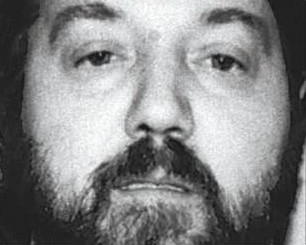
Danny Lee King, who was sentenced to death Tuesday
for the murder of a Roanoke County real estate agent, is a suspect in
the disappearance and slaying four years ago of the brother of Craig
County Sheriff B.B. McPherson.
McPherson, who attended King's sentencing Tuesday
with the state police agent who has investigated his brother's death,
said authorities have information that King helped another career
criminal kill Gene Allen McPherson in a murder-for-hire scheme in May
1987.
King has denied to investigators that he was involved
in killing McPherson, the sheriff said. But King has admitted that he
was aware that a contract was out on Gene McPherson's life, the sheriff
said.
King's involvement in McPherson's death was not
mentioned at his sentencing hearing Tuesday.
Instead, King, 40, told Roanoke County Circuit Court
Judge Kenneth Trabue that he did not inflict the blow that killed
Carolyn Horton Rogers. He said it was his wife who killed Rogers Oct. 11
in an empty Southwest Roanoke County home she had listed for sale.
Trabue imposed the jury sentence of death by
electrocution on King for beating, choking, scratching, stomping and
stabbing Rogers to death.
King appeared shaken and looked down at the table as
Trabue announced the sentence.
King was convicted in June by a Chesterfield County
Circuit Court jury of capital murder. The case was moved to Chesterfield
after Trabue ruled it would be impossible for King to get a fair trial
in Roanoke County because of pretrial publicity.
King, of Montgomery County, admitted during the seven-day
trial that he beat Rogers and then forged her checks. But by accusing
his wife, Becky, of fatally stabbing Rogers, he had tried to avoid the
electric chair.
B.B. McPherson said Tuesday he was glad Trabue
imposed the death penalty and that he might ask to be allowed to witness
King's execution.
The sheriff said he had not wanted the judge to "cut
him any slack" in hopes that King would cooperate with authorities and
lead police to Gene McPherson's remains.
Gene McPherson, 42, a Catawba Hospital maintenance
man, disappeared May 23, 1987. His body never was found.
John Colclasure, a career criminal who already was
serving life plus 156 years for various crimes, pleaded guilty in 1989
to killing McPherson and was sentenced to life in prison plus four years
for using a firearm in the commission of murder.
Colclasure told authorities he was hired to kill
McPherson by a Roanoke County man who was angry that McPherson was
having an affair with his wife. He said he had known the man in Richmond
in the 1970s, when the man was dealing drugs.
The man, who holds a high-paying professional
occupation, never was charged by police. He has since moved out of state
and repeatedly has denied any involvement in McPherson's death. The man
did serve time in prison in 1979 and 1980 on drug charges.
In addition to information authorities have about
King's involvement in the case, there is circumstantial evidence to show
that King was in a position to know both Colclasure and the man police
believe hired him, B.B. McPherson said.
King and the man both lived in Richmond when the man
was involved in the drug world, McPherson said. King and Colclasure both
lived in the Portsmouth/Norfolk area in 1987, when Gene McPherson was
killed.
McPherson's truck was found at a Montgomery County
rest area, and King's mother lives in Montgomery County, B.B. McPherson
said. King lists his mother's address as his current residence.
King also has lived in the area of Smith Mountain
Lake, where authorities spent many weeks searching for Gene McPherson's
remains, the victim's brother said.
Barry Keesee, the state police special agent
investigating Gene McPherson's death, would not comment Tuesday on
whether King was a suspect in the case. He said he simply was attending
the sentencing as an observer.
About 40 real estate agents also attended the
sentencing. One groaned when King denied that he had killed Rogers.
King told Trabue that his court-appointed attorneys
had not presented the defense he had wanted them to present and asked
that he be appointed new attorneys.
Trabue denied the request, saying that defense
attorneys David Damico and James Swanson had "done an outstanding job on
your behalf, from what I have observed."
King read a long statement that said he did not have
a violent history and was productive while serving time in prison on
other charges.
He began to sob once when he told Trabue that Rogers'
family and society deserved retribution, but that the "guilty party is
allowed to walk free before God and man."
King's wife, Becky King - who now goes by her maiden
name of Becky Tilley - was sentenced by a Roanoke County jury to five
years in jail for her role in Rogers' death. The jury believed that she
was not aware that her husband intended to kill Rogers as she showed
them the house.
Damico also argued that Trabue should reduce his
client's sentence to two life terms because of the disparity in his jury
sentence and that of his wife.
"Becky King was just as much involved in setting it
up, planning it and doing it as Danny King was," he said. "Becky King
was in it up to her neck."
Becky King's sentence for her role in the slaying is
"the thing that bothers us the most," Damico said. "It is fundamentally
wrong for one partner in crime to possibly be out [of jail] in a year
and for the other to be executed for it," he said.
But Commonwealth's Attorney Skip Burkart urged Trabue
to impose the death penalty.
"I didn't like the result of Becky King's trial any
more than anyone else did," he said. "But that's a different issue."
Just because justice was not done in her case, "we
should not disregard the justice that has been done in Mr. King's case,"
Burkart said.
Rogers, 55, an agent with Mastin Kirkland Bolling Inc.,
died from a single stab wound in the chest. But she suffered more than
that.
She was choked so hard that fingernail scratches were
left on her throat, beaten so hard that blood vessels in her eyes burst,
and stomped so hard that footprints from Danny King's black leather
boots were left on her head.
Burkart advised Trabue to rely not just on the jury
verdict in sentencing King to death. "You saw the evidence. You saw
photographs of Carolyn Rogers' body the jury was not allowed to see. You
saw a videotape of her body the jury did not see," he said.
Trabue imposed the death penalty on King for Rogers'
death, as well as a life sentence for robbing her and 40 years for
forging and passing two of her checks.
The sentence will be automatically reviewed by the
state Supreme Court.
DANNY LEE KING,
v.
FRED W. GREENE, Warden,
Mecklenburg Correctional Center.
No. 97-28
Argued: March 4, 1998 - Decided: April 20, 1998
OPINION - PER CURIAM:
A jury found Danny Lee King had beaten, kicked,
choked and stabbed a woman to death; the state court, on recommendation
of the jury, sentenced King to death. After pursuing direct appeals and
seeking post-conviction relief from the state courts, King petitioned
for federal habeas relief. The district court
denied his petition, and we affirm.
I.
A.
On June 14, 1991, a jury convicted King of murder,
robbery, and two counts of forgery and uttering. All charges stemmed
from the brutal murder of Carolyn Horton Rogers on October 11, 1990. The
jury recommended a term of life imprisonment plus 40 years for the
noncapital offenses. After a separate sentencing hearing, the jury found
both future dangerousness and vileness, statutory aggravating factors
under Va. Code § 19.2-264.4(c) and recommended a death sentence for the
murder conviction. The state trial court considered King's presentence
report and then imposed the sentences recommended by the jury.
On April 17, 1992, the Virginia Supreme Court
affirmed the convictions and the death sentence. King v. Commonwealth,
416 S.E.2d669 (Va.), cert. denied sub nom., King v. Virginia, 506 U.S.
957(1992).
On June 11, 1993, King filed an amended petition for
state post-conviction relief with the Circuit Court for Roanoke County.
The petition was transferred to the Virginia Supreme Court, in
accordance with Va. Code § 8.01-654(c)(1). On March 14, 1996, that court
dismissed the amended petition.
The Commonwealth of Virginia scheduled King's
execution forJuly 8, 1996. Five days before the scheduled execution
date, the District Court for the Eastern District of Virginia stayed the
execution pending King's application for federal habeas relief. On July
11, 1996, King's case was transferred to the Western District of
Virginia; six weeks later, that court appointed counsel for King. On
January 24,1997, King filed his application for a writ of habeas corpus.
On August 4, 1997, without holding an evidentiary hearing, the district
court issued a well reasoned, 75-page, memorandum opinion denying the
writ. After the court denied King's motion for reconsideration, he
appealed to this court.
B.
The Virginia Supreme Court recounted the facts of the
case and some of the evidence presented at trial:
The record shows that on October 1, 1990, King was
released on parole from imprisonment for a prior offense. On October 8,
he and Becky Hodges King, with whom hehad entered into a bigamous
marriage in January of 1989, stole a van from a used car lot in
Chesterfield County. They then traveled to the home of King's mother in
Christiansburg, where Becky had been staying during King's imprisonment.
On October 11, King and Becky rode in the van to
Roanokeand went to a residential area known as Kings Chase. As they
drove around, Becky wrote on a yellow pad the names and telephone
numbers of three real estate agents whose signs were displayed on vacant
houses. Carolyn Horton Rogers was one of the agents whose name and
telephone number Becky wrote down.
From a nearby shopping center and at King's
direction,Becky used the name "Mrs. Keaton" and telephoned Ms.Rogers'
office. She told the person who answered that "[sheand her husband]
wanted to see a house in Kings Chase." When informed Ms. Rogers was not
in, Becky placed a call to the Rogers home. Ms. Rogers agreed to show
the house in Kings Chase, and she left home about 10:00 a.m. to keep the
appointment.
When Ms. Rogers did not return home or appear at her
office, her son and two of her co-workers began looking forher. After
5:00 p.m., one of the co-workers entered the vacant house Ms. Rogers had
agreed to show and found her body in the basement furnace room, lying
face down in apool of blood. She had been beaten, choked, stomped upon,
and stabbed. A ring and an earring had been forcibly removed from her
body and were missing, along with other jewelry. Ms. Rogers' automobile
was found at a nearby shopping mall.
On the afternoon of the same day, three checks,
forged byKing and drawn on Ms. Rogers' account, were presented and
cashed by Becky at Roanoke area banks. On the same afternoon, Becky
pawned Ms. Rogers' ring at a local pawnshop.
Four days later, King and Becky were arrested in the
stolen van in New Philadelphia, Ohio. At the time of his arrest, King
spontaneously told Ohio police officers: "[Becky]doesn't know anything
about this. I'm the one you want."
* * * *
In addition to the evidence previously recited, the
record shows that King and Becky met Ms. Rogers at the vacant house in
Kings Chase and introduced themselves as"Dannya nd Becky Keaton." Ms.
Rogers showed them through the house, and the three of them eventually
reached the basement. There, Becky asked King for a cigarette. He said
he did not have any, and he suggested she get one from their van. Becky
left and was gone "a few minutes."
What happened after Becky left was disclosed by the
testimony of Vincent Austin Lilley, one of the attorneys appointed to
represent Becky on her capital murder charge. On November 2, 1990,
Lilley accepted a collect telephone call from King, who was calling from
the Powhatan Correctional Center. King told Lilley that "[t]his thing
with Becky is, insane . . . because [she] did not do what she's charged
with." When Lilley pointed out that Becky had cashed Ms.Rogers' checks
and that the police had Becky "on file doing that," King said "she
cashed checks because if she wouldn't have, [he] would have broken her
damn neck, or she believed that." King asked Lilley to visit him, saying
that what he wanted to talk with Lilley about "is the fact that [he,
King, was] the one that should be charged with it." Lilley agreed to
visit King, and he went to the correctional center on November 6 for
that purpose.
On that date, King told Lilley that he was a member
of "a Hell's Angels . . . motorcycle gang" and that Ms. Rogers' killing
was a contract killing, murder for hire, that was setup before he got
out of the penitentiary. He said "a guynamed Smoky" contacted him after
his release from prisonand asked for his help with "a hit." Smoky knew
Ms. Rogers was a real estate agent and he wanted to have her show a
vacant house because she was "the focus of this murder for hire." Smoky
"had [already] been paid." However, Ms. Rogers was supposed to have at
least $1,000 in her checking account and King "could get whatever he
wanted off of Mrs.Rogers."
The plan was to have Becky call Ms. Rogers to arrange
the meeting at the vacant house. King boasted to Lilley that he owned
Becky, that she was his "property," and that "[if he]told her to do
something, that was it." Lilley asked Kinghow he knew Becky "didn't kill
Ms. Rogers." At that point, King "took a little piece of paper . . . and
he wrote . . . in capital letters I D-I-D . . . and . . . he said, I did."
According to the plan, Smoky was supposed to "come
creeping down the stairs and get in the basement," then King was to get
Ms. Rogers to the basement and "knock her out to the point of
unconsciousness," after which Smoky would"take her to another place and
complete the contract killing."King told Lilley he did strike and choke
Ms. Rogers until she was unconscious, but he did not stab her. Smoky
appeared from the garage area and told King: "[T]hat's good enough.
You've done your part." The last thing King saw was Smoky pulling Ms.
Rogers' sweater "up over her head."
On December 6, Lilley, accompanied by John Gregory,
Jr.,Becky's co-counsel, and George Harris, III, Lilley's investigator,
again visited King, this time at the Buckingham Correctional Center.
After going over some forms with King, Lilley was about to introduce
Gregory and Harris when King "just burst out, let's cut the b___ s ___,
I stabbed Carolyn Rogers to death. Becky had nothing to do with it. Now,
what do you want to know?"
King reiterated that Ms. Rogers' death was a result
of a contract killing, and he described how a contract killing is
arranged. He went on to say that after Becky left to get a cigarette
from the van, he asked Ms. Rogers "some question. . . and at that point
he took his fist and hit her[on] the left side of her face." He
continued striking her and then choked her and threw her against the
basement wall. When she started falling to the floor, he grabbed her by
the throat,"squeezed very, very hard," and threw her to the floor.
Ms.Rogers was "semiconscious [and] moaning" and he grabbed her at the
waist. When he pulled on her limp body,"asweater type . . . of thing . .
. came up, and . . . he could seeher brassiere." She must have thought
he was going to rape her because "all of a sudden she reached . . .
upward into his groin area . . . and squeezed hard." He then removed a
knife from his boot and thrust it "in an upward fashion. . . int oher
chest and that was how he killed her." King directed Becky to drive Ms.
Rogers' car to a nearby shopping mall and said he would be right behind
her. When King reached the mall, he "wiped down" Ms. Rogers' car to
remove any fingerprints. He and Becky then left the mall in the van
andthere after cashed the checks forged on Ms. Rogers' accountand pawned
the ring stolen from her.
King, 416 S.E.2d at 670-671,674-675.
II.
King initially challenges the constitutionality, as
applied, of the Antiterrorism and Effective Death Penalty Act of 1996 (AEDPA).Congress
enacted that statute effective April 24, 1996; it amends the federal
habeas corpus statute. 28 U.S.C.A. § 2254 (West 1994 &Supp. 1998).
Chapter 153 of the Act provides for certain changes in the standards of
federal court habeas review of all state court convictions. § 2254(d).
Chapter 154 creates new procedures for federal habeas review of
petitions filed by inmates sentenced to death instates that merit
statutory "opt-in" requirements. § 2254(b). The district court held that
the Commonwealth of Virginia did not meet the"optin" requirements and so
refused to apply Chapter 154 of the Act in King's case. The Commonwealth
does not appeal that determination.
The district court did apply the Chapter 153
amendments, holding that they applied to all petitions filed after April
24, 1996. See Lindhv. Murphy, ___ U.S. ___, 117 S. Ct. 2059, 2068
(1997). King launches a series of arguments asserting that the district
court erredin doing so, that the AEDPA is unconstitutional as applied,
and that the district court misinterpreted it. We need not reach these
arguments because King has not raised a single ground that provides a
basis for habeas relief, even under the pre-AEDPA standards of review.
See Satcher v. Pruett, 126 F.3d 561, 567 n.2 (4th Cir. 1997).
Accordingly, we turn to examination of King's contentions under pre-AEDPA
law.
III.
King maintains that, on several occasions, the
Commonwealth obtained statements from him in violation of his rights to
remain silent and to counsel.
A.
King made his first statement to Detective James
Lavinder on October 16, 1990. Lavinder had traveled to Ohio with a
warrant charging Becky King with capital murder when he spoke with King,
who was detained at the Carroll County jail. King was being held for
violation of parole, and Lavinder advised King of his Miranda v.
Arizona, 384 U.S. 436 (1966), rights before the two spoke for
approximately half an hour. Lavinder made a short telephone call and
then began another conversation with King. Before this second
conversation began, Lavinder again advised King of his Miranda rights.
They talked for 40 to 50 minutes this time, and King reiterated his
denial of any involvement in Carolyn Rogers's death. Their conversation
ended when King told Lavinder, "I think I better not say anything else
until I talk to an attorney."
King asserts that this constituted a request for
counsel and that because the Commonwealth failed to honor this request,
every subsequent statement that he made to law enforcement officers is
inadmissible. The Virginia Supreme Court held that King had waived this
contention because "in argument following the close of evidence at the
suppression hearing, defense counsel did not once mention the October 16
incident." King, 416 S.E.2d at 671. Instead, he maintained that it was
"`clear that . . . the request for counsel took place on November 1st.'"
Id. King asserts that"[t]his description is factually wrong," Brief of
Appellant at 35, and that the district court's deference "to the Supreme
Court of Virginia's finding of procedural default . . .`was not
reasonable'" because that court never "`adjudicated [this claim] on the
merits.'" Id. at 21.
King's argument is meritless -- the Virginia Supreme
Court fully adjudicated the issue on the merits. As the district court
noted,"[b]ecause the Virginia Supreme Court found the claim barred
understate law, the claim is procedurally barred" from federal habeas
review. See Coleman v. Thompson, 501 U.S. 722, 728 (1991).
Moreover, our
independent review of the record convinces us that the Virginia court's
conclusion was correct. At the suppression hearing, defense counsel did,
as King maintains, elude to his statement to Officer Lavinder -- and the
only statement King made to Lavinder took place on October 16. So,
contrary to the Virginia Supreme Court's statement, the "October 16
incident" was "mentioned" at the suppression hearing, if only implicitly.
But review of the record unquestionably reveals the truth of the Supreme
Court's larger point -- that King never argued at the suppression
hearing that he had requested counsel on October 16 but instead asserted
he had requested counsel on November 1. King's suppression hearing
attorney stated that King" requested an attorney on November 1," and
then again that "there quest for counsel took place on November 1."
Therefore, the state court did not err in ruling that King waived any
argument that he invoked his right to counsel on October 16.
B.
On October 18, two days after Lavinder and King's
discussion, Detective Ken Kern talked with King in the basement of the
Carroll County jail. Kern advised King of his Miranda rights and then
showed King the items of clothing that had been seized from the van.
Specifically, Kern singled out a particular shirt with a button missing;
King stated that he "had never seen it before and it wasn't his." This
episode lasted five minutes.
Although it is not absolutely clear, King apparently
argues that the statements made during this short conversation should
have been suppressed. The Virginia Supreme Court held that King had
waived this argument because he "failed to list this statement in his
motion to suppress and did not include it in his argument at the
suppression hearing." King, 416 S.E.2d at 671 n.1. (relying on Va. Rule
5:25). Accordingly, the claim is procedurally barred from habeas review.
Coleman, 501 U.S. at 728. Moreover, our de novo review again convinces
us that the record fully supports this holding.
C.
Two weeks later, on November 1, 1990, Detectives Kern
and Patrone went to the Powhatan Correctional Center where King wasbeing
held on parole violations (he had not yet been charged in connection
with Rogers' murder) to execute a court order to take King's hair and
blood samples and fingerprints.
The Assistant Warden escorted the
detectives to King's room and told King the detectives could answer any
questions he might have. Before the officers could show King the court
order or ask him any questions, King asked them what was taking them so
long to "drop warrants" on him and stated that Becky was not involved in
the Rogers death, adding that she would "follow a puppy dog."
Detective Kern advised King of his Miranda rights and explained that the officers
were executing a court order to obtain the samples. King indicated that
he understood his rights and refused to sign a waiver. He said that the
officers wouldnot find anything because he was "too good." King then
volunteered to make a statement if he was provided with an attorney, at
a meeting with the police, a prosecutor, his attorney, Becky, and
Becky's attorney. The officers responded by telling King that he was not
charged with any crimes related to Rogers' murder so they"could not"
provide him an attorney; however, they also told him that he could
retain an attorney on his own.
King made several more statements while the officers
collected the samples. He told the detectives that they should be
fingerprinting other people. The detectives responded that they knew
that only three people -- King, Becky, and Rogers -- were in the house
at the timeof the murder. To this, King replied that the people he
mentioned, who the officers should be fingerprinting, "had nothing to do
with this offense."
Eight days later, on November 9, the officers
transported King to Roanoke County jail in order to take foot
impressions and to conducta handwriting analysis. Before transporting
King, Officer Patrone again provided King with his Miranda rights. While
the police took the samples, King told Kern, "[i]f you got questions,
just ask me."Kern then proceeded to ask King about the murder. King
denied killing Rogers. However, he made several incriminating statements.
For example, he acknowledged being with Rogers and Becky in the house
where the murder occurred; he claimed that a man named "Dude" had Rogers
on the floor when he left the house. King also admitted that he took
Rogers' checks and jewelry.
After providing this account, King reiterated his
desire to make a statement before a prosecutor, Becky, Becky's lawyer,
and counsel appointed for him. The officers then contacted an Assistant
Commonwealth Attorney, who went to King and told King that he was
willing to listen. King repeated his earlier account and acknowledged
that he might be "pulling the trigger" on himself in telling this story.
King maintains that under Edwards v. Arizona, 451 U.S.
477(1981), the statements that he made on November 1 and 9 should not
have been admitted at trial because he requested counsel on both
occasions. The Virginia Supreme Court rejected this argument -- and with
good reason. See King, 416 S.E.2d at 360-62.
In Edwards, the Supreme Court held that when an
accused has invoked his Fifth Amendment, Miranda right to have counsel
present during custodial interrogation, all interrogation must cease
until counsel is made available "unless the accused himself initiates
further communications, exchanges, or conversations with the police."Edwards,
451 U.S. at 484-85. Subsequently, the Court clarified that an Edwards
right can only be invoked by an"unambiguous[ ] request for counsel."
Davis v. United States, 512 U.S. 452, 461 (1994).
As the Virginia Supreme Court ruled, King, 416 S.E.2d
672-73, King's statements during the November conversations concerning
his desire to meet with several people including "an attorney for
himself" simply do not constitute an "unambiguous request for counsel."Davis,
512 U.S. at 455; see also McNeil v. Wisconsin, 501 U.S. 171,177-79
(1991) (statement must reasonably be construed to "express[ ]a desire
for the assistance of an attorney in dealing with custodial
interrogation by the police").
In addition, despite the fact that King was in
custody, the November conversations between King and the detectives were
not interrogations for the purposes of Miranda or Edwards. See Rhode
Island v.Innis, 446 U.S. 291, 300 (1979) ("Interrogation . . . must
reflect a measure of compulsion above and beyond that inherent in
custody itself"). The detectives were executing court orders when they
met with King on November 1 and 9; in neither of these encounters did
the detectives meet with King in order "to elicit an incriminating
response." Id. at 301.
Moreover, King initiated the November 9 conversation--
telling the police "[i]f you got questions, just ask me." In doing so,
King waived his Fifth Amendment rights. See Solem v. Stumes, 465 U.S.
638, 640-41 (1984). (Arguably, in asking the police what was taking them
so long "to drop warrants" on him on November 1, King mayhave initiated
that conversation as well.)
King also argues that the officers misinformed him of
his right to counsel on November 1 when they told him that they could
not provide him with counsel before he was charged. King does not
contest the fact that the officers had the "option" either to provide
counsel or to cease interrogation, however, he argues that they only
told him that they "could not" provide counsel. See Reply Brief at
23-24. King never raised this claim at trial, on direct appeal, or in
his state habeas petition. It is, therefore, defaulted. See Gray v.
Netherland, 116 S. Ct.2074, 2080 (1996).
In any case, the information
the officers provided King was accurate, albeit not complete. Had King
indicated that he did not want to discuss anything with the officers
unless he was provided with an attorney, he would have been invoking his
Fifth Amendment right to counsel, and the officers would either have to
provide him with an attorney or cease questioning him. See Edwards,451
U.S. at 481 (requiring the police "to inform the suspect of his right to
counsel and to cease questioning immediately if the suspect wants legal
aid"). But King did not do this. Rather, as noted above, he waived that
right. Furthermore, as the police accurately related to King, he had no
Sixth Amendment right to counsel until he was formally charged with the
crimes. See Kirby v. Illinois, 406 U.S. 682,687-88 (1972).
The district
court properly concluded, "[n]othing in the record suggests that the
police deliberately delayed the initiation of formal criminal
proceedings in order to deprive King of access to an attorney or
intentionally misrepresented King's constitutional rights."
King also maintains that he did not make a knowing,
intelligent and voluntary waiver of his right to counsel during the
November conversations with the officers. However, nothing in the record
indicates that King's decision to continue his discussions with the
officers was coerced or manipulated. Rather, the Virginia Supreme Court
accurately pointed out that after each occasion in which King mentioned
the possibility of being appointed counsel, King initiated subsequent
conversation with the officers. King, 416 S.E.2d at 673; cf. Edwards,451
U.S. at 483 (noting that a individual can waive his right to either be
appointed an attorney or terminate the questioning if he initiates
further conversation).
D.
Even if admission of King's October and November
statements to the police constituted error, under binding circuit
precedent that error would be harmless. In Cooper v. Taylor, 103 F.3d
366, 370 (4th Cir.1996) (en banc), we held that admission of a
defendant's lengthy, detailed, and tape-recorded confession was harmless,
even though that confession was recognized as determinative of the
verdict by the trial judge and provided most of the basis of the
prosecutor's closing argument.
We concluded that, in view of two short
and poorly recollected prior confessions and certain circumstantial
evidence, admission of the tape recorded statement did not have "a
substantial and injurious effect or influence in determining the jury's
verdict." Id. at 370 (quot-ing Brecht v. Abrahamson, 507 U.S. 619, 638
(1993)).
King maintains that his case is different than
Cooper's; he's correct-- it is different, and
substantially weaker than Cooper's case. The two "differences" King
offers are: (1) his asserted Edwards violations occurred before he made
any incriminating statements, while Cooper's occurred after an
incriminating statement and (2) his statements were used to impeach his
trial testimony, while Cooper's were not. King does not cite a single
case holding that these differences are constitutionally significant.
They are not.
Rather, the fundamental inquiry in determining whether a
state trial error is harmless on federal habeas review is whether it had
a "substantial and injurious effect or influence on the jury's verdict."
Brecht, 507 U.S. at 658. Only if a judge" is in grave doubt about the
likely effect of an error on the jury's verdict" does a habeas
petitioner prevail. O'Neal v. McAnninch, ___ U.S.___, 115 S. Ct. 992,
995 (1995). We have no such grave doubt here.
In his October and November 1 statements, King simply
denied all involvement in the murder. Admission of those statements
clearly did not substantially and injuriously affect the jury's verdict,
particularly when considered with the mountain of other evidence
incriminating King.
In his November 9 statements to the police, King did
link himself to the murder, but his statements to Becky's attorneys,
Lilley and Gregory, were far more damaging. In none of the statements
made to the police -- not even the November 9 statement-- did King
confess to the murders; in both of his statements to Becky's counsel, he
did. In fact, during King's second visit with Becky's attorneys on
December 6, 1990 he stated: "Let's cut the bullshit. I stabbed Carolyn
Rogers to death." This followed his prior admission in a November 6
conversation with them, when he wrote "I did" in response to their
questions as to how he knew that Becky had not killed Rogers.
Further,
King's first confession to Becky's lawyers was made prior to the
statement made to the officers on November 9. (Thus, one of the asserted
"differences" between King's and Cooper's case disappears). King
followed this admission with a later, even fuller, confession to Becky's
lawyers on December 6. Considering these graphic, detailed, and dramatic
confessions and the physical evidence linking King to the murder with
the assertedly, illegally admitted statements made to the police
officers, utterly convinces us that the statements to the police had no
substantial or injurious effect on the jury's verdict.
IV.
King also contends that he was denied the right to
conflict-freecounsel and to proceed pro se in violation of the Sixth,
Eighth, and Fourteenth Amendments. Because King failed to raise either
claim ondirect appeal or in his state habeas petition, he has failed to
exhaust them. See Gray, 116 S. Ct. at 2080-81. However, we need not
dismiss the claims without prejudice to permit King to exhaust his state
remedies, because, for the reasons set forth by the district court,
these non-exhausted claims are barred from review in state court. See id.
Moreover, as outlined below, both claims are also meritless.
A.
"[A] defendant who desires to invoke his right to
self-representation, thereby waiving his right to counsel, must do
so`clearly and unequivocally.'" See Fields v. Murray, 49 F.3d 1024,1029
(4th Cir. 1994) (en banc) (quoting United States v. Reddeck, 22F.3d
1504, 1510 (10th Cir. 1994)). King never did this. Rather, after he had
been convicted of these brutal crimes, King asked the court for
permission to represent himself until "other counsel [could] be
appointed to represent" him.
Indeed, when he argued this motion, King
requested the appointment of new counsel. Nor, contrary to his
contentions before us, did King unequivocally state his desire to
proceed pro se and waive his right to counsel in his pro se brief to the
Supreme Court of Virginia. In that brief, King asked the court to
consider the arguments "in his pro se brief in addition to any appeal
filed in his behalf by counsel."
Thus, King never made clear that he
truly wanted to proceed pro se. Moreover, even King's equivocal request
to proceed pro se until counsel could be appointed did not occur until
after the guilt phase of his trial. For this reason, the decision of
whether to permit him to discharge counsel and to proceed pro se waswell
within the trial court's discretion. See Bassette v. Thompson, 915F.2d
932, 939-42 (4th Cir. 1990) (finding criminal defendant has no
constitutional right to represent himself on appeal); United States
v.Gillis, 773 F.2d 539, 560 (4th Cir. 1985) (same). Accordingly, even if
King had clearly expressed his wish to proceed pro se on appeal, his
argument that the court's refusal to permit this violated his
constitutional rights would be meritless.
B.
King's claim with respect to his right to conflict-free
counsel is equally unpersuasive. In his pro se brief to the Virginia
Supreme Court, King never raised a constitutional challenge that he was
denied conflict-free counsel. Nor did he raise this issue in his state
habeas petition. Accordingly, federal habeas relief is barred. See Gray,
116S. Ct. at 2080-81.
Moreover, even if King had preserved the claim of a
conflict with his counsel, it is meritless. The crux of this claim is
that defense counsel "had not presented the case in the manner that King
wished, to the point of directing King to perjure himself on the stand."
Brief of Appellant at 39. The alleged perjury concerned King's testimony
about "stomping" the victim. After two experts had opined that King's
boots had left very distinctive marks on the victim's head, King's
counsel advised him that denying the stomping in view of this strong
evidence would risk conviction and the death penalty. King reluctantly
followed this advice and testified that he did not remember the stomping,
when actually, he asserts, he remembered that he did not stomp the
victim.
King's claim is not really one that counsel had a
conflict with his interest. Cf. Cuyler v. Sullivan, 446 U.S. 335, 350
(1980). In fact, it is clear that counsel were acting in what they
perceived to be King's interest in giving this advice. Rather, King's
claim constitutes a disagreement with his counsel's trial tactics.
Indeed, when he responded to his counsel's motion to with draw, King
contended simply that he disagreed with the trial tactics of his counsel:"counsel
was not presenting the defense he wished presented to the Court."
Moreover, as noted above, King did not assert that he was denied
conflict-freecounsel in this response, nor did he raise this issue in
his state post-conviction pleadings. Thus, King's real contention seems
to have been that he disagreed with his counsel's trial strategy. Such a
claimis not one for conflict-free counsel but for deprivation of
effective assistance of counsel. See United States v. Leggett, 81 F.3d
220, 227(D.C. Cir. 1976). As such, it must fail because King cannot
demonstrate this aspect of counsel's representation was either deficient
or prejudicial.
V.
King argues that he was denied his constitutional
right to effective assistance of counsel. The Supreme Court has
articulated a two-part test to examine an ineffective assistance claim.
Strickland v.Washington, 466 U.S. 668 (1984). First, a defendant must
demonstrate that the performance of his trial counsel failed to meet an
objective standard of reasonableness. Id. at 688-89. Second, a defendant
must show that this failure resulted in prejudice, i.e., that there is a
reasonable probability that the outcome of the trial would have been
different without his counsel's errors. Id. Determinations regarding the
effectiveness of counsel involve mixed questions of fact and law that we
review de novo. Smith v. Angelone, 111 F.3d 1126, 1131 (4thCir.), cert.
denied, ___ U.S. #6D6D 6D#, 118 S. Ct. 2 (1997).
A.
King maintains that his trial counsel should have
argued in his motion to suppress that King requested counsel on October
16, rather than exclusively asserting King requested counsel on November
1.
First, as the district court observed, counsel's
decision to focus on the November 1 request made sense strategically.
The October statements made by King did not damage his case, rather, in
them, he denied his involvement in the crimes. Thus, counsel did not
have the same incentive to suppress the October statements as he did
those made in November. Accordingly, counsel's failure to focus on the
October 16, rather than November 1, well may not be deficient at all.
Moreover, even if counsel did err in not focussing on
the asserted invocation of counsel on October 16, King cannot
demonstrate any prejudice resulting from this action. In none of the
statements King made to the officers did he admit that he committed the
murder. Rather, his multiple confessions were made to Becky's lawyers.
Furthermore, in King's October and November 1 statements, he denied any
involvement in the murder. Moreover, his November 9 statement (in which
he did make damaging admissions concerning his involvement in the crimes)
would have been admissible even if King's attorney had successfully
argued that he had requested counsel on October16 and the state trial
court had excluded the October and November1 statements because King
initiated the November 9 conversation with the officers.
King also argues that his counsel's failure to make
the argument that King had not intelligently, knowingly and voluntarily
waived his right to counsel or to end the conversations with the
officers constituted ineffective assistance of counsel. As we discussed
previously,the substance of King's claim concerning waiver is meritless.
The record does not provide evidence that King's decision to continue to
initiate discussions with the officers was involuntary or somehow
coerced. Since King's arguments concerning waiver lack merit, hiscounsel
was not deficient in failing to make this argument.
B.
King next contends that his counsel erred in failing
to maintain that King enjoyed an attorney-client relationship with
Becky's counsel, Lilley, such that his communications to Lilley were
privileged.
The record reflects that Lilley informed King on
several occasions that he represented Becky, not King. In fact, in their
first conversation, Lilley stated "I'm not your lawyer." In addition, on
November 6, 1990, King executed a waiver, which Lilley had prepared,
that memorialized that King knew Lilley was acting solely for Becky: "I
understand that Vincent A. Lilley represents Becky Hodges King and that
he will protect her interests, and not mine." After Lilley went over the
waiver word for word with King, King signed it. The two men then talked
for approximately two and one-half hours, and during that discussion
King confessed to the murder.
The day after that conversation, King called Lilley
once again. Becky's other counsel, Jack Gregory, also took part in this
telephone conversation. Gregory reiterated that he and Lilley
represented Becky's interests only, and King acknowledged this. During
the course of that conversation King asked Gregory and Lilley how he
should deal with the media, and Lilley replied,"I don't represent you. I
represent Becky . . . And you've got to get your own lawyer to give you
advice because I'm not on the same side of this thing with you."Gregory
supported this statement by remarking to King, "[W]e're onopposite side
of the fence," and encouraged King to get his own counsel. Later in the
conversation, King told Becky's attorneys:
I'm very well aware of y'alls major purpose in this
thing. Iam very well aware of the fact in more ways than one we are on
opposite sides of the fence because of the fact that uh,y'alls main
concern, if anything, would be to hang me if that would protect Becky.
King telephoned Lilley and Gregory once again on
December 3,1990. He initially told them that he understood that they
were acting solely as Becky's counsel, and then they arranged a meeting
for December 6. An investigator accompanied Lilley and Gregory when they
met with King at Buckingham Correctional Center for that meeting. At its
outset, King signed another waiver acknowledging that Lilley and Gregory
did not represent his interests.
The record indicates that King had an interest in
contacting Lilley precisely because he was Becky's attorney, and King
wanted to help Becky. But regardless of King's motivation for contacting
Becky's counsel, the record is clear that King understood that Lilley
and Gregory did not represent his interests.
The district court noted that perhaps King's
strongest argument concerning attorney-client privilege would have been
under the "common interest" rule, which recognizes the need of
defendants charged with the same crime to discuss with each other the
pursuit of a joint defense. See, e.g., Hicks v. Commonwealth, 439 S.E.2d
414, 415 (Va.1994). However, as the district court pointed out, even if
King had made this argument, it would have been rejected because King's
discussions with Becky's counsel were not made to pursue a joint-defense
or "with any reasonable understanding that the communications would
remain confidential."
For all of these reasons, counsel for King did not
perform unreasonably in not pursuing the attorney-client privilege
claim.
C.
King also asserts that his counsel's representation
was ineffective during the penalty phase of the trial because counsel
failed to develop mitigating evidence concerning King's childhood. King
argues thathis attorney should have investigated and documented the
abuse he suffered as a child, particularly the physical and emotional
abuse King received from his father. According to King, this included "severe
beatings, including the use of electrical cords, belts and sticks, which
caused deep welts and cuts, bleeding, and excruciating pain."Brief of
Appellant at 49.
We note at the outset that King's counsel did in fact
present evidence of King's abusive childhood. King's mother, Anna Mae
King, testified that King's father drank alcohol and abused King both
physically and verbally. According to Mrs. King, the abuse began when
King was a baby and continued throughout his childhood. She testified
that after one of the beatings King received from his father, his back
was bloody and covered with welts. Thus, although further family
testimony undoubtedly would have added more details, it mightwell have
simply been cumulative.
Furthermore, whether or not counsel should have
presented more extensive evidence of the abuse King suffered as a child,
not presenting such further evidence did not prejudice
King. In fact, more such evidence might have harmed King's defense. As
the Commonwealth points out, the jury might have interpreted such a
history of abuse as evidence that King would be dangerous in the future.
Cf. Penry v. Lynaugh, 492 U.S. 302, 324 (1989) (noting that such
evidence of abuse may "indicate[ ] that there is a probability that he
will be dangerous in the future"); Barnes v. Thompson , 58 F.3d 971, 980
(4thCir. 1994) (history of abuse may indicate future dangerousness).
In this regard, counsel provided a defense psychologist who stated that
while incarcerated King did not pose a danger to others. Including more
extensive testimony of King's background of being abusedcould have
undermined defense counsel's argument at sentencing that King would not
pose a danger in prison. This is particularly true inview of the fact
that none of the three experts who submitted affidavits for King in
state court, support his contention that the effects ofhis abuse were "readily
treatable."
In addition, King's argument that his counsel should
have presented testimony concerning King's good behavior in prison is
meritless. King maintains that his counsel should have obtained the
testimony of his prison work supervisors, who he argues would have
testified that during his previous incarcerations they permitted King to
retain dangerous tools in his cell and to perform repair work out-side
the perimeter wall of the prison.
King also notes that his counsel did
not put on the testimony of a prison guard whose life King helped save.
He argues that this testimony and the testimony of a witness "with
special experience and knowledge in reviewing and analyzinga prisoner's
corrections records" would have helped "explain" his prison record.
Reply Brief at 29.
King's counsel, however, did provide evidence of
King's record in prison and introduced the contents of the prison
guard's letter concerning the incident in which King helped save his
life. This evidence provided an understandable description of King's
behavior during his previous incarcerations. The addition of further
testimony would have been cumulative. Moreover, there is no reasonable
probability that the outcome at sentencing would have been different had
such evidence been introduced. See Strickland, 466 U.S. at 691.
D.
King also maintains that counsel should be held
ineffective for not objecting to the verdict form presented to the jury
and the sentencing instructions. He argues that the jury could have been
misled into believing that it had to impose the death penalty if it
found one of the two aggravating factors present.
When viewed in their entirety, however, the court's
instructions and the verdict form provided adequate guidance to the jury.
King's argument ignores the portion of the instructions in which the
court stated:
If you find from the evidence that the Commonwealth
has proved beyond a reasonable doubt either of the two alterna-tives,
and as to that alternative you are unanimous, then you may fix the
punishment of the defendant at death or if you believe from all the
evidence that the death penalty is not justified, then you shall fix the
punishment of the defendantat life imprisonment.(emphasis added).
This instruction clearly provided the jury with
discretion not to impose the death penalty even if it found aggravating
factors present. Moreover, in maintaining that his counsel was deficient,
King fails to recognize that his counsel offered alternative sentencing
instructions with respect to the jury's ability to recommend a life
sentence, but the court refused to provide these instructions because
the matter was adequately covered.
King's contention that the jury may have interpreted
the instructions so as to require unanimity if it recommended a life
sentence is foreclosed by Evans v. Thompson, 881 F.2d 117, 123-24 (4th
Cir.1989), cert. denied, 497 U.S. 1010 (1990). There, we held that
an instruction such as the one provided in this case accurately reflects
Virginia law. Id. The failure of defense counsel to object to such
instructions does not constitute ineffective assistance of counsel.
King also maintains that the aggravating factors
considered in this case -- vileness and future dangerousness -- are
unconstitutional lyvague. He asserts that his counsel's failure to
challenge the constitutionality of these aggravating factors constituted
ineffective assistance of counsel. We disagree. We have previously
upheld the constitution-ality of both vileness and future dangerousness
as aggravating factors. See Bennett v. Angelone, 92 F.3d 1336, 1345 (4th
Cir. 1990);Giarratano v. Procunier, 891 F.2d 483, 489 (2d Cir. 1989).
Based on this precedent, counsel clearly was not deficient in failing to
raisesuch a challenge.
VI.
King contends that the trial court violated his
rights under the Eighth and Fourteenth Amendments when it denied him the
opportunity to rebut the state's evidence as to his future dangerousness
by presenting evidence that if he received a life sentence he would
not be eligible for parole for thirty years.
In Simmons v. South Carolina, 512 U.S. 1564 (1994),
the Supreme Court held that if the government seeks the death penalty
based on a defendant's future dangerousness a capital defendant has a
due process right under the Fourteenth Amendment to provide evidence
indicating his ineligibility for parole. Id. There are two reasons why
Simmons does not support King's claim. First, Simmons was a case in
which the defendant was ineligible for parole as a matter of law;
subsequent cases have limited Simmons to that realm. See Ingram v.Zant,
26 F.3d 1047, 1054 n.5 (11th Cir.), cert. denied, 513 U.S. 1167(1995).
King does not maintain that he was ineligible for parole as a matter of
law. Therefore, Simmons provides no assistance to him.
Second, Simmons' ruling in 1994 announced a"new rule"
of procedural constitutional law. See O'Dell v. Netherland, 117 S. Ct.
1969(1997) (holding that Simmons rule was a new rule that could not be
used to disturb habeas petitioner's death sentence). As the Court
explained in Teague v. Lane, 489 U.S. 288, 300-01 (1989), a "ne wrule"
is not to be applied retroactively on habeas appeal. With regard to
King's assertion of an Eighth Amendment (rather than Fourteenth
Amendment) right, the district court correctly pointed out that
werecently held that to extend the Simmons rule to the Eighth Amendment
would be to create a "new rule." O'Dell v. Netherland, 95 F.3d1214, 1238
n.13 (4th Cir.), aff'd, 117 S. Ct. 1969 (1997).
VII.
King makes several arguments that he was denied his
due process rights and effective assistance of counsel because evidence
exonerating him was not introduced at trial.
A.
King claims that his counsel should have developed
evidence to demonstrate that Becky, not he, killed Rogers. He contends
that there is exculpatory evidence that would have supported his theory
that this was a "contract murder." Specifically, King claims that his
counsel failed to obtain a "package of materials" that exonerated him by
indicating that Becky killed Mrs. Rogers in an effort to settle a drug
debt.
The record provides no support for this argument. The
Commonwealth presented evidence that several real estate agencies
received telephone calls from Becky seeking to have an agent show her a
house. In addition, the Commonwealth introduced a legal pad, foundin
King's van, which listed the names of contact information of three real
estate agents in the area. This evidence contradicts King's assertions
that Becky specifically wanted to kill Mrs. Rogers.
In addition, this argument was presented in King's
federal habeaspetition for the first time and thus has not been
exhausted.
Moreover, as the district court pointed out, Virginia law prevents a
defendant from raising a claim in an additional habeas petition unless
the
facts giving rise to this claim were not known by or available to the
defendant
at the time he filed his initial habeas petition. Va. Code Ann.§
8.01-654(B). As
the district court concluded, King has failed to allege "any
particularized facts
demonstrating that the facts giving rise to his claims were unknown or
unavailable to him at the time he filed his first habeas petition."
Accordingly,
this claim is both unexhausted and procedurally defaulted. See Gray,
116 S. Ct.
at 2080-81.
B.
King also maintains that his counsel "failed to
develop and
present serological and forensic evidence showing that King was not in
the
presence of the victim when she was killed." Brief of Appellant at
63.Specifically, King focuses on the boots that left footprints in blood
at the
scene of the crime and marks on Mrs. Roger's head.
Detective Kern testified that
King had acknowledged that the bootswere his. The Commonwealth's expert
opined
that even though no blood was found on the boots, fresh blood can readily
wash
away in water. Moreover, the Commonwealth provided evidence that it
rained on the
day of the murder. Another state expert testified that King's boots, or a
pair
identical to them, had left multiple marks on Mrs.Roger's head.
King's counsel
had obtained funds to retain an expert to evaluate the evidence regarding
the
bootprints on Mrs. Roger's head. However, as the district court noted,
this
expert, while not as convinced as the Commonwealth's expert that the
marks on
Mrs. Roger's head came from the boots, informed King's counsel that he
believed
theboots "appeared to match the marks on the victim's head." King
now argues that
his counsel only had this expert review the Commonwealth's photographs
of the
evidence, and these photographs had been altered and did not possess a
scale. See
Brief of Appellant at 30. Thus, King maintains that his counsel did not
have the
expert examine the actual evidence.
However, this argument ignores the fact that the
Commonwealth's expert had enlarged the photographs in an effort to
better
analyze them and used these photographs in determining that King's
boots caused
the prints on Mrs. Roger's head. In addition, there is no evidence that
King's
expert stated that he needed to view the actual evidence in order to
make such
a determination. Thus, counsel's decisionnot to pursue further inquiries
with
respect to this forensic and serological evidence or to challenge such
evidence
at trial was a reasonable tactical decision, clearly not one that was
deficient.
VIII.
For all of these reasons, the judgment of the
district court is, in all respects
AFFIRMED.